IATF 16949 beyond the Automotive Mandate: What the Certificate Really Tells Buyers in Other Industries
18 October 2026 · 15 min read

Editorially responsible: Leon J. Hermann
Written by the Amplifa Marketplace editorial team with AI assistance
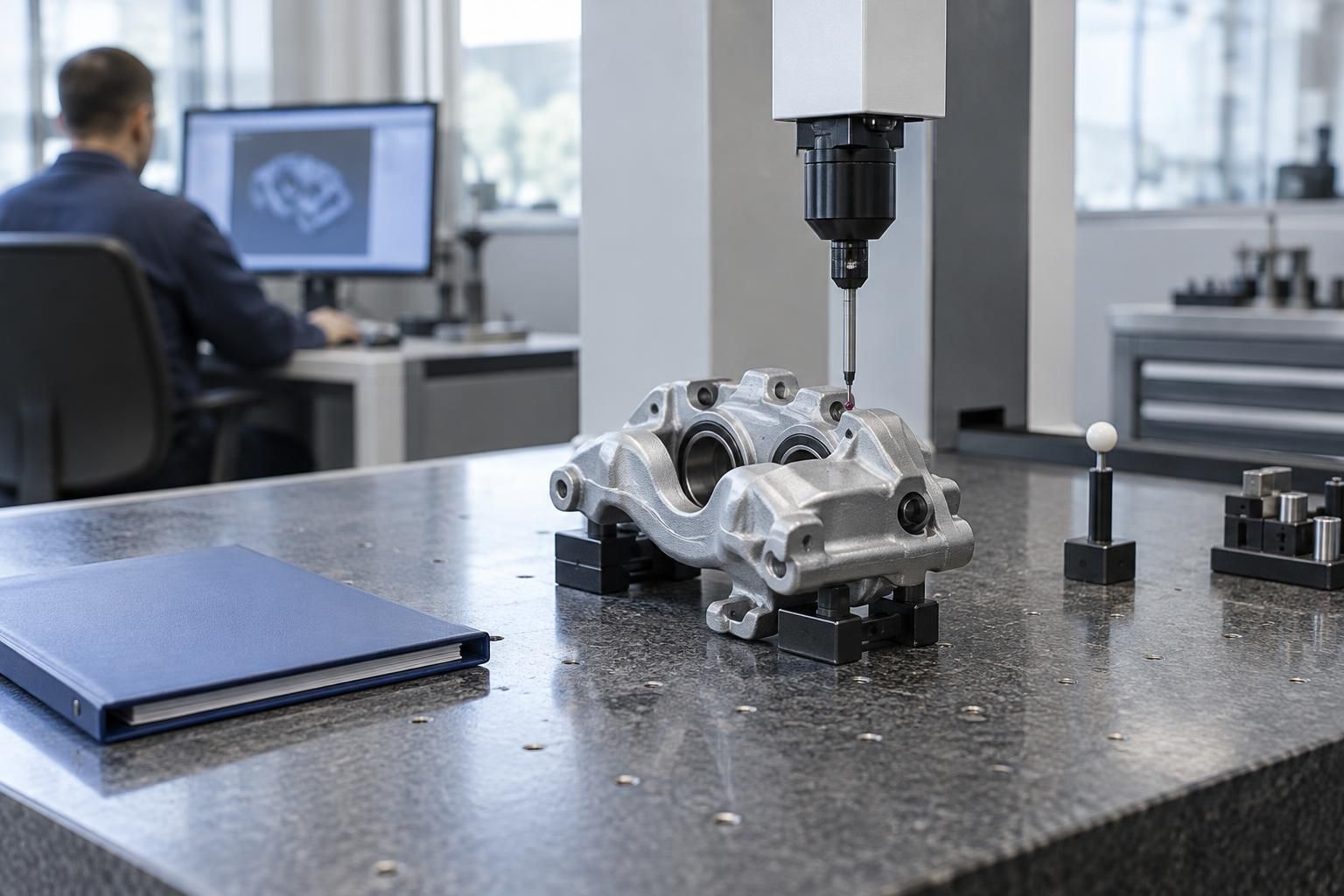
A practical guide for buyers and suppliers: What an IATF 16949 certificate means without an automotive link, how to place it meaningfully in the supplier selection process, and which typical mistakes arise along the way.
The problem: a certificate from a foreign industry on the desk
A buyer at a mechanical engineering company is qualifying suppliers for precision stamping lines. Among the documents of an interested party is an IATF 16949 certificate: the quality standard of the automotive industry. The buyer knows the standard by name, but not as an evaluation benchmark: Does the certification even apply if the supplier does not manufacture a single vehicle part? Does it say anything about process quality in the buyer's own industry? Or is it merely a showcase credential that proves nothing for the specific requirement at hand?
Conversely, supplier companies ask themselves the same question from the opposite direction: Is the effort of implementing IATF 16949 worthwhile even though no automotive customer demands certification? Can the certificate act as a quality argument in competition for non-automotive customers at all, or does the effort go unused?
Both sides need a well-founded answer before making investment or selection decisions. This practical guide provides the foundation for that: with a deliberate distinction between what the standard demonstrably proves, what constitutes a defensible assessment, and what remains open and can only be verified case by case.
What IATF 16949 actually requires, and how it differs from ISO 9001
IATF 16949:2016 is the global quality management standard of the automotive industry. It is published by the International Automotive Task Force (IATF), an association of major vehicle manufacturers and their national trade bodies: including AIAG (USA), ANFIA (Italy), FIEV (France), SMMT (UK) and VDA QMC (Germany) as trade associations, as well as vehicle manufacturers such as BMW Group, Ford, General Motors, Renault, Stellantis and Volkswagen. The standard was published in October 2016; since 15 September 2018 only IATF 16949 certificates are permitted: the predecessor standard ISO/TS 16949 is obsolete.
The standard builds on ISO 9001:2015 and supplements it with automotive-specific requirements. The two-standard format is no accident: according to their own statements, the IATF and ISO were unable to reach a licensing agreement for publication in an integrated document, which is why IATF 16949 is only readable in conjunction with ISO 9001. In practical terms this means: everything ISO 9001 requires also applies under IATF 16949, but the automotive standard goes significantly beyond it in several areas.
The core requirement is: the supplier must demonstrate that its processes are under control: not on paper, not in declarations of intent, but through data. Process capability evidence, measurement system analyses, statistical process control, traceability and control plans are mandatory. Anyone who cannot present the data at an IATF audit has a serious problem.
| Topic | ISO 9001 | IATF 16949 (additional) |
|---|---|---|
| Quality planning | General requirement for planning and development | APQP (Advanced Product Quality Planning): structured 5-phase process from concept phase to series production, mandatory |
| Approval procedure | No specific requirement | PPAP (Production Part Approval Process): formalised approval procedure with up to 18 supporting documents before the first series part |
| Risk analysis | Risk-based thinking (general) | FMEA as mandatory for Design FMEA and Process FMEA, evaluated via the risk priority number (RPN) |
| Process control | Monitoring and measurement (general) | SPC with control charts for all special characteristics; process capability evidence with Cpk ≥ 1.33 for stable processes |
| Measurement systems | Calibration of inspection equipment | MSA: Gage R&R studies for all measurement systems used for special characteristics |
| Traceability | Where required | Mandatory, gap-free from raw material to finished part; for safety-relevant parts down to individual part level |
| Supplier evaluation | Evaluation of external providers | Supplier development as an active obligation, second-party audits (e.g. VDA 6.3), escalation procedures for quality problems |
| Emergency planning | No specific requirement | Contingency plan for production interruptions, supplier failure, epidemics, cyberattacks: must be tested |
The five Core Tools: the heart of the standard
Central to practice are the five so-called Core Tools. Under IATF 16949 they are not optional: every certified company must master and apply them:
- APQP structures the entire product creation process into five phases: planning, product design, process design, product and process validation, and series production. It applies to every new product, every product change and every process change.
- PPAP documents the evidence that the supplier has the process under control and the product meets the specification: with up to 18 supporting documents before the first series shipment, and on process changes, site relocations or tool changes.
- FMEA identifies potential failure modes, evaluates their impact and defines countermeasures: as Design FMEA for the product and Process FMEA for manufacturing. During series production it is updated when new failures occur or processes change.
- SPC monitors process parameters with statistical control charts and detects systematic deviations before scrap occurs: for all special characteristics defined in the control plan.
- MSA checks whether the measurement system, gauge, operator and environment, is suitable for the measurement task; Gage R&R studies quantify repeatability and reproducibility.
For buyer evaluation, this catalogue is decisive: these are all concepts that are technically industry-neutral. Process capability, measurement system analysis and structured failure analysis are not inventions of the automotive industry: the standard merely enforces them there with audit pressure and data obligations. It is precisely here that the question of transferability arises.
The scope of application: when a company may even get certified
An often overlooked point with direct relevance to the question of benefit beyond the automotive industry: certification is formally tied to an automotive link. The IATF certification rules define the circle of certifiable companies narrowly.
Certification to IATF 16949 is only possible for production sites at which customer-specified series or production, spare and/or accessory parts are manufactured that are installed in the vehicle as a fixed component or connected electronically, and which are supplied to customers in the automotive industry.
A remarkable exception: even fire extinguishers, car jacks, floor mats, operating manuals, warning triangles and hi-vis vests are deemed customer-specified series parts despite this definition. Accordingly, a company that exclusively manufactures parts for other industries cannot be certified to IATF 16949: the certificate in fact presupposes existing or planned supply relationships in the automotive chain.
This check takes only a few minutes and should be part of the standard repertoire of every supplier qualification involving an IATF certificate. It answers two questions at once: Is the certificate currently valid, and does the certified scope actually cover the products relevant to the tender? A certificate for a single production line says nothing about the quality of other manufacturing areas of the same company.
Why the certificate is indispensable within the automotive industry
To assess the meaning of the standard beyond the industry, it helps to look at why it is mandatory there. Vehicle manufacturers such as BMW, Ford, General Motors, Stellantis, Renault and Volkswagen require certification as a contractual precondition for entry into their supply chains: it is prescribed by the manufacturers themselves, not by legislation. The standard is therefore de facto a market access criterion for the global automotive industry, even though it is formally not a legal requirement. Without a valid certificate, a business relationship with major OEMs is generally not possible; in many cases the requirement is passed on from Tier 1 to Tier 2 and Tier 3 suppliers, because overall responsibility for supply chain quality lies with the Tier 1.
For non-certified suppliers, the consequences within the industry are concrete:
- Loss of existing orders: If a certificate expires or is suspended, ongoing supply contracts may be at risk.
- Exclusion from tenders: New projects and award procedures require a valid certificate.
- Reputational damage: In the closely networked automotive industry, certification status is actively monitored and communicated.
- Increased inspection effort by the customer: Non-certified suppliers are audited more frequently and more extensively by the customer itself: with considerable additional effort on both sides.
These hard conditions explain why the automotive supply chain has oriented itself around the standard for decades, and why a valid certificate is a strong signal in this industry. For the question outside the industry, what matters is which part of this signal is transferable and which is not.
Meaning beyond the automotive mandate: what is transferable, and what is not
The fact first is the content of the standard: IATF 16949 contains binding requirements for process control, data basis, traceability, supplier development, contingency planning and the application of the five Core Tools. These requirements are formulated in such a way that they remain relevant for other manufacturing sectors: process capability, measurement system analysis and failure prevention are not automotive-specific concepts, but general principles for controlling series processes.
Also demonstrable is what accredited certification bodies cite as benefits: a globally uniform set of rules for series and spare parts production, consistent failure tracking with increased customer confidence, a strong focus on prevention and planning with resulting cost reductions, and the avoidance of multiple certifications. In addition, the annual audits place increased emphasis on demonstrating improvement in key figures and productivity: the standard thus does not merely prescribe a state, but demands its continuous development and makes this auditable.
The assessment of transferability is differentiated:
- An IATF 16949 certificate demonstrates with greater certainty than a pure ISO 9001 certificate that statistical process control, capability evidence and structured failure analysis are genuinely practised in the company, because these points are verified with data in the audit, not just as documented procedures.
- The automotive-specific elements such as APQP, PPAP and customer-specific requirements are only partially transferable to other industries. The certificate says nothing about whether a supplier meets the industry-specific standards and test regulations of another customer industry.
- The certificate is an indicator, not proof: it demonstrates the existence of a regulated system at the time of the audit. It replaces neither the technical qualification for a specific component nor the buyer's own sample inspection or process auditing.
- Since certification is tied to series parts for the automotive industry, a valid certificate in fact describes an operating mode that has been proven under series conditions. For buyers with series or repeat-part characteristics, this can be more informative than an ISO 9001 certificate containing more general requirements.
As a working hypothesis for the selection process, the following can be formulated: a valid IATF 16949 certificate with an appropriate scope is a strong positive signal for process discipline and series production capability, but it does not shift the duty of verification away from the buyer. Technical suitability for the specific part must still be verified independently.
Practical steps: correctly placing IATF 16949 certificates in the supplier selection process
For buyers who want to use an IATF certificate in supplier evaluation, a clear sequence has proven effective: regardless of whether one's own industry is automotive or not.
Step 1: Verify validity and scope
First, the certificate is checked via the IATF Customer Portal. There, the site and the validity of the certificate can be determined using the IATF number or IATF Unique Site Identifier. In parallel, the scope on the certificate is read, which product lines, which site, which manufacturing processes are certified? A site certificate does not automatically cover all sites of a group.
Step 2: Establish relevance to your own requirement profile
In the second step, it is assessed which of the certified practices are relevant to the buyer's own procurement project. For series parts with tight tolerances and repeat characteristics, SPC, process capability and MSA are highly relevant. For single-part or small-batch production, the link is weaker: here the automotive-specific evidence says less about the actual process situation. This classification is a technical assessment that the buyer must make on the basis of their own part profile.
Step 3: Use the certificate as an input filter, not as a final grade
It makes sense to use the certificate as one of several criteria in a weighted evaluation: alongside technical qualification, references, capacity, logistics and, where applicable, own process audits. Anyone who makes the certificate the sole selection criterion is committing a classic mistake (see below). Anyone who uses it as a filter to narrow the circle of candidates for in-depth checks saves time and reduces complexity.
Step 4: Targeted follow-up on open points
Remaining uncertainties are addressed directly: certificate scope, extent of the automotive parts supplied, handling of complaints and change management. The standard itself requires certified companies to have a functioning complaint and corrective action system: so answers to such questions can not only be obtained, but also cross-checked in the audit report or in conversation.
Concrete examples: three typical constellations from practice
The following mapping shows how the certificate can be weighted differently depending on the procurement constellation. The examples are typical situations; the assessment in individual cases remains the buyer's responsibility.
| Constellation | Meaning of the certificate | Recommendation |
|---|---|---|
| Series part with tight tolerances, high volume (e.g. precision components for recurring production) | High: SPC, capability evidence and traceability are audited with data and match the buyer's own need for process control | Treat the certificate as a strong positive criterion, supplemented by technical approval of the specific part |
| Small series or special-purpose machinery, high variant diversity | Partial: traceability and FMEA thinking are relevant, but PPAP and APQP logic target series production | Treat the certificate as an indication of QM discipline, but prioritise own process and product audits or sample approvals |
| Purchased components with safety-relevant characteristics | High to very high: the standard requires gap-free traceability down to individual part level for safety-relevant parts, as well as product safety processes | Combine the certificate with a scope check and contractually fix safety-relevant characteristics |
Common mistakes in interpretation, and how to avoid them
In practice, buyers and suppliers encounter recurring misunderstandings surrounding the IATF certificate. The six most common:
- Accepting a certificate without comparing scope: a certificate applies per site and defined scope. Anyone who does not match the scope with the product being purchased may be evaluating a production area that is not certified at all.
- Not checking validity: certificates can expire or be suspended: within the automotive supply chain this puts ongoing supply contracts at risk. The validity check in the IATF Customer Portal is free and quick.
- Treating ISO 9001 and IATF 16949 as equivalent: IATF 16949 contains all ISO 9001 requirements and goes significantly beyond them in several areas. Anyone who treats the two certificates as interchangeable loses information.
- Mistaking the certificate for technical approval evidence: it demonstrates a QM system, not suitability for a specific component, material behaviour or the specific industry standards of your own market.
- Overlooking customer-specific requirements: IATF 16949 requires fulfilment of customer-specific requirements: these are directed at the automotive customer. For a non-automotive buyer, no automatic fulfilment of their own specifications follows.
- On the supplier side: pursuing certification without series-relevant supply relationships: since the certification scope is tied to customer-specified series parts for the automotive industry, certification without such a link is not possible under the certification rules: the effort of preparation would be wasted as long as there is no automotive business.
The supplier perspective: when the path towards IATF 16949 is worthwhile
For manufacturing companies without ongoing automotive business, the demonstrable starting point is: under the certification rules, certification is only possible with corresponding series parts for automotive customers. The strategic question therefore has two stages.
First: is there a realistic market entry into the automotive supply chain? If so, certification is not an optional quality competition but a market access prerequisite: without a valid certificate, inclusion in the qualified supplier lists of OEMs and Tier 1 suppliers is generally not possible. The path there proceeds through defined phases: from internal preparation via a pre-audit to the actual certification audit; the Stage 1 audit examines, among other things, applicability, certification structure and planned scope, followed by an assessment of readiness for certification via an on-site audit using the Gemba method.
Second: can the quality lever be used even without the certificate? Here is the assessment: the methods of the standard, FMEA, SPC, MSA, control plans, contingency planning, can be introduced as best-practice instruments without going through the certification scheme. The advantage lies in more robust processes and a better negotiating position with all industrial customers; the disadvantage is that without audited proof, credibility depends on the customer's own verification. A compromise can be to first orient oneself to ISO 9001, on which IATF 16949 is built anyway, and to make the automotive-specific extensions available step by step once an automotive project becomes realistic.
Existing automotive suppliers, in turn, have a side effect for their non-automotive business: they can present the certificate to all customers as evidence of lived process discipline. The accredited certification bodies explicitly cite customer acceptance and the trust of customers and partner organisations as a benefit, because the certificate demonstrates fulfilment of the industry- and customer-specific requirements of the automotive industry. How strongly this argument resonates with non-automotive customers is an assessment and depends on the respective procurement profile.
Checklist for buyers: systematically evaluating an IATF 16949 certificate
The following checklist summarises the evaluation steps for supplier qualification:
- Certificate validity checked via the IATF Customer Portal (Certificate Validity Check) using the IATF number or Unique Site Identifier
- Scope on the certificate reconciled with the product to be purchased and the site
- Automotive link of the supplier made plausible (series parts in line with the certification rules)
- Clarified which Core Tool practices (APQP, PPAP, FMEA, SPC, MSA) are relevant to your own part profile
- For safety-relevant characteristics: traceability down to individual part level addressed contractually
- Certificate weighted as one of several criteria in supplier evaluation: not as the sole selection criterion
- Own technical approval (sample inspection, process audit where applicable) planned independently of the certificate
- Customer-specific requirements of your own company explicitly fixed in the contract, not derived from the certificate
- For certificates nearing expiry: renewal status and consequences for ongoing supply contracts clarified
Next steps: what you can do from tomorrow
For buyers: check your existing supplier base for which suppliers are already IATF 16949-certified and whether the scopes cover the products you purchase. Add an explicit field for industry-specific QM certificates to your supplier evaluation: with the rule that an IATF 16949 certificate is weighted as a strong process indicator, but technical approval of the part always remains independent. For a structured search for correspondingly qualified suppliers, this requirement can be integrated directly into the selection criteria.
For supplier companies: honestly assess whether market entry into the automotive supply chain is strategically intended. If so, IATF 16949 is a duty, not an option: entry begins with clarifying the scope and preparing for the two-stage initial certification audit. If not: introduce the industry-neutral core methods of the standard (FMEA, process capability evidence, measurement system analysis, contingency planning) anyway, wherever they fit your manufacturing profile, and make their application visible in tenders: for example through documented capability evidence that buyers can read as an indication of robustness even without a certificate.
In the end, both sides are helped by the same principle: a certificate answers the question of whether a QM system has been audited. The question of whether the supplier delivers the right part in the right quality it never answers alone: that is answered in the combination of certificate, technical qualification and ongoing supplier development.
Sources
- IATF 16949: Was Automobilzulieferer wissen müssenStützt die Darstellung der Kernforderungen, der Zusatzanforderungen gegenüber ISO 9001 (inkl. Cpk ≥ 1,33, PPAP-Dokumente, Rückverfolgbarkeit) und der fünf Core Tools
- IATF-16949-Zertifizierung: Der Standard für AutomotiveStützt Veröffentlichungsdatum 2016, Obsoletwerden von ISO/TS 16949 ab 15.09.2018, beteiligte Verbände und OEMs sowie die genannten Zertifizierungsvorteile
- FAQs zum IATF-ZertifizierungsschemaStützt den Anwendungsbereich der Zertifizierung (Serienteile-Definition, Ausnahmen), die Prüfmöglichkeit im IATF Customer Portal und das Zwei-Standard-Format via IATF-FAQ
- Warum ist IATF 16949 für Automobilzulieferer Pflicht?Stützt die Darstellung der OEM-Vorgaben, der Konsequenzen fehlender Zertifizierung und der Weitergabe der Anforderung an Tier-2 und Tier-3
- IATF 16949 | ZertifizierungStützt den Fokus auf Fehlerverhütung, die Rolle als Voraussetzung für Geschäftsbeziehungen mit Automobilherstellern sowie Hinweise zu Rules 6th Edition und Stufe-1-Audit
- IATF 16949:2016 – Häufig gestellte Fragen (FAQs)Stützt die Erklärung des Zwei-Standard-Formats und die Produktsicherheitsanforderung (Kapitel 4.4.1.2)
Editorially responsible
Leon J. Hermann
COO & Co-Founder at Amplifa
As COO and co-founder, Leon is responsible for scaling Amplifa's operations.
View profileResearched from publicly available sources and automatically checked for completeness; not individual professional advice.
Get multiple quotesLatest articles
Injection Moulding Manufacturers in the DACH Region: Market Conditions, Capacities, and Insolvency Risks in the Trend Report
Market analysis for buyers: Capacity utilization, insolvency risks, and order status among plastic processors in the DACH region, with consequences for supplier selection and price negotiation.
23 October 2026 · 10 min read

Laser cutting or waterjet: process selection for sheet and profile blanks from a buyer's perspective
Material, thickness, heat affected zone, tolerance and batch size: which criteria buyers should apply when evaluating laser and waterjet blanks.
19 October 2026 · 10 min read

Make-or-Buy in Parts Production: Cost Items Beyond the Unit Price
Comparing unit prices is easy, the truth lies elsewhere: set-up, capital tied up, logistics and quality costs distort make-or-buy decisions. A structured methodology for a fair comparison.
19 October 2026 · 9 min read