Injection Moulding Manufacturers in the DACH Region: Market Conditions, Capacities, and Insolvency Risks in the Trend Report
23 October 2026 · 10 min read

Editorially responsible: Anthony Filipiak
Written by the Amplifa Marketplace editorial team with AI assistance
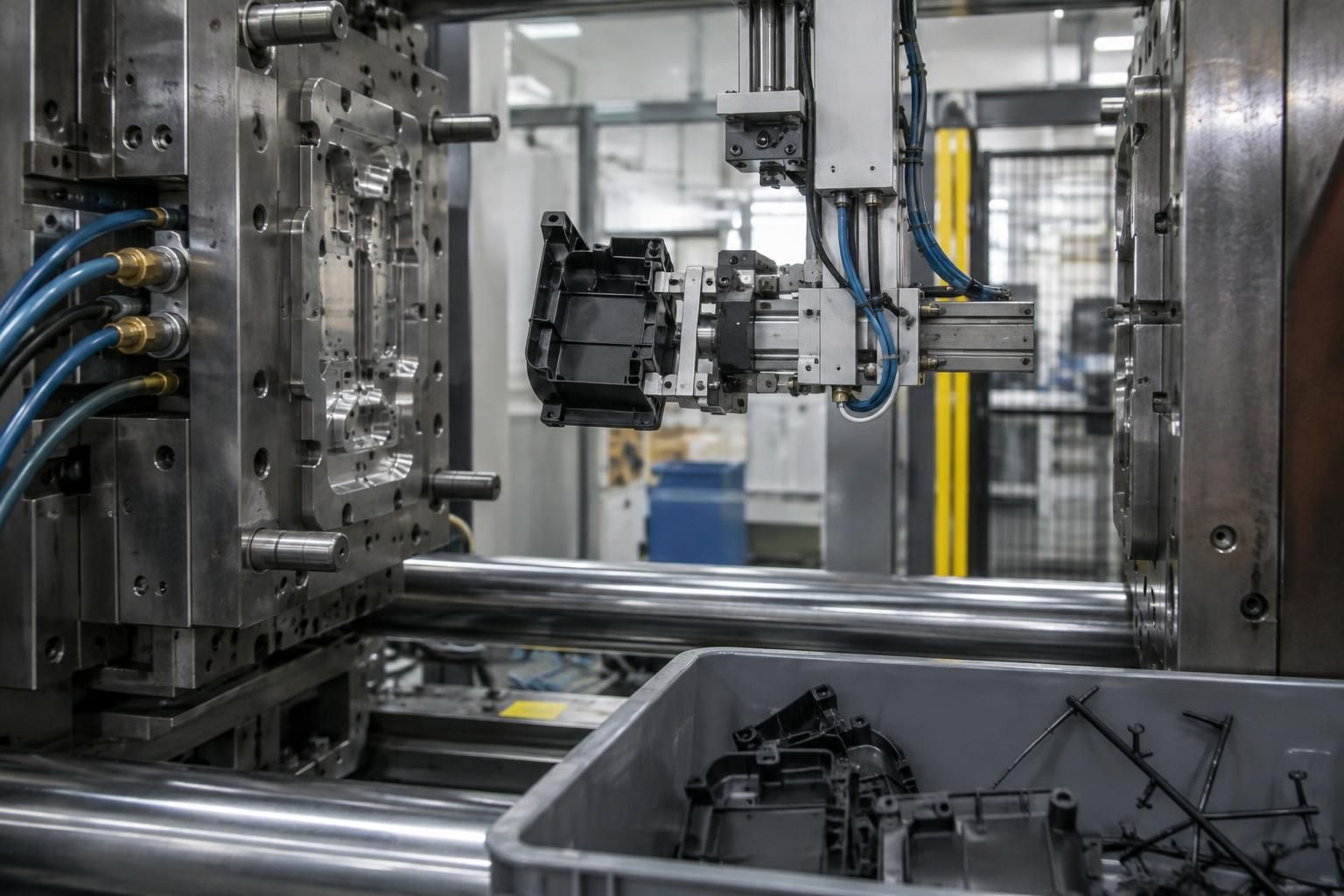
Market analysis for buyers: Capacity utilization, insolvency risks, and order status among plastic processors in the DACH region, with consequences for supplier selection and price negotiation.
Status Quo: An Industry in its Third Crisis Year
Anyone seeking injection moulding capacity currently encounters a paradoxical situation. On one hand, many processors are under severe economic pressure due to a lack of orders from core end markets. On the other, buyers are not finding, but sometimes finding it difficult, to secure a reliable supplier. This is because the current crisis does not select based on performance. It affects technically sound companies whose end markets are contracting, while simultaneously increasing the risk that a qualified supplier will go into insolvency mid-project.
German plastics manufacturers reported turnover of around 68.2 billion euros in 2025, according to the industry portal insolvenzkarte.de. This marks the third consecutive year of negative growth. In 2025 alone, approximately 5,600 jobs were lost in plastic processing. The industry is not a peripheral symptom of the industrial crisis; it is a core component of it. Plastic parts are essential in automotive, construction, packaging, and medical technology, and it is precisely these end markets that are currently weak in demand.
For buyers, the status quo means the price environment is favourable for negotiation, but the risk of failure is high. Both aspects belong to the same equation.
Development 1: The Wave of Insolvency has Reached Industrial Substance
The data on insolvency development is perhaps the most critical input for any supplier selection in the plastics sector. According to the Leibniz Institute for Economic Research Halle (IWH), Germany recorded 17,604 insolvencies of individuals and capital companies in 2025. This is the highest figure since 2005, roughly 5 percent above the crisis year of 2009. The Federal Statistical Office registered a total of 24,064 business insolvencies for 2025, 10.3 percent more than the previous year, and the highest level since 2014. The creditors' claims arising from these proceedings amounted to approximately 47.9 billion euros.
The dynamics intensified in 2026. In the second quarter of 2026, local courts reported 4,996 insolvencies of individuals and capital companies, 9 percent more than the first quarter, and the highest level since the second quarter of 2005. In June alone, there were 1,702 cases, an increase of 12 percent compared to the previous month and 20 percent compared to the same month last year. June was thus around 80 percent above the average of pre-Covid June months from 2016 to 2019.
Especially relevant for buyers: the wave is reaching industrial substance. Approximately 170,000 jobs nationwide were affected by insolvencies in 2025, roughly 62,000 of which were in the manufacturing sector. In the second quarter of 2026, about 45,500 jobs were directly affected, more than the previous record quarter Q2 2005 with 41,500. The plastics industry itself is in the middle of this. In the third quarter of 2024 alone, six companies relevant to plastics, including the panel producer Epsotech, the seating manufacturer Recaro, and the WKW Group, were found among the 78 major insolvencies with over ten million euros in revenue. The supplier Gerhardi filed for insolvency, affecting about 1,500 employees.
A calming note from IWH: The manufacturing sector as a whole was below its previous high in the second quarter of 2025 in the second quarter of 2026, while construction, trade, hospitality, and services recorded new highs. Industry has been hit by the insolvency wave less severely than consumer-facing sectors. This provides some relief, but it is no guarantee for individual injection moulding companies.
Development 2: Capacity is Available, but the Structure is Bifurcated
The question of injection moulders' utilization cannot be precisely answered with available data, but the direction is clear. The VDMA association for plastics and rubber machines reported a price-adjusted increase in order intake of 5 percent for the first quarter of 2025 compared to the previous year. However, machine builder revenue was still 17 percent below the previous year. 2024 was again weak, with order intake down 21 percent and revenue down 19 percent on a price-adjusted basis. The association's interpretation is that the trough in order intake has been passed and the industry is recovering in small steps.
What this means for injection moulding capacity: Companies investing in new machines first need orders, and the investment hesitation from previous years is now reflected in thin order books. The VDMA projected a flat revenue trend in 2025 in the best-case scenario. For buyers, this means that free machine capacity is likely available in the market, and processors are struggling to meet utilization demands. At the same time, short-time work was a widespread tool during the crisis years, and layoffs were also on the agenda. Consequently, personnel and expertise in some companies have become thinner than machine utilization might suggest.
A fact, not an assessment, is the structural loss of European competitive position: According to insolvenzkarte.de, European plastic production now holds 12 percent of the world market share, compared to 22 percent in 2006. Cheap imports from Asia add additional pressure on processors. Thus, the capacity question has a geographical dimension: capacity is migrating long-term to where costs and consumers are located.
Development 3: The Causes of the Crisis are Structural, Not Cyclical
The research identifies three simultaneous pressure points: high energy costs, falling orders from the automotive and construction sectors, and cheap imports from Asia. The industry portal insolvenzkarte.de summarizes that processors, packaging manufacturers, and injection moulding companies are simultaneously facing these factors and concludes that the crisis is structural.
- Energy costs directly impact injection moulders in raw material melting and peripheral plant construction as they are energy-intensive.
- The automotive sector, traditionally the largest buyer of technical injection moulded parts, is reducing volumes and platforms; the construction industry has also been weak for years.
- Asian imports are putting downward pressure on prices, especially for commodity products and simple manufacturing technologies.
In addition, there is regulatory pressure, which the research mentions as a forward-looking point without quantifying concrete cost effects. For assessment as a buyer, the finding is sufficient: The price flexibility of processors is not narrowly constrained by economic cycles alone. Part of the crisis will remain even after a recovery. Those who negotiate prices downward today based on a supplier's dire situation should critically examine the sustainability of these conditions.
Data at a Glance: What the Sources Specifically Provide
| Indicator | Value | Source | Time Period |
|---|---|---|---|
| Turnover Plastics Manufacturers Germany | 68.2 billion Euros | insolvenzkarte.de | 2025, third consecutive year of decline |
| Jobs Lost Plastic Processing | 5,600 | insolvenzkarte.de | 2025 |
| Insolvencies Individuals and Capital Companies | 17,604 | IWH via insolvenzkarte.de | 2025 |
| Business Insolvencies (Official) | 24,064, +10.3 % | Federal Statistical Office via insolvenzkarte.de | 2025 |
| Creditors' Claims from Insolvencies | approx. 47.9 billion Euros | Federal Statistical Office via insolvenzkarte.de | 2025 |
| Insolvencies Q2 2026 | 4,996, +9 % vs Q1, highest since 2005 | IWH via K-Zeitung | Q2 2026 |
| Insolvencies June 2026 | 1,702, +12 % vs previous month, +20 % vs previous year | IWH via K-Zeitung | June 2026 |
| Jobs Affected by Insolvency Q2 2026 | approx. 45,500 | IWH via K-Zeitung | Q2 2026 |
| Order Intake Plastic and Rubber Machine Building | +5 % price-adjusted | VDMA via industrieanzeiger | Q1 2025 |
| Revenue Plastic and Rubber Machine Building | -17 % | VDMA via industrieanzeiger | Q1 2025 |
| Order Intake Machine Building 2024 | -21 % price-adjusted | VDMA via industrieanzeiger | 2024 |
| World Market Share European Plastic Production | 12 % (2006: 22 %) | insolvenzkarte.de | current survey |
Uncertainties: What Nobody Can Seriously Predict
Three uncertainties should be integrated into all procurement planning. First, the trajectory of investment willingness. The VDMA sees the trough being passed, but simultaneously emphasizes that US trade policies are triggering uncertainties, and revenue in 2025 will likely remain flat at best. It is not derivable from this that a wave of investment will end downward pressure on machine capacity.
Second, the selection effect of the insolvency wave. It is proven that the number of bankruptcies is historically high. Whether specific companies emerge stronger or remain threatened cannot be determined from aggregated data. A company with a full order book can fail just as easily as one with an empty one if demands from creditors or customer insolvencies strain liquidity. The industry refers to an escalating risk of failure in the supply chain, as the K-Zeitung ticker puts it.
Third, the geopolitical component. Trade policy measures by the USA and the competition from Asian imports influence both the demand for European injection moulded parts and the competitive situation of the processors. The direction and speed remain open.
Implications for Supplier Selection
The overall picture yields several concrete consequences for buyers. These are interpretations based on the available data, not empirically proven rules of conduct.
- Credit check before unit price negotiation. Given the insolvency dynamics of Q2 2026, the supplier's probability of survival is the biggest supply chain risk. Economic information, payment behaviour, and ongoing proceedings must be part of the initial qualification before discussing economic terms.
- Utilise initial qualification, but factor in the risk of capacity shortages early. Free machine capacity is available, but the personnel and tool base may be thinner than the machine park size suggests. Audit questions regarding short-time work, staff reductions, and tool maintenance are particularly informative in this market environment.
- Rethink dual sourcing. Classic dual sourcing protects against capacity bottlenecks, but not against the failure of a partner due to insolvency, which involves permanent costs for tool transfer and requalification. If a second supplier does not exist, at least contractual access to the tooling should be secured.
- Search regionally in a differentiated manner. Since the manufacturing sector as a whole is less severely affected by insolvencies than construction or trade, injection moulders located closely to industry with a diversified customer base are expected to be relatively robust. Dependence on a single end market sector, particularly automotive, is a warning sign.
- Monitor market data continuously. Ongoing insolvency tickers, such as those from K-Zeitung, and industry lists like those from KunststoffWeb provide earlier warnings of endangered suppliers than official statistics.
Digital marketplaces and platforms can contribute to this, for example, by providing structured supplier profiles and comparability in tenders. Amplifa connects technical buyers with certified manufacturing suppliers. However, self-assessment of creditworthiness and manufacturing depth remains crucial, regardless of the sourcing channel.
Negotiation Strategy: Price Pressure Yes, but with Realism
The negotiation position of buyers is objectively strong. Processors are striving for utilization, machine builders report three years of weak orders, and the automotive and construction end markets are subdued. A price reduction compared to the height of the supply chain crisis is realistic.
The limit of the negotiation strategy is shown by the revenue development of processors: three years of losses in a row, 5,600 jobs lost in 2025, high energy costs, and import pressure. A supplier who offers prices at cost to secure orders is not a reliable partner in the long run; they are a future insolvency case with all the costs of a supplier failure. This is an assessment derived from combining the data: the cheapest price in this market is not automatically the most economically sound.
Based on practical experience, separating price and structural negotiations has proven effective. Volume-based discounts and indexing clauses for material and energy prices can be combined with longer-term purchase commitments. This gives the processor the planning security needed in difficult years and the buyer certainty of capacity. Such arrangements are rational for both parties in a market where the trough is just being passed.
Preparation: What Buyers Can Do Now
- Evaluate existing suppliers: For every active injection moulding supplier, check credit reports, payment history, and any insolvency tickers, and increase monitoring frequency.
- Document tooling rights: Check whether ownership of all molds and tools is clearly stipulated contractually and how they will be handled in the event of supplier failure.
- Identify alternative sources: Know at least one qualified replacement supplier for critical components, even without actively sourcing them.
- Test price ranges: Use current tenders to price the market. The leverage provided by weak demand is real, but check the sustainability of the conditions.
- Assess long-term contracts: In a market with structural cost and competitive pressure, purchase commitments can secure both parties.
- Subscribe to indices and tickers: Ongoing insolvency lists from specialized portals and the quarterly reports from IWH provide early warning indicators long before official statistics show them.
Final Assessment as a Hypothesis, Not a Forecast: If the VDMA's assessment is correct and the machine building sector recovers gradually, the negotiating position of buyers is expected to shift slowly over the coming years. Those who seek suppliers now will find favourable terms and must manage increased risk of failure. Those who wait too long will lose the price advantage and retain the risk. The current market rewards precisely those procurement organisations that can do both: negotiate prices with discipline and secure against supplier failure systematically.
Sources
- Aktuelle Insolvenzen in der Kunststoffbranche, K-ZeitungInsolvenzzahlen Q2 2026 (4.996 Fälle, höchster Stand seit Q2 2005), Juni 2026 (1.702 Fälle), 45.500 betroffene Arbeitsplätze, Verarbeitendes Gewerbe unter Vorjahreshöchststand, eskalierendes Ausfallrisiko in der Lieferkette
- 30+ Kunststoff-Insolvenzen Statistiken: Branche unter DruckUmsatz Kunststoffverarbeiter 68,2 Mrd. Euro 2025, 5.600 abgebaute Stellen, IWH-Zahl 17.604 Insolvenzen 2025, Destatis 24.064 Unternehmensinsolvenzen und 47,9 Mrd. Gläubigerforderungen, 170.000 bzw. 62.000 betroffene Arbeitsplätze, Großinsolvenzen Epsotech, Recaro, WKW, Gerhardi mit 1.500 Beschäftigt
- Wieder mehr Aufträge im Kunststoff- und Gummimaschinenbau, industrieanzeigerVDMA-Daten zu Auftragseingängen (+5 % Q1 2025, -21 % 2024) und Umsatz (-17 % Q1 2025, -19 % 2024), Talsohle durchschritten, Kurzarbeit und Entlassungen, Unsicherheit durch US-Handelspolitik, Seitwärtsentwicklung 2025 im besten Fall
Editorially responsible
Anthony Filipiak
CEO & Co-Founder at Amplifa
Anthony leads Amplifa as CEO and co-founder.
View profileResearched from publicly available sources and automatically checked for completeness; not individual professional advice.
Get multiple quotesLatest articles

Laser cutting or waterjet: process selection for sheet and profile blanks from a buyer's perspective
Material, thickness, heat affected zone, tolerance and batch size: which criteria buyers should apply when evaluating laser and waterjet blanks.
19 October 2026 · 10 min read
Make-or-Buy in Parts Production: Cost Items Beyond the Unit Price
Comparing unit prices is easy, the truth lies elsewhere: set-up, capital tied up, logistics and quality costs distort make-or-buy decisions. A structured methodology for a fair comparison.
19 October 2026 · 9 min read

Energy Prices as a Location Factor: What Europe's Electricity Cost Structure Means for Supplier Selection
How different industrial electricity prices across Europe affect quoted prices, supply chain risks and relocation decisions, and which criteria buyers should consider when selecting locations and suppliers.
18 October 2026 · 10 min read