Laser Cutting vs. Waterjet Cutting: A Criteria Catalogue for Selecting the Right Process for Sheet Metal Blanks
18 October 2026 · 15 min read

Editorially responsible: Leon J. Hermann
Written by the Amplifa Marketplace editorial team with AI assistance
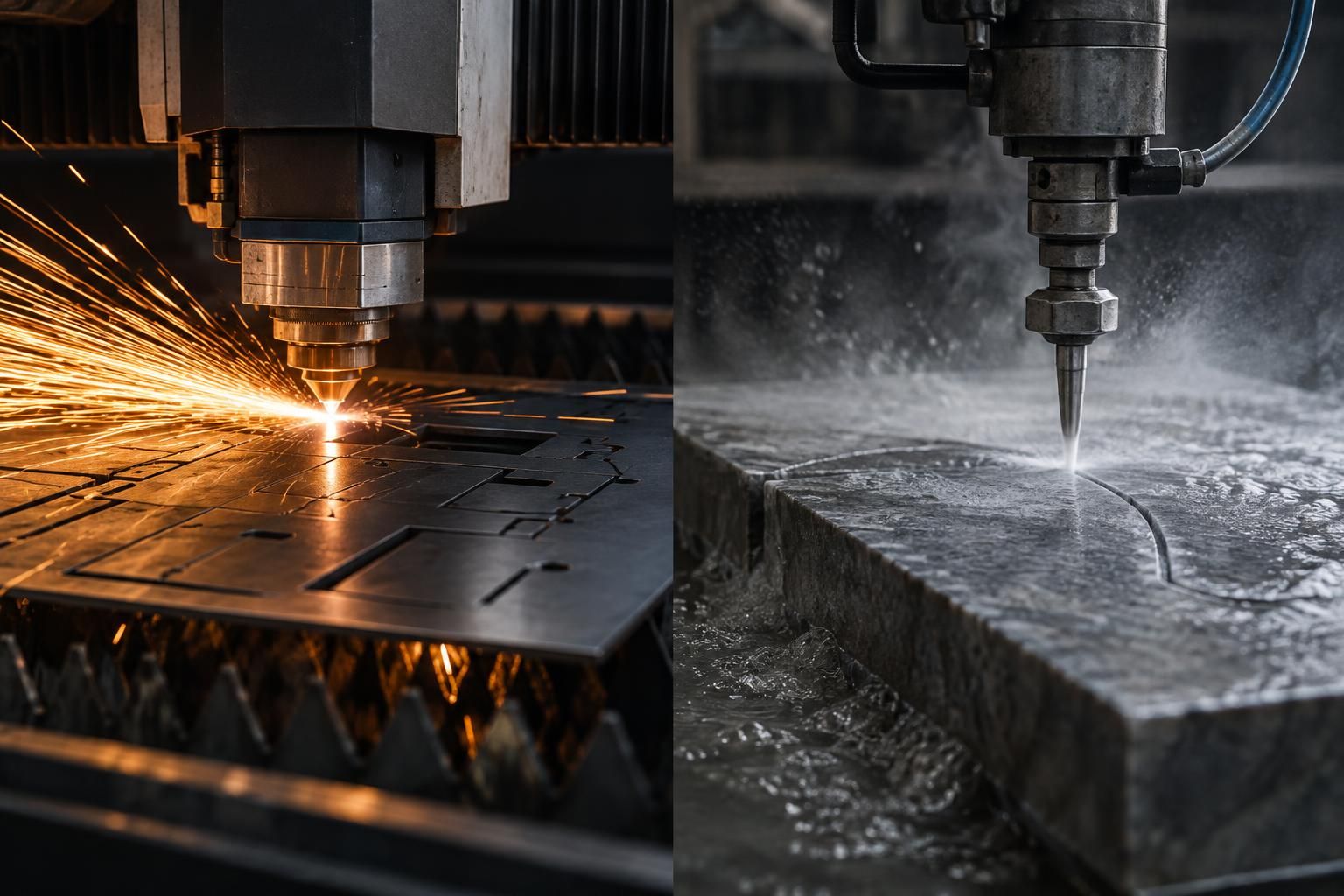
A structured comparison of laser cutting and waterjet cutting along the criteria of cut edge quality, heat-affected zone, material thickness, material variety and unit costs: with decision support for buyers and design engineers.
Two quotations for the same sheet metal blank are on the table: the laser service provider offers fast delivery and low unit costs, while the waterjet supplier promises an entirely cold cut with no change to the material structure. Which offer is right for the component, and how can the suppliers' claims even be verified? This question arises regularly in practice, because both processes promise similar performance at first glance while technically operating on different principles. This comparison positions the two cutting processes along verifiable criteria: principle of operation, heat-affected zone, cut edge quality, material thickness, material variety, speed and cost structure. At the end there is a criteria framework that allows quotations from laser and waterjet service providers to be evaluated systematically.
Two processes, two principles of operation: the technical starting point
The fundamental difference between the two processes lies in how the material is separated. Laser cutting is a thermal cutting process: a focused laser beam, typically a fibre or CO₂ laser, heats the material in the cutting zone, melting, burning or vaporising it. A process gas supports the cutting and blows the molten material out of the kerf. Waterjet cutting, by contrast, works mechanically and cold: an ultra-high-pressure water jet with a pressure between 3,000 and 6,000 bar erodes the material. In the industrially dominant abrasive waterjet cutting process, a fine abrasive, typically garnet, is added to the jet, which does the actual cutting work.
Almost the entire subsequent evaluation follows from this principle of operation. The thermal approach of the laser explains the high speed with thin sheets, but also the formation of a heat-affected zone and the limitations with transparent or highly reflective materials. The cold approach of the waterjet explains its universal material compatibility and the absence of a heat-affected zone, but also its comparatively lower cutting speed. Anyone who wants to understand process selection should therefore always start with the principle of operation: not with the prices.
Heat-affected zone: the core argument for the waterjet
The heat-affected zone (HAZ) is the central qualitative distinguishing feature between the two processes. In laser cutting, a technically inherent, unavoidable thermal influence occurs in the edge zones of the kerf. In metals, the high temperatures cause what is known as edge-zone hardening, in which the metallic microstructure of the material changes. Visible consequences are temper colours at the edge. According to one source, the heat-affected zone is present in laser cutting, even if described as minimal: its extent depends on material, thickness and process parameters.
This change in microstructure is not merely a cosmetic problem. If downstream machining steps follow at the cut edge, for example milling, edge-zone hardening can lead to unexpected difficulties. If cutting depth and feed rates during milling are not adjusted to the altered material properties, chatter marks may appear on the workpiece or the milling cutter may even break. For design engineers this means: anyone who needs a fitting surface or a function-critical edge directly at the cutting line must either account for the HAZ in the tolerance discussion or plan for post-machining.
Waterjet cutting produces, according to consistent sources, no heat-affected zone, no thermal distortion and no change to the molecular structure of the material. Thermally induced material distortion is entirely ruled out. This is particularly relevant for heat-sensitive materials such as aerospace-grade titanium, composites or hardened materials, but also for delicate workpieces where thermal distortion in the form of linear dimensional change can jeopardise highly precise cutting with the tightest tolerances.
Cut edge quality: very good in both cases, but in different ways
At first glance, both processes deliver a comparably good cut edge: according to the available sources, both achieve a very good edge quality, and both operate without mechanical tool contact. The differences lie in the detail. Laser cutting produces clean, nearly burr-free edges that, at thin material thicknesses, generally require no post-processing. The kerf is typically very narrow, which also improves material utilisation during nesting, although according to the sources both processes achieve very good material utilisation through CNC nesting.
Waterjet cutting leaves a somewhat rougher edge surface, but without burrs or oxidation. A practically important aspect: with the waterjet, the cut quality can be freely selected across defined quality levels Q1 to Q5 and thus specifically matched to the component's requirements. Those who need a decorative or function-critical edge choose the higher quality level and pay for it with longer cutting time; those who only need a rough contour cut faster. The kerf with the waterjet is typically wider than with the laser; with micro-jet technology, kerfs of 0.3 mm are achieved.
- Laser cutting: clean, nearly burr-free edges, usually without post-processing for thin sheets, very narrow kerf
- Waterjet cutting: somewhat rougher surface, but without burrs and without oxidation, cut quality selectable in levels Q1 to Q5
- Both processes: no mechanical tool contact, very good material utilisation through CNC nesting
Material thickness: where the economics tip over
Material thickness is the criterion on which the processes diverge most clearly. Thin to medium sheet is the laser's domain: up to around 8 millimetres, lasers cut effortlessly and to a high quality, and for thin sheets up to 15 millimetres the laser is significantly faster according to one source. For carbon steel, sheet thicknesses up to around 25 mm are cited as the practical limit of laser cutting; another source cites 30-40 mm in steel as the efficient range. Modern fibre lasers with powers of 30 kW and more can also cut thick steel: albeit with clear quality losses and reduced speeds once the efficient range is exceeded.
According to the available sources, the waterjet cuts material thicknesses from 0.5 mm to over 200 mm in steel. It therefore covers a range that the laser cannot sensibly reach beyond 25 to 30 mm. With thick materials, the laser's speed advantage diminishes and the waterjet can become competitive. For very thick components, waterjet cutting is clearly at an advantage according to the available sources.
| Criterion | Laser cutting | Waterjet cutting |
|---|---|---|
| Efficient thickness range for steel | Thin to medium sheet, up to approx. 25 mm (30-40 mm also cited) | 0.5 mm to over 200 mm |
| Achievable tolerances | Up to ±0.05 mm, typically ±0.05-0.1 mm | Workpiece tolerances between 0.07 and 0.12 mm; with micro-jet under 0.1 mm |
| Kerf | Typically very narrow | Typically wider; approx. 0.3 mm with micro-jet |
| Reflective metals (copper, brass) | Possible with fibre laser (up to 15 mm cited), otherwise limits | Unrestricted possible |
| Non-metallic materials | Largely not possible | Glass, stone, ceramics, plastics, composites, rubber |
These figures come from different sources with different machine configurations: they should be read as an orientation framework, not as hard process limits. Which thicknesses a specific service provider can actually cut economically depends on its machine fleet: according to one source, fibre lasers up to 30 kW and waterjet machines with tables up to 16 x 4 metres; another cites lasers up to 25 mm structural steel, 30 mm stainless steel and 30 mm aluminium. Buyers should therefore always check the thickness specifications in a quotation against the machine technology actually available.
Material variety: the laser is a metal process, the waterjet a universal cutting process
With the range of materials, the second great dividing line becomes apparent. The laser is ideal for metals: steel, stainless steel and aluminium are rated as very well suited by all sources. Limits arise with highly reflective materials such as copper and brass, which can only be machined by laser to a limited extent, depending on the alloy and machine. Transparent materials such as glass and non-metallic materials such as stone, ceramics, natural stone, many composites and most plastics are unsuitable for laser cutting or at least not a standard application.
The waterjet, by contrast, cuts practically any material: steel, aluminium, titanium, copper, brass, stone, ceramics, glass, composites, rubber and plastics. Material mixtures and composite materials are also no problem, since the cutting process works independently of thermal, optical or electrical material properties. For components that combine several materials or consist of sandwich or composite constructions, waterjet cutting is therefore often the only sensible option.
- Clear laser domain: thin and medium sheet made of steel, stainless steel, aluminium in series production
- Clear waterjet domain: glass, stone, ceramics, composites, plastics, very thick cross-sections
- Grey area requiring clarification: copper, brass, titanium: depending on the machine sometimes laser-cuttable, with the waterjet unrestrictedly possible
Speed and costs: why the laser usually wins with thin sheet
With thin and medium sheet, laser cutting is the clear favourite in terms of throughput. According to the available sources, the laser is clearly ahead up to around 15 mm material thickness; one source quantifies the laser's lead as five- to tenfold cutting speed. This speed translates directly into unit costs: the laser has lower unit costs for medium to large series of thin sheet, and for steel sheets up to 3 mm, typical project costs of 50 to 300 euros per order are cited. Machine hourly rates are cited, depending on the source, at 80 to 250 euros for laser and, in one cost overview, 45 to 65 euros per hour: the spread between the sources shows how heavily the specific machine, region and order structure weigh.
Waterjet cutting is correspondingly more expensive with thin standard sheet because the cutting time is considerably longer. The picture reverses for special materials, large material thicknesses and heat-sensitive components: here the waterjet is either the only sensible option or simply the more economical one, because rework, scrap or distortion damage are avoided. Another cost aspect is the quantity: waterjet cutting is described as economical only from medium quantities of around 50 to 100 parts, whereas laser cutting is attractive from a single piece. For very large series of thin sheet, the laser is particularly interesting according to the sources; punching only becomes an alternative from around 500 to 1,000 parts.
Precision: on a par, with different strengths
Both processes achieve comparable tolerances for most components and are excellent for precise cutting. According to the available sources, the laser achieves tolerances of ±0.1 mm at thin thicknesses, in some cases ±0.05-0.1 mm or up to 0.05 mm, and has slight advantages in repeatability with thin sheets. The waterjet achieves workpiece tolerances between 0.07 and 0.12 mm, under 0.1 mm with micro-jet technology, and scores with thick or heat-sensitive materials because no thermal distortion occurs.
For process selection this means: with thin sheet and tight tolerances, the laser has a slight technical edge, especially in series production where repeatability matters. With thick cross-sections or heat-critical materials, the picture reverses, because there the laser's thermal distortion can impair the actual component accuracy more than the waterjet's nominal machine tolerance. The buyer should therefore always read the precision specification in a quotation together with the material thickness and the material.
Strengths and weaknesses at a glance
Laser cutting
- Very high cutting speed with thin metals (0.5-6 mm)
- Low unit costs in series production for thin to medium sheet
- Clean, nearly burr-free cut edges without post-processing at thin thicknesses
- Very narrow kerf, high repeatability
- Complex geometries and fine details, small holes in suitable materials
- Tube cutting and laser marking/engraving available as additional services
- Heat-affected zone with temper colours and possible microstructural change (edge-zone hardening)
- Thermal distortion possible depending on material and geometry
- Limits with reflective metals such as copper and brass
- Glass, stone, ceramics and many composites cannot be cut
- Quality and speed losses at large material thicknesses
Waterjet cutting
- Practically all materials: metal, glass, stone, ceramics, plastics, composites, rubber
- No heat-affected zone, no thermal distortion, no microstructural change
- Very large material thicknesses up to approx. 200 mm
- Cut quality Q1-Q5 freely selectable
- 5-axis and 3D cutting possible
- No edge-zone hardening: unproblematic for downstream machining
- Lower cutting speed (a factor of 5-10 slower than laser is cited)
- Higher unit costs with thin standard sheet
- Economical only from medium quantities (approx. 50-100 parts)
- Somewhat rougher edge surface
- Wider kerf than the laser
Comparison table: all criteria at a glance
| Criterion | Laser cutting | Waterjet cutting |
|---|---|---|
| Principle of operation | Thermal: melting, burning, vaporising | Mechanical-cold: erosion by high-pressure jet with garnet abrasive (3,000-6,000 bar) |
| Heat-affected zone | Present (described as minimal), microstructural change possible | None |
| Thermal distortion | Possible depending on material and geometry | Ruled out |
| Cut edge quality | Clean, nearly burr-free edges; usually no rework with thin sheet | Somewhat rougher, but without burrs/oxidation; Q1-Q5 selectable |
| Efficient thickness range | Thin to medium sheet; steel up to approx. 25 mm | 0.5 to over 200 mm in steel |
| Tolerances | Up to ±0.05 mm, typically ±0.05-0.1 mm | 0.07-0.12 mm; under 0.1 mm with micro-jet |
| Material variety | Metals (steel, stainless steel, aluminium) very good; copper/brass limited; glass/stone/composites unsuitable | Practically all materials and composites |
| Speed | Very high with thin sheet (significantly faster up to 15 mm) | Medium, around 5-10x slower; competitive with thick materials |
| Unit costs | Low with thin sheet and medium/large series | Higher with thin sheet; economical with thick/special/heat-sensitive parts |
| Minimum quantity | Attractive from 1 piece | Economical from approx. 50-100 parts |
| Non-metallic materials | Largely not possible | Standard application |
| Downstream machining | Account for edge-zone hardening | Unproblematic, no thermally altered microstructure |
Suitability by target group: what matters for whom
For buyers
Buyers evaluate quotations not primarily by technology, but by total cost and risk. The available sources provide clear anchor points: with thin standard metals (steel, stainless steel, aluminium up to approx. 10 mm), laser cutting is usually significantly cheaper because the cutting speed is higher. With material thicknesses over 25 mm, non-laser-cuttable materials or heat-sensitive components, the picture reverses. When reviewing a quotation, the buyer should therefore check whether it states the following points: the actual thickness range of the machine, whether a HAZ must be accepted or ruled out, which cut quality level is offered and whether post-machining is included or excluded. If the process in the quotation does not match the component's requirements, the seemingly cheaper price quickly becomes more expensive.
For design engineers
Design engineers decide on the process through the drawing itself. The rules of thumb from the available sources: thin sheet with medium to high quantities points to laser; material thickness over 25 mm points to waterjet; glass, stone, plastics or composites require waterjet; likewise if no heat at all may be introduced into the component. Also relevant: anyone who needs fitting surfaces directly at the cut edge should either design the laser's HAZ with tolerance allowances or provide for post-machining: with the waterjet this issue does not arise. For delicate contours in thin material, the laser has advantages; for 3D or 5-axis cuts, the waterjet.
For managing directors of supplier companies
For suppliers, the question is more strategic: operating both technologies under one roof makes it possible, according to the available sources, to choose the optimal process for every workpiece or to combine both in one project: for example laser cutting for thin-sheet parts and waterjet for components with great thickness or made of special materials. A supplier offering only one of the processes can serve as a buyer-side fallback if the preferred supplier has bet on the wrong process. From a market perspective, laser cutting is described as a growing field: the global market for laser cutting machines was estimated at around 5.5 billion US dollars in 2023 and is expected to grow at an annual rate of 8.4 percent until 2030.
The well-founded decision: a criteria framework for evaluating quotations
A blanket statement that “laser is better” or “waterjet is better” is technically not meaningful: the actual results always depend on machine, material, material thickness, geometry, cut quality and the required tolerances. The decision can nevertheless be prepared systematically. The following framework assigns typical requirement constellations to the processes; it is based exclusively on the criteria documented above.
- Check the material: pure metal sheet suits both processes; glass, stone, ceramics, composites or plastics require the waterjet; copper and brass require a machine check when using the laser.
- Check thickness: up to approx. 25 mm steel, the laser is efficient; beyond that, the waterjet with up to 200 mm is clearly at an advantage.
- Heat assessment: is a heat-affected zone or microstructural change at the edge acceptable? No means waterjet: especially with titanium, hardened materials and composites.
- Check post-machining: if machining follows at the cut edge, the laser's edge-zone hardening is a genuine process risk; the cold waterjet cut avoids it.
- Quantity and geometry: small quantities are attractive by laser from 1 piece, waterjet from approx. 50-100 parts; many internal contours increase cutting time for both processes, but at a lower level with the laser.
- Read the cost structure: cutting costs alone are misleading; rework, scrap risk and distortion correction must be included in the comparison.
The well-founded decision in most practical cases is therefore: for standard sheet blanks made of steel, stainless steel or aluminium in the thickness range up to about 25 mm and with quantities from small series upwards, laser cutting is the more economical and faster choice, provided the heat-affected zone is tolerable. For components over 25 mm thick, made of non-laser-cuttable materials or with the requirement of an absolutely heat-free process, waterjet cutting is the right choice: even if the cutting time is longer and the edge somewhat rougher. Between these poles lie the cases where checking the specific drawing against the supplier's specific machine technology is decisive. Anyone comparing several quotations is well advised not simply to accept the supplier's process choice but to verify it against the framework above. On Amplifa, vetted manufacturing suppliers for both processes can be specifically found and their quotations compared against criteria such as these.
Conclusion: process selection is a material and thickness question with a cost underlay
Laser cutting and waterjet cutting are not competitors for the same application window, but overlapping processes with clearly distinguishable core competencies. The laser wins with thin to medium metal sheet through speed, low unit costs and a narrow kerf; its price is the heat-affected zone with possible microstructural change and risk of distortion. The waterjet wins with thick cross-sections up to over 200 mm, with non-laser-cuttable materials and wherever the component cannot tolerate any thermal alteration whatsoever; its price is the slower cutting speed and the higher edge roughness with thin standard sheet. Buyers and design engineers who systematically check quotations against the criteria of material, thickness, HAZ requirement, post-machining and quantity thereby make a comprehensible and justifiable process decision: regardless of which process the supplier is promoting.
Manufacturing processes on AmplifaCategory overview of cutting and manufacturing processes for finding suitable vetted suppliers for laser and waterjet cutting.Evaluate quotations systematicallyTools for buyers to structure the evaluation of manufacturing quotations against technical criteria.Sources
- Wasserstrahlschneiden vs. Laserschneiden – osjetWirkprinzipien beider Verfahren, umfassender Kriterienvergleich (WEZ, Verzug, Materialvielfalt, Schnittspalt, Kantenqualität), Aussage dass ein pauschaler Vergleich technisch nicht sinnvoll ist
- Wasserstrahlschneiden vs. Laserschneiden: Wann welche Technologie – CortaliaDruckbereich 3.000–6.000 bar, Faserlaser bis 30 kW, Dicken 0,5 mm bis über 200 mm (Wasserstrahl) bzw. 30–40 mm Stahl (Laser), Toleranzen ±0,1 mm und unter 0,1 mm mit Mikroschnitt, Schnittdicke 0,3 mm, Entscheidungskriterien für beide Verfahren, Kombination beider Technologien
- Laserschneiden vs. Wasserstrahlschneiden – KIELDickenbereiche (Laser bis 25 mm Baustahl/30 mm Edelstahl/30 mm Alu, Wasserstrahl bis ca. 200 mm), Faserlaser bis 15 mm bei Kupfer, Schnittgeschwindigkeit 5–10x, Q1–Q5-Qualitätsstufen, Faustregeln und Kostenargumente
- Wasserstrahlschneiden vs. Laserstrahlschneiden – wpfiRandzonenaufhärtung und Fräsprobleme nach Laserschnitt, thermischer Verzug bei filigranen Werkstücken, Grenzen des Lasers bei Glas und reflektierenden Werkstoffen, Toleranzen 0,07–0,12 mm (Wasserstrahl) und bis 0,05 mm (Laser)
- Laserschneiden vs. Wasserstrahlschneiden vs. Plasmaschneiden – Steeling.netToleranzen ±0,05–0,1 mm beim Laser, Geschwindigkeitsvorteil bei 0,5–6 mm Blech, Marktgröße Laserschneidmaschinen 2023 ca. 5,5 Mrd. USD mit CAGR 8,4 % bis 2030
- Laserschneiden vs. Wasserstrahlschneiden – Kosten und Entscheidungshilfe – PartflowWirtschaftlichkeitsbereiche (Wasserstrahl ab ca. 50–100 Teilen, Laser ab 1 Stück, Stanzen ab ca. 500–1000 Teilen), Projektkosten 50–300 € für Stahlbleche bis 3 mm, Kosten-Kriterien-Matrix
Editorially responsible
Leon J. Hermann
COO & Co-Founder at Amplifa
As COO and co-founder, Leon is responsible for scaling Amplifa's operations.
View profileResearched from publicly available sources and automatically checked for completeness; not individual professional advice.
Get multiple quotesLatest articles
Injection Moulding Manufacturers in the DACH Region: Market Conditions, Capacities, and Insolvency Risks in the Trend Report
Market analysis for buyers: Capacity utilization, insolvency risks, and order status among plastic processors in the DACH region, with consequences for supplier selection and price negotiation.
23 October 2026 · 10 min read

Laser cutting or waterjet: process selection for sheet and profile blanks from a buyer's perspective
Material, thickness, heat affected zone, tolerance and batch size: which criteria buyers should apply when evaluating laser and waterjet blanks.
19 October 2026 · 10 min read
Make-or-Buy in Parts Production: Cost Items Beyond the Unit Price
Comparing unit prices is easy, the truth lies elsewhere: set-up, capital tied up, logistics and quality costs distort make-or-buy decisions. A structured methodology for a fair comparison.
19 October 2026 · 9 min read