Make-or-Buy in Parts Production: Cost Items Beyond the Unit Price
19 October 2026 · 9 min read

Editorially responsible: Leon J. Hermann
Written by the Amplifa Marketplace editorial team with AI assistance

Comparing unit prices is easy, the truth lies elsewhere: set-up, capital tied up, logistics and quality costs distort make-or-buy decisions. A structured methodology for a fair comparison.
Why the unit price is the wrong basis for comparison
A buyer puts the in-house production costs of a part next to a supplier's quotation, sees a difference and decides. That sounds like clean arithmetic, but in practice it is often the moment the calculation goes wrong. The unit price of in-house production is often derived from running costs, without fixed costs being fully allocated, calculated costs being included or the capacity utilisation situation being taken into account. On the other side, external sourcing involves items that never appear in the quoted price at all: transport, inspection effort, capital tied up through longer replenishment times, effort for supplier management.
The result is decisions that look good on the calculation sheet and turn out differently in the P&L later. For both in-house production and external sourcing, the decision-relevant costs are partly hidden. Anyone who wants to work cleanly here needs a system that maps both scenarios on the same level, including the items nobody voluntarily mentions in a quotation comparison.
A look at the academic literature shows that this problem is not new and has at the same time become more strategic. Make-or-buy decisions today relate to all direct and indirect areas of value creation, no longer just to classical manufacturing processes. This also raises the bar for the quality of the cost comparisons on which such decisions are based.
Fundamentals: what a clean cost comparison has to deliver
At its core, the make-or-buy analysis consists of a total cost comparison. First, the costs are calculated that would arise if the company manufactured the product itself. In a second step, these costs are compared with the alternative of sourcing the same product from another provider. That is the textbook definition, and it already contains the first trap.
The comparison must not take into account only expense-based costs, in other words the outlays actually incurred. Calculated costs must be included. These include imputed depreciation and imputed interest. Anyone who omits these items is implicitly assuming that machines and tied-up capital are free of charge. That is precisely the typical distortion that makes in-house production artificially attractive, because the machine is there and the capital remains invisible in the annual accounts.
The mirror image appears on the external sourcing side. The purchase price is an expense-based figure and appears in full on the invoice. The internal costs of one's own operation, by contrast, are often obscured by proportional overhead allocation. A fair comparison therefore requires a clean separation between decision-relevant and non-decision-relevant costs on both sides.
The cost structure as the first test: fixed costs and capacity utilisation
The first and most consequential cost item besides the unit price is the fixed cost structure. In-house production comes with higher fixed costs and hence higher capital tied up. External sourcing allows greater flexibility through variabilisation of fixed costs. This simple juxtaposition explains a large share of real-world wrong decisions.
The reason for the trend towards more external sourcing lies in the high fixed cost pressure that own capacities create. These fixed costs push the break-even point ever closer to the capacity limit. Profits are often only achieved at capacity utilisation above 70 per cent, in the automotive industry at times not until 90 per cent. In times of weakening business cycles, the largely immovable fixed cost structures then produce disproportionate losses.
For the buyer this means: the question is not whether the machine can produce the parts cheaply when it is fully utilised. The question is what happens to the fixed costs when demand drops or the part is discontinued. In-house production that only pays off at high utilisation is a loss maker in a sales crisis. The utilisation situation is thus not a footnote but a central cost variable.
In practical terms for the calculation: manufacturing overheads may only be fully allocated to a part if the capacity cannot be used otherwise without that part. If the machine is idle anyway, the decision-relevant costs of in-house production lie well below the full costs. If the machine is fully utilised, the displacement of other orders must be factored in, in other words the contribution margins forgone.
Cost items of in-house production that are often missing
The in-house production calculation in many operations contains material, direct labour and machine hour costs. What is frequently missing, or included only incompletely, are items that are decision-relevant for the comparison with the purchase price. These include, among others:
- Imputed depreciation and imputed interest on tied-up capital, if these are not already part of the overhead surcharges
- Investment costs for new equipment and staff training, if capacity or know-how is lacking
- Set-up costs and changeover times, which weigh heavily per unit at small batch sizes
- Inspection and quality control effort, which arises in-house with in-house production but is rarely reported separately
- Administrative and coordination effort for one's own production, which in the external sourcing scenario is replaced by supplier management, not eliminated
A further point is the quantity. Whether in-house production pays off depends on the production volume. Anyone who needs only a few components, for which dedicated production machinery and staff would have to be acquired, is better off sourcing from other companies. The break-even between the two alternatives can be calculated: fixed costs of in-house production divided by the difference between the purchase price and the variable unit costs of in-house production gives the volume from which make becomes cheaper than buy. Below that volume, external sourcing dominates.
Cost items of external sourcing missing from the quoted price
The purchase price is the visible end of a chain of hidden costs. When a make-or-buy analysis compares only quoted prices, items that arise within one's own operation are systematically omitted on the buy side. These include:
- Transport and logistics costs, including the costs of internal handling-intensive processes such as goods receipt and warehousing
- Effort for supplier selection, qualification, audits and ongoing supplier evaluation
- Quality costs in external sourcing: inspection effort at goods receipt, rework and scrap costs from quality fluctuations, complaint handling
- Capital tied up through longer replenishment times and higher safety stocks to guard against supply bottlenecks
- The risk of delivery delays and dependence on suppliers, which materialises in buffer stocks and escalation effort
These items cannot always be quantified precisely. They can, however, be estimated, and an estimated item is better than an ignored one. What matters is that both scenarios are treated with the same rigour. If in-house production has to carry imputed interest, then the extended supply chain in external sourcing has to carry the costs of its safety stocks. Otherwise you are comparing apples with oranges.
Beyond costs: the qualitative criteria with cost effects
The make-or-buy decision is not a purely cost-based trade-off. Quality, flexibility, strategic relevance and know-how protection matter. The mistake in many analyses, however, is not that these factors are considered, but that they are separated from the cost accounting. Most qualitative criteria have a cost effect that can be mapped.
- Quality fluctuations at the supplier can be captured monetarily through inspection and rework costs
- Capacity availability, whether internal or at the supplier, determines whether a scenario can deliver at all during demand peaks
- Know-how leakage at the external manufacturer is a strategic risk that cannot be expressed directly in euros but should influence the weighting of the decision
- Protection of trade secrets and patents: in-house production offers full control, while external sourcing creates know-how about one's own products at the supplier
- Dependence on suppliers as a long-term risk within the strategic analysis
To compare different scenarios quantitatively, operationalisation and weighting are useful. In practice, a two-stage approach has proven itself: first a quantitative analysis based on the decision-relevant costs, then a qualitative assessment using a decision matrix with defined weightings. The quantitative calculation provides the baseline, the matrix documents why the baseline is departed from in a given case.
Operational or strategic: two analyses with different questions
Not every make-or-buy question can be answered in the same way. The operational analysis focuses on short-term factors: fluctuations in production costs, supply bottlenecks, costs, quality and delivery times. It answers the question of how a given demand is to be met here and now, for example through external supply during demand peaks.
The strategic analysis looks at long-term corporate goals, the core business and long-term risks such as dependence on suppliers, protection of trade secrets and effects on core competencies. Core processes and core products should not be outsourced, as these represent differentiation from the competition and secure market position.
For practice this yields a clear rule: before a calculation even starts, it must be clear which question is to be answered. A short-term capacity decision must not be burdened with the same fixed cost allocations as a strategic decision about the company's own depth of production. Conversely, a long-term outsourcing decision must not rest solely on a snapshot of capacity utilisation.
The counter-argument: why the trend towards buy does not apply to all parts
The argument in favour of external sourcing is one-sided when viewed in isolation. External sourcing carries the risk of supply bottlenecks and quality fluctuations. The real weakness of the buy scenario shows up when the procured output lies outside the company's control and security of supply suffers.
Make, by contrast, is advantageous when quality can be better controlled and assured internally, when internal capacity is available, or when the product is strategically important. Lower dependence on suppliers is a value in its own right that a pure unit price comparison does not capture. Moreover, an external service provider may indeed have synergy potentials that enable better quality at lower cost, but that does not apply to every part and every provider.
So there is no general direction. What is needed is a decision that evaluates both sides with the same methodology. A wrong decision can lead to long-term competitive disadvantages, for example through quality problems, loss of know-how or dependence on suppliers. The risk exists on both sides, merely in different forms.
Recommendations: how to structure the comparison in practice
From the relationships described, a concrete procedure can be derived that can be implemented in the cost calculation.
- Clarify the scenario: define whether the analysis is to answer an operational question (short-term capacity and demand coverage) or a strategic one (depth of production, core competence)
- Standardise the cost concept: treat expense-based and calculated costs equally on both sides, in particular include imputed depreciation and interest
- Capture all cost items: on the make side fixed costs, set-up, investment and training costs, inspection effort; on the buy side transport, supplier management, quality costs, capital tied up in safety stocks
- Factor in utilisation: for idle capacity, apply only the decision-relevant variable costs plus opportunity costs; for fully utilised capacity, account for the contribution margins displaced
- Calculate the break-even: set the fixed costs of in-house production in relation to the cost difference per unit and determine the volume from which make becomes cheaper
- Operationalise qualitative criteria: build a decision matrix with defined weightings for quality, delivery capability, know-how protection and strategic relevance
- Document the result: record which items were estimated and on what grounds, so the decision remains traceable
Anyone who follows these steps will find that the result shifts in many cases compared with a pure unit price view. Sometimes at the expense of in-house production, which has so far omitted imputed interest and set-up effort. Sometimes at the expense of external sourcing, whose hidden logistics and quality costs nobody has ever charged up. Both are progress.
For buyers who want to search for suppliers systematically and make quotations comparable, a clean cost logic is the prerequisite. A marketplace such as Amplifa can support the supplier search here, but the calculation decision remains a task for one's own controlling. No comparison tool replaces engagement with one's own fixed cost structure.
Sources
- Make or Buy: Definition und EntscheidungskriterienDefinition, Kriterien (Kostenstruktur, Qualität, Flexibilität, Ressourcen, Lieferantenzuverlässigkeit, strategische Relevanz), Methoden der Analyse und Bedingungen, wann Make bzw. Buy vorteilhaft ist
- Make or Buy: Eigenfertigung oder FremdbezugZiele der Analyse (Kostenoptimierung, Qualitätsverbesserung, Kernkompetenzen, Risikominimierung, Flexibilität, Kapitalbindung, Nachhaltigkeit), Fixkosten- und Kapitalbindungseffekte, operative und strategische Analyse, Hinweis auf Nicht-Kostenebene (Geschäftsgeheimnisse)
- Fremdbezug oder Eigenfertigung - Make or BuyMethodik des Gesamtkostenvergleichs und Einbezug kalkulatorischer Kosten (Abschreibungen, Zinsen) neben pagatorischen Kosten
- Make-or-buy-Kalkulationen im modernen BeschaffungsmanagementFixkostendruck eigener Kapazitäten, Verschiebung des Break-Even-Points, Auslastungsgrenzen von 70 bzw. 90 Prozent, strategische Bedeutung des Fremdbezugs und Systemanbieter-Ansatz
- Make or Buy • Eigenfertigung oder Fremdbezug?Entscheidungskriterien Kosten, Liquidität und Ressourcen, Produktionsmenge, Zeit, Risiken sowie Investitionskosten für Maschinen und Schulungen bei fehlender Kapazität
- Make-or-Buy-Entscheidung - Eigenfertigung oder Fremdbezug - BerechnungAbhängigkeit des Kostenvergleichs von der Produktionsmenge, Break-even-Betrachtung, Kapazitäts- und Know-how-Fragen, Investitionsrisiko bei Eigenfertigung
Editorially responsible
Leon J. Hermann
COO & Co-Founder at Amplifa
As COO and co-founder, Leon is responsible for scaling Amplifa's operations.
View profileResearched from publicly available sources and automatically checked for completeness; not individual professional advice.
Get multiple quotesLatest articles
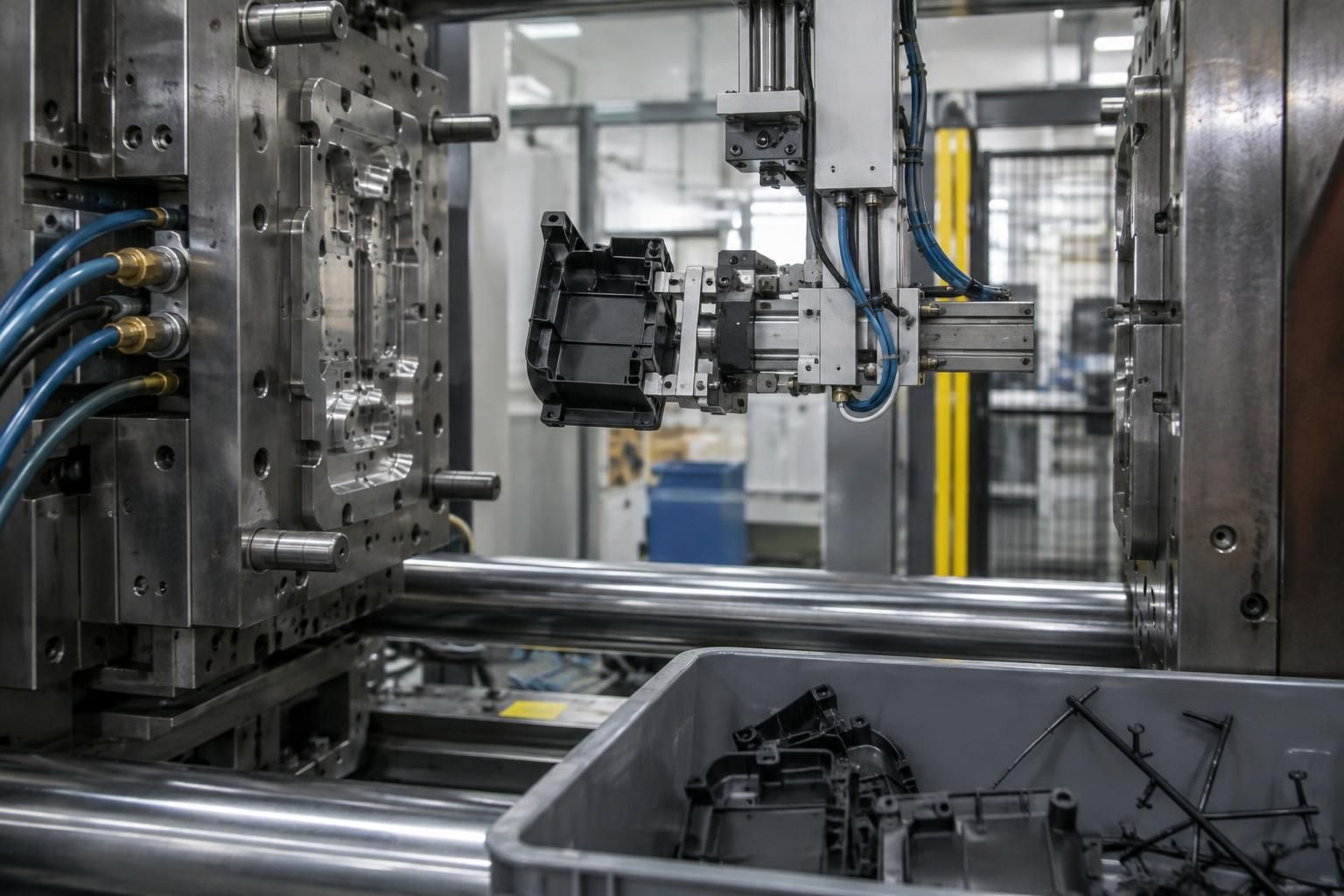
Injection Moulding Manufacturers in the DACH Region: Market Conditions, Capacities, and Insolvency Risks in the Trend Report
Market analysis for buyers: Capacity utilization, insolvency risks, and order status among plastic processors in the DACH region, with consequences for supplier selection and price negotiation.
23 October 2026 · 10 min read

Laser cutting or waterjet: process selection for sheet and profile blanks from a buyer's perspective
Material, thickness, heat affected zone, tolerance and batch size: which criteria buyers should apply when evaluating laser and waterjet blanks.
19 October 2026 · 10 min read

Energy Prices as a Location Factor: What Europe's Electricity Cost Structure Means for Supplier Selection
How different industrial electricity prices across Europe affect quoted prices, supply chain risks and relocation decisions, and which criteria buyers should consider when selecting locations and suppliers.
18 October 2026 · 10 min read