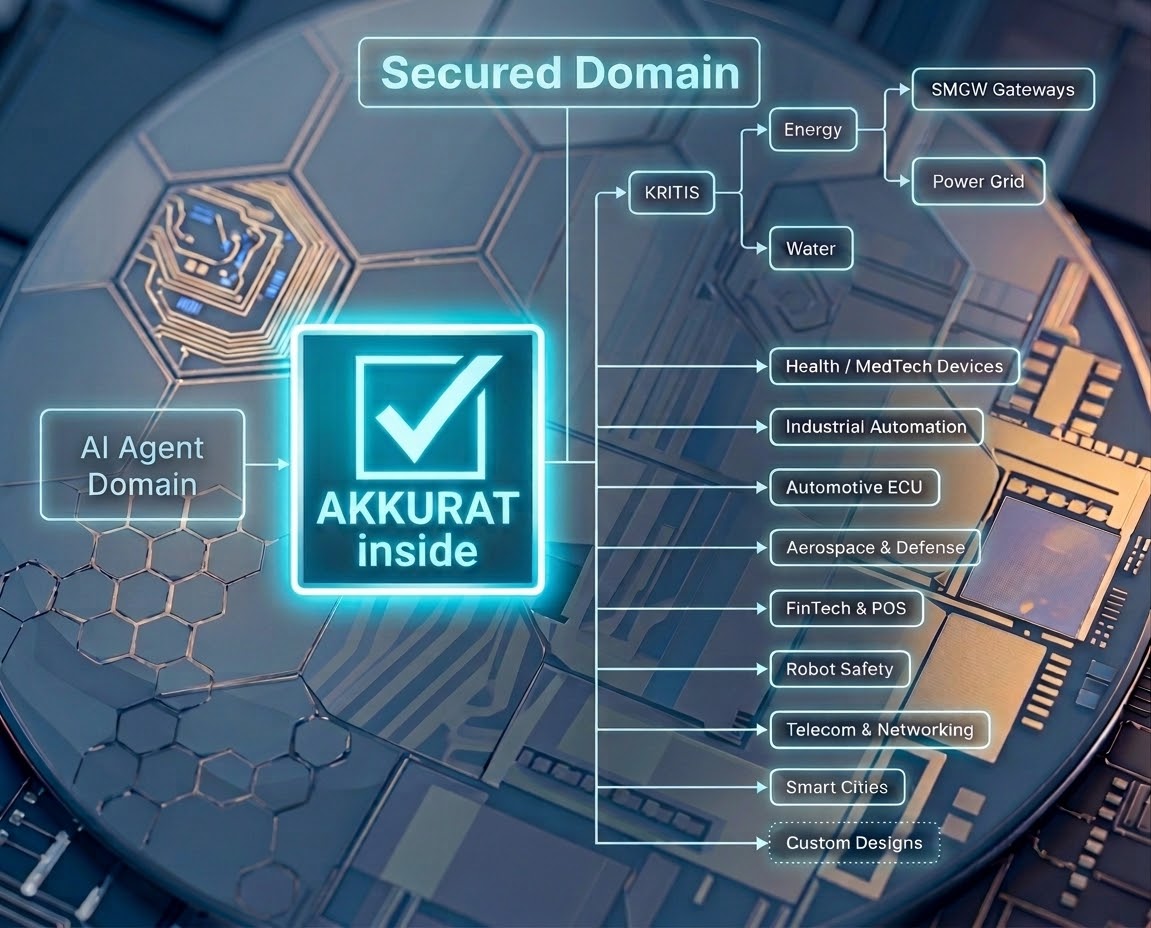
Licensable hardware security architecture for semiconductors: physical domain separation via DTI, E-Fuse and non-galvanic coupling.

AkkuratCore
Dresden (Germany)New on Amplifa
About AkkuratCore
AkkuratCore is a semiconductor IP company based in Dresden (Silicon Saxony). The company develops and licenses the AkkuratCore™ security architecture for chips in regulated environments: the application and security domains are physically separated — through Dielectric Trench Isolation (DTI) with a closed perimeter, irreversible E-Fuse fixing of the security rules during wafer test, and non-galvanic, capacitive or inductive coupling across Boundary Crossing Points. The ratio of isolation to active area (T_ratio) remains constant across all process nodes, which means the security proof is valid in a node-agnostic manner. The architecture is implemented as a System-in-Package with Island A and Island B as separate chiplets on a Security Interposer. Offerings include IP licensing, chiplet integration, design partnerships, RTL audit, tape-out support and silicon test vehicles. Application fields are critical infrastructure (KRITIS), smart meter gateways, automotive ECUs, MedTech, aerospace, robot safety and AI agent systems.
- Site
- Dresden, Germany
- Processes
- Semiconductor Security IP (AkkuratCore™: DTI, E-Fuse, BCP), Architecture licensing (IP block for SoC/SiP designs), Chiplet integration (Island B as security chiplet on Security Interposer), Design partnership / co-development, RTL audit, tape-out support, silicon test vehicle
- Materials
- Dielectric Trench Isolation, E-Fuse Axiom Fortress, Boundary Crossing Points, System-in-Package / Security Interposer, T_ratio scale invariance, RTL implementation
- Certificates
- Utility model active, European patent application in finalization, DPMA trademark registered
- Industries
- Semiconductors / Semiconductor IP, Critical infrastructure (energy, water, healthcare), Smart Meter Gateways & Power Grid, Automotive ECU, Industrial Automation, Health / MedTech
- 01
Architecture specification
- 02
RTL implementation
- 03
RTL audit
- 04
Tape-out support
- 05
Wafer test (E-Fuse fixing)
- 06
Silicon test vehicle
- 07
Customer validation
- 08
IP licensing / chiplet integration
Architecture Principles and Methods
Dielectric Trench Isolation
Separates the application domain from the security domain through a closed dielectric perimeter.
E-Fuse Axiom Fortress
Security rules are burned in during wafer test and can be altered neither by software nor by firmware.
Boundary Crossing Points
All data paths between the islands run exclusively via capacitive or inductive coupling — with no galvanic attack path.
System-in-Package / Security Interposer
Island A and Island B integrated as separate chiplets on a Security Interposer.
T_ratio scale invariance
The ratio of isolation to active area remains constant across all process nodes.
RTL implementation
The specified core architecture is transferred into a Register-Transfer-Level design.
Location
Dresden
DEPhysical design site / development
- Materials
- Semiconductor IP, RTL, SiP chiplet architecture
IP Modules and Security Components
Inside the production
Industries
Additional services
Security Proof
The architecture enforces security invariants outside software control: limits are physically sealed during wafer test, and according to the company a design audit is valid across all process nodes.
| Evidence | Dresden |
|---|---|
| Utility model active | |
| European patent application in finalization | |
| DPMA trademark registered |
History
- 2010
Stuxnet on the website as a reference for the physical consequences of software-based attacks (context reference).
Core architecture fully specified, T_ratio scale invariance formalized, RTL implementation in progress, utility model active, European patent application in finalization, trademark registered with the DPMA.