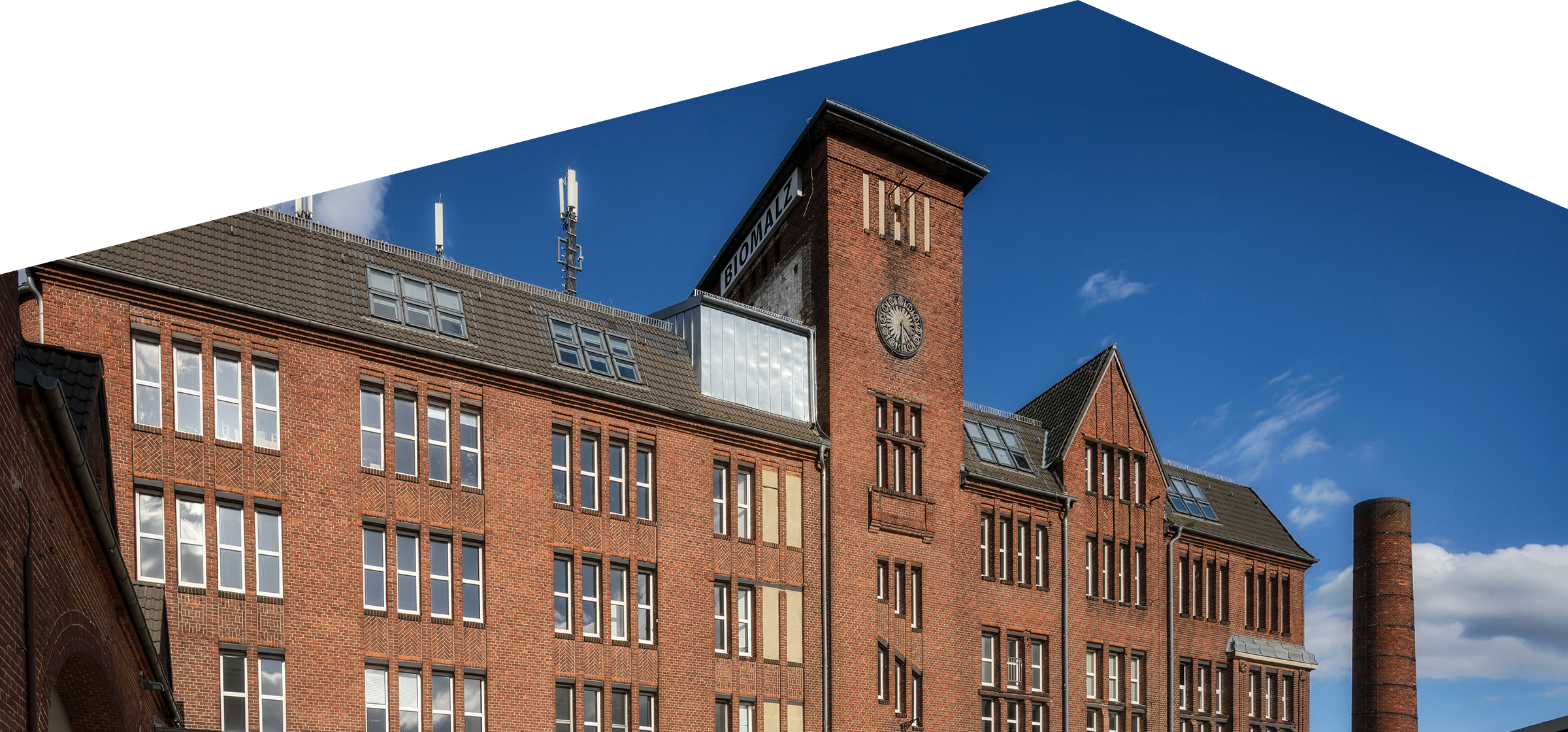
Restored historic factory complex in Teltow offering production, craft and office space to around 40 commercial tenants

BIOMALZ-Fabrik Teltow
Teltow (Iserstraße 6–10)New on Amplifa
About the BIOMALZ factory
The BIOMALZ factory in Teltow is a listed factory ensemble of red brick, today used as a modern commercial location. The facility was built in 1911 to plans by engineer J. K. Meyer as the production site of the malt factory Gebr. Patermann, which manufactured malt extracts under the Biomalz brand. After expropriation in 1953 and operation as a VEB, the property was returned to the founding family in 1991; since 2006 the existing buildings have been gently restored and equipped with modern infrastructure. The roughly 40,000 m² site on Iserstraße comprises 20 fully renovated buildings, including five listed factory buildings, as well as approximately 15,000 m² of developable land for new projects. Tenants include around 40 companies from manufacturing, craft trades, commerce and culture as well as two restaurants. The site is located in southwest Berlin, about 30 minutes from Berlin City, BER Airport and Potsdam.
- Site
- Teltow
- Processes
- Leasing of commercial space
- Founded
- 1911 (Fabr
- Industries
- Commercial real estate/leasing, (historic) food production/malt extracts
Location
Teltow
DECommercial park and leasing; administration/info office
Inside the production

Industries
Additional services
Reference customers
History
- 1906
Myro Patermann develops a malt fortifying agent in Berlin-Schöneberg
- 1907
Brand “Biomalz” registered at the Imperial Patent Office (6 May 1907); production in Friedenau, later Steglitz (Chem. Fabrik Gebr. Patermann)
- 1911
Start of production at the new factory in Teltow (Iserstraße 8–10), built by Boswau & Knauer to plans by J. K. Meyer
- 1913
Licenses granted to Switzerland; later production in Vilnius and London
- 1928
Company name: Gebr. Patermann Teltow-Berlin Biomalz-Fabrik
- 1941–1945
Supplies to the army and air force; destruction during air raids, major fire in April 1945
- 1953
Expropriation, operation becomes public property: VEB (K) Biomalz “Walter Schütz” Teltow (over 100 employees)
- 1946
Vitaborn-Werke in Kirn take over licensed production
- 1951
Death of founder Myro Patermann; continuation by son-in-law Erhard Wigand (family limited partnership)
- 1991
Restitution to the founding family (1 October 1991)
- 1994
Heritage protection for the factory buildings
- 1995
Back in the black for the first time
- 2006
Start of restoration of the existing buildings into a modern commercial location