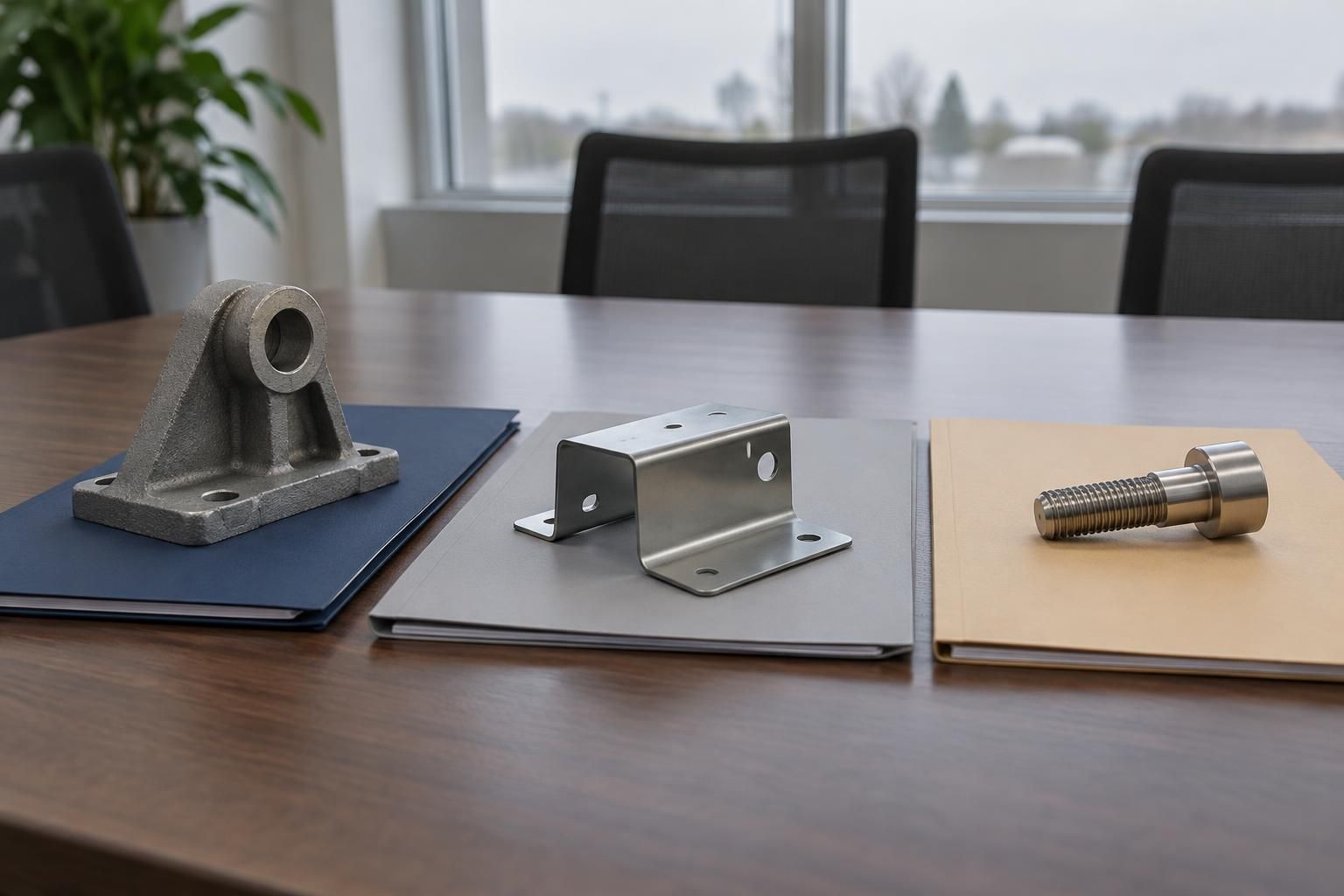
ContainmentImmediate measures for quality defence in the supply chain
Procurement glossary · Updated · 8 min read
Also known as: Interim Containment Action, Containment measure, Immediate measure, Interim Action, Emergency Reaction
Short answer
- Containment refers to the immediate containment of defective parts in order to prevent further impact on production and customers.
- Typical measures are stock blocks, 100% inspections and supplying inspected replacement parts.
- The actual elimination of the root cause follows afterwards; in the 8D process, containment is step D3.
In procurement and quality management, containment refers to the immediate containment and shielding of defective parts or processes in order to prevent further impact on production and customers. The term originates from English ("to contain") and is known primarily from fault analysis methods such as the 8D report or IATF 16949. For buyers, containment is a central instrument for maintaining supply capability during supplier quality incidents and limiting follow-on costs. The following article explains the definition, process, KPIs and practical aspects of containment measures.
Key facts
- Containment comprises all immediate measures to contain defective parts before the actual root cause analysis begins.
- Typical measures are stock blocks, 100% inspection, recall from the supplier and stockpiling of inspected parts.
- In the automotive industry, containment is an integral part of the 8D report and IATF 16949.
- Containment measures frequently cause additional costs, whose assumption should be governed contractually.
- Effectiveness is typically monitored via blocked stock, complaint rate and scrap.
- A temporary supply stoppage safeguard through inspected alternative sources reduces the risk of production stoppages.
Contents
- Definition: containment
- Methods and procedure in the containment process
- Containment within the framework of 8D and IATF 16949
- Important KPIs for steering and evaluation
- Risks, legal aspects and controls
- Current developments and digitalisation
- Typical metrics
- Practical example: containment for an assembled component
- Conclusion
- Frequently asked questions
Definition: containment
Containment is the phase immediately after the occurrence of a quality problem, in which defective parts are to be prevented from reaching further stages of the supply chain. It is expressly not about eliminating the root cause, but about shielding the customer and one's own production.
Distinction from correction and corrective action
Containment is the immediate reaction, the correction fixes the specific defect, and the corrective action permanently eliminates the cause. In practice, containment is often referred to as "Interim Action" or "containment measure". A disciplined approach separates these levels: anyone who already treats the root cause together with the stock block risks the problem recurring later. The 8D process makes this separation explicit, which is why containment appears there as the self-contained step D3.
- Containment = immediate measure
- Correction = elimination of the specific defect
- Corrective action = permanent elimination of the root cause
Significance for procurement
For procurement, a quality incident often creates a tension between supply capability and cost responsibility. Containment measures such as 100% sorting or express orders of replacement parts typically generate significant additional costs, which can contractually be reclaimed from the supplier as part of complaint management. Buyers therefore coordinate closely with quality management within procurement and keep the escalation paths to the supplier landscape analysis ready in order to examine alternative sources of supply at short notice if necessary.
Methods and procedure in the containment process
Effective containment follows a structured process: identify the problem, block suspect stock, ensure a defect-free supply and document the measures. In many industries a standardised approach is mandatory, for example in the form of the 8D report.
Immediate measures in the first hours
First, the suspect period is determined: since when could the defective part have been produced? All affected warehouse, WIP and customer stock is blocked and identified. In parallel, the requirement determination for inspected replacement parts begins, frequently via an express order with elevated priority. A clear allocation of responsibilities is important, in practice often via a designated containment leader who brings quality, logistics and procurement to the same table.
100% inspection and sorting
The most common containment measure is the 100% inspection of suspect stock against the characteristic that triggers the defect. This inspection usually takes place at the supplier before delivery (supplier sorting) or, where necessary, in one's own production. Costly but customary in critical situations is the use of external sorting services on site. Inspection instructions, inspected quantities and results are documented, as these records are later required for root cause analysis and any potential claims.
Supply safeguarding and documented release
To keep production running, inspected parts are marked on both sides or provided from a batch produced before the suspect period. A temporarily increased minimum stock of inspected parts serves as a buffer until the corrective action takes effect. Only after a validated elimination of the cause is the containment formally lifted – in practice typically after a defined number of defect-free production batches or deliveries.
Containment within the framework of 8D and IATF 16949
Containment is not an isolated tool but firmly embedded in established quality methods. Suppliers to the automotive and medical technology sectors in particular must master the procedure and document it in a verifiable manner.
The 8D report as a framework
In the 8D report, step D3 ("Interim Containment Actions") represents the containment. It is preceded by D2, the precise problem description, for example using a 5-Why or Ishikawa approach; the root cause analysis follows in D4. Relevant for buyers: the quality of the containment is often the first visible signal of how seriously a supplier takes an incident. A delayed or incomplete 8D is a valuable element for the supplier rating.
Requirements of IATF 16949 and other standards
IATF 16949 requires companies in the automotive supply industry to have demonstrable problem-solving processes, which include containment. Similar expectations are found in customer–supplier agreements in medical technology or aerospace. Procurement should anchor these requirements in quality assurance agreements (QAAs), including response times: in practice, 24 hours for the initial response and 48 hours for the first containment status report are frequently agreed.
Containment at one's own customer
As a supplier, a company may also be obliged to support containment measures at the customer – for example by providing inspection equipment, personnel for sorting campaigns or replacement for parts already installed. Procurement should know the internal responsibilities and budget lines for this so that no time is lost through coordination in an emergency. In addition, it is worth aligning with the Available-to-Promise (ATP) logic in order to reserve the stock of inspected parts bindingly for critical customer orders.
Important KPIs for steering and evaluation
Containment can be well supported by measurement. The relevant KPIs show whether the measure is working, what it costs and how the supplier should be classified in the long term.
Core KPIs during the incident
During containment, what count above all are response times (time to blocking or initial report), the quantity of blocked parts, the inspection effort in person-hours and the rate of defective parts found during sorting. The sorting rate allows an estimate of how many defective parts may already have been shipped – an important input for the customer's risk assessment.
Downstream evaluation of the supplier
After completion, the incident and response quality feed into the supplier rating. Weighting by severity, extent and recurrence risk has proven effective. If the complaint rate and scrap for a supplier rise repeatedly, this supports decisions on supplier reallocation or make-or-buy towards in-house production or an alternative source. A documented incident history can also be used as procurement leverage in future price negotiations.
Cost tracking
All additional costs – sorting personnel, inspection equipment, transport, material replacement, production downtime – should be consolidated in an incident cost statement. This serves as the basis for recovery claims against the supplier and as an argumentation basis for internal investments in prevention. In practice, these analyses show that a single serious incident frequently causes several person-days of effort in production and logistics.
Risks, legal aspects and controls
Containment carries economic and legal pitfalls. Without clear agreements, additional costs remain disputed, and without discipline in implementation, the shielding remains incomplete.
Cost assumption and contract design
Whether the supplier must bear sorting and replacement costs results from warranty, the QAA and general purchasing terms. To avoid disputes, the procurement policy should explicitly address incident costs and agree hourly rates for sorting services. Note: the enforceable claims depend on the individual case; legal details should, if in doubt, be reviewed with the legal department.
Typical implementation errors
Common mistakes are a suspect period set too narrowly, missing identification of inspected parts, incomplete stock blocks in external warehouses or for customer-owned stock, and lifting the measure prematurely. The interface with logistics is also underestimated: without coordinated delivery advice note (ASN) processing with batch reference, it is impossible to trace which delivery is affected. With call-off orders with a high call-off turnover, blocking is otherwise considerably delayed.
Preventive containment capability
Good buyers do not only ask about their suppliers' containment competence when an incident occurs, but verify it in advance – for example as part of a supplier development plan or in the audit checklist. This includes defined blocking and identification processes, the training status of employees and documented examples from previous incidents. Prepared alternative sources from a supplier landscape analysis significantly shorten the re-procurement time in an emergency.
Current developments and digitalisation
Containment increasingly benefits from digital tools: batch traceability, automated blocking logic in the ERP and standardised digital complaint processes significantly shorten the response time.
Traceability and batch management
Without batch reference, containment is blind. Modern ERP and MES systems make it possible, at the latest with delivery advice note (ASN) processing, to trace batch identity through to receipt at the customer. This allows precise blocking at batch level instead of indiscriminately across all stock – a major lever for reducing sorting and downtime costs.
Digital complaint and 8D workflows
Digital complaint portals and 8D software standardise the exchange of incident information, photos, measurement records and blocked stock between procurement, quality and the supplier. Typically, this significantly shortens response times and structures the incident history for the supplier rating. The prerequisite is that smaller suppliers can also be connected, for example via simple web forms.
Containment and resilience
In recent years, awareness has grown that rapidly available alternative sources are part of a viable risk management approach. Dual sourcing, defined safety stocks of critical parts and inspected transitional solutions act like a "preventive containment capability" for the entire supply chain. Procurement is increasingly integrating these aspects into the supplier development pipeline.
Typical metrics
| Metric | Benchmark | Context |
|---|---|---|
| Response time to initial report | ≤ 24 h | usual contractual requirement in automotive supply industry QAAs |
| Containment implementation time | ≤ 48 h | time until complete blocking and initial measure |
| Sorting rate (defect proportion in 100% inspection) | case-dependent, frequently 0–20% | indicates the scale of defects potentially already shipped |
| Effectiveness verification after correction | typically 3–30 batches/deliveries defect-free | criterion for lifting the containment |
| Recovery of incident costs | frequently 80–100% where responsibility is clear | requires contractual provision and documented evidence |
Typical practical benchmarks – they vary by industry, part and contract.
Practical example: containment for an assembled component
A medium-sized mechanical engineering company notices in final assembly that hardened gears from a supplier do not achieve the required surface hardness. Assembly is stopped for the suspect period, all warehouse and WIP stock is blocked, and the supplier is informed within hours. An external sorting service inspects the remaining stock with 100% hardness testing, while in parallel the supplier delivers from a batch documented as produced before the suspect period. The 8D report later identifies a deviant furnace temperature in the hardening process as the cause.
- Use batch documentation and ASN data to precisely narrow down the suspect period instead of blocking indiscriminately
- Supply inspected replacement parts with a temporarily increased minimum stock level and reserved ATP availability
- Document all incident costs (sorting, transport, downtime) and invoice them to the supplier
- Subsequently anchor containment expectations and response times in the QAA and include them in the supplier rating
Conclusion
Containment is the decisive first step after a quality incident and determines whether a defect remains locally contained or becomes a production crisis. For procurement, it is also a litmus test of the supplier relationship: response speed, transparency and cost assumption show how robust a supplier is. Those who anchor containment expectations contractually, verify suppliers' competence in advance and map batch traceability digitally reduce both incident costs and recurrence risks. In combination with supplier rating, complaint management and inspected alternative sources, containment thus evolves from firefighting into a steerable element of resilient procurement management.
Frequently asked questions
What does containment mean in quality management?
Containment refers to all immediate measures intended to prevent defective parts from reaching further stages of the supply chain. This includes stock blocks, 100% inspections and securing the supply of inspected parts. The actual elimination of the root cause follows afterwards in the corrective action, for example within the 8D process.
What is step D3 in the 8D report?
D3 describes the Interim Containment Actions, i.e. the immediate containment measures taken after the problem description in D2. Here, suspect stock is blocked and sorted, and customer supply is secured. Only once the containment is effective does the systematic root cause analysis begin in D4.
Who bears the costs of containment measures?
As a general rule, the customer can claim additional costs such as sorting personnel, transport or material replacement from the supplier responsible, provided the defect falls within their area of responsibility. Enforceability depends on warranty, the quality assurance agreement and purchasing terms. It is advisable to agree cost reimbursement and hourly rates contractually in advance; in individual cases, the legal department should be involved.
How long does a containment measure last?
That depends on the defect class: in practice, the initial response should occur within 24 hours, and the full containment status frequently within 48 hours. The measure remains in place until the cause has been eliminated and its effectiveness demonstrated – typically over several defect-free production batches or deliveries.
Which KPIs are relevant for containment?
During the incident, response time, blocked quantity, inspection effort and sorting/defect rates are what count. After completion, complaint rate, incident costs and response quality feed into the supplier rating. Recurring incidents can thereby support decisions on supplier reallocation or make-or-buy.
How can procurement prepare proactively for containment situations?
Important factors are defined expectations in the QAA, verified containment competence in the supplier audit, and functioning batch traceability including ASN processing. In addition, safety stocks of critical parts and known alternative sources from the supplier landscape analysis help. This significantly shortens the response time in an emergency.