OEM/ODM ModelProcurement Strategies Between Own Brand and Bought-in Products
Procurement glossary · Updated · 7 min read
Also known as: Original Equipment Manufacturer, Original Design Manufacturer, Contract Manufacturing, Private Label
Short answer
- OEM means the buying company designs the product and the partner manufactures it to specification.
- ODM means the manufacturing partner provides design and production, and the buying company sells under its own brand.
- The choice depends on core competency, volume, time pressure and risk and is made via a cost-benefit analysis.
The OEM/ODM model describes two fundamental forms of value-creation partnership between brand companies and manufacturing partners: under OEM (Original Equipment Manufacturer), a supplier produces components or complete devices to the buying company's specifications; under ODM (Original Design Manufacturer), the partner additionally takes on design and development. For buyers, this model determines how much manufacturing depth, intellectual property and supplier dependence their own company carries. The choice between OEM and ODM is therefore not a purely technical one, but a strategic procurement decision with direct implications for cost, quality and marketability.
Key facts
- OEM means: the buying company defines the product and specification, and the manufacturing partner produces to drawing.
- ODM means: the manufacturing partner contributes its own design and engineering, and the product is sold under the buying company's brand.
- As a rule: OEM offers more control; ODM offers faster market entry and lower development costs.
- Key contractual points are IP clauses, exclusivity, Engineering Change Notice (ECN) processes and framework conditions.
- The choice of model influences procurement marketing, supplier evaluation and long-term supplier strategy.
- With both models, nearshoring and offshoring shift the question of country risks and logistics costs.
Contents
Definition: OEM/ODM Model
The OEM/ODM model describes the division of labour between a brand or systems company and a manufacturing partner. It defines who is responsible for development, design, production and brand management. In practice, both variants are often combined within a supplier strategy.
OEM: Original Equipment Manufacturer
Under the OEM model, the buying company purchases a finished component or device manufactured to its specifications, drawings and test requirements. Intellectual property in the design normally rests with the buying company. The buyer bears responsibility for development, the bill of materials and the qualification of all components – the partner is a pure contract manufacturer or system supplier. Typical examples are die-cast housings, printed circuit boards made to circuit diagrams or complete assemblies built to customer specification.
ODM: Original Design Manufacturer
Under the ODM model, the manufacturing partner contributes its own, usually already proven product design and adapts it to the buying company's requirements. The buyer essentially purchases a finished concept including production and resells it under its own brand. This significantly reduces development effort and time-to-market, but shifts knowledge – and partly sales flexibility as well – to the partner. This variant is common, above all, in electronics, household appliances and industrial components with a high degree of standardisation.
Distinction from Contract Manufacturing and Private Label
Contract manufacturing largely corresponds to the OEM approach of pure contract production, while private label usually refers to the purchase of an existing ODM product under one's own brand. An intermediate stage is JDM (Joint Design Manufacturing), where the buying company and manufacturer develop jointly. A clear distinction between the terms is worthwhile for buyers, as responsibilities, liability issues and cost allocation are regulated differently depending on the model.
Methods and Approach for Choosing the Model
The decision for OEM or ODM should be made in a structured way based on technological core competency, volume, time pressure and risk. A sound cost-benefit analysis compares in-house development with external sourcing over the entire life cycle. In addition, an inventory analysis and demand planning provide the data basis for volume contracts.
Make-or-Buy as the Starting Point
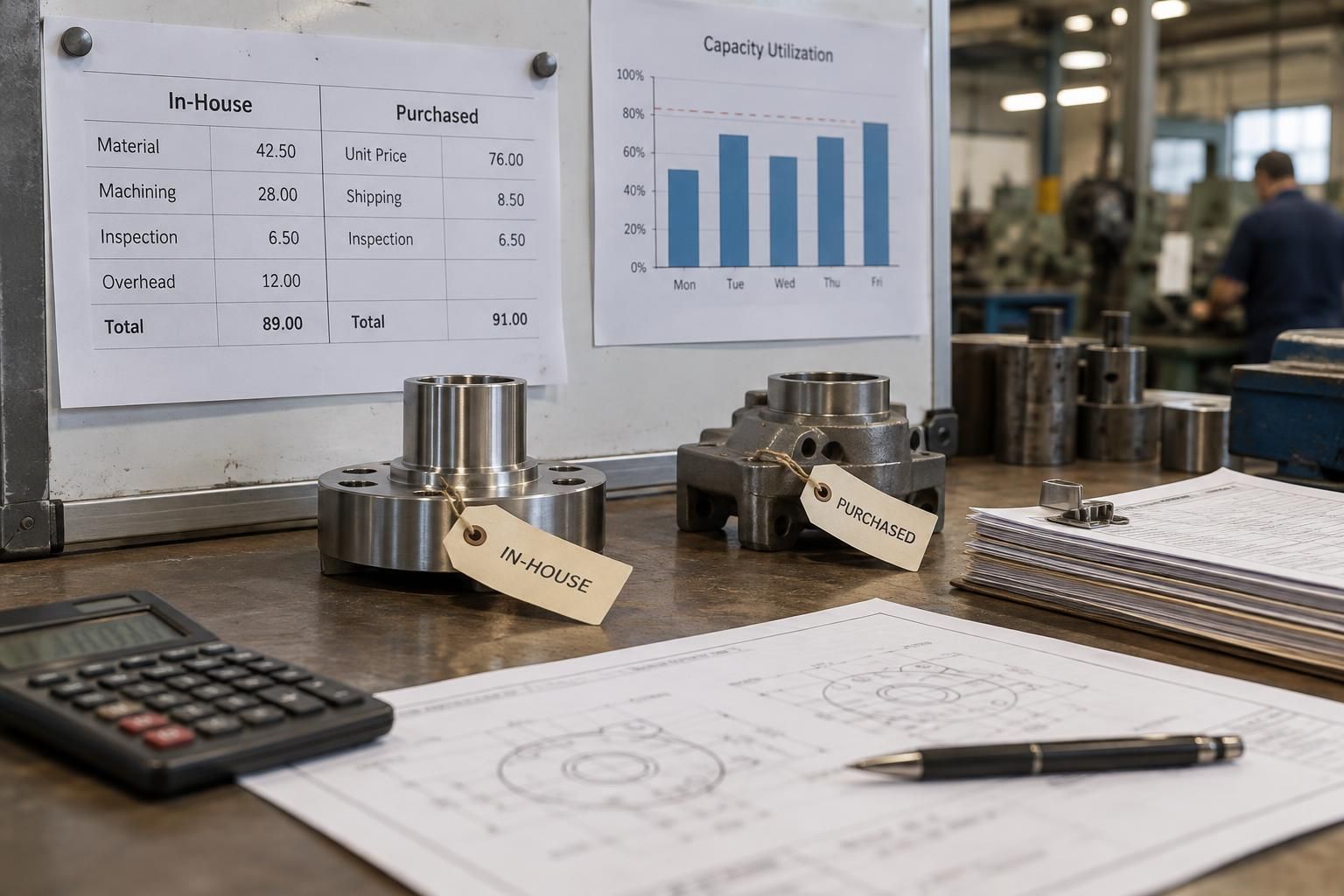
Before choosing between OEM and ODM comes the fundamental make-or-buy decision: can – or should – the product be developed and manufactured in-house? Core competencies and differentiated technologies argue for in-house production or OEM with own design. Standard products with little differentiation can be procured efficiently via ODM. A thorough cost-benefit analysis takes account not only of unit costs but also of development costs, tooling investments and quality risks.
Procurement Marketing and Supplier Search
Procurement marketing governs how potential manufacturing partners are identified, approached and qualified. With ODM, selection is particularly critical, because the partner's design know-how becomes part of the company's own value proposition. A structured request for quotation with a detailed requirement specification creates comparable offers. In international procurement, categories such as offshoring and nearshoring help to weigh cost advantages against supply chain risk.
Contractual Implementation
A framework agreement secures volumes, prices via price corridors, lead times and quality agreements over several years. Key clauses concern intellectual property, exclusivity, mandate restrictions (the ODM may not produce for direct competitors) and change management via an Engineering Change Notice (ECN). Units of measure and currency master data should also be clearly defined in the contract to avoid later friction in invoicing and price verification.
Key KPIs for Managing OEM/ODM Partnerships
OEM/ODM relationships can be managed well using quantitative metrics that are regularly incorporated into supplier evaluation. The combination of quality, delivery and cost metrics reveals at an early stage whether the partnership is meeting expectations.
Delivery and Quality Metrics
On-time-in-full delivery (OTIF) shows whether the partner meets deadlines and quantities; in practice, values above 95% are frequently set as targets. The defect rate in PPM (parts per million) measures the process quality of production. With ODM partners, first pass yield is added, because the development process is also evaluated there. Both metrics should form part of a regular target-actual comparison of price and performance.
Cost and Process Metrics
The material cost share and the cost deviation compared with the calculation show whether prices remain within the agreed price corridor. The lead time from request for quotation to order confirmation measures the partner's responsiveness. In ECN processes, the processing time for change orders is a practically relevant metric, as delayed implementation of changes directly affects costs and delivery dates.
Strategic Metrics
The degree of dependence (single-source share per ODM partner) should be monitored regularly, typically with upper limits in the double-digit percentage range per core product. Time-to-market for new variants shows how quickly the partner responds to market requirements. These metrics feed into procurement planning and the annual strategy review.
Risks and Controls in the OEM/ODM Model
Both models carry specific risks: OEM arrangements carry design and specification risks, while ODM partnerships create dependence on the partner's design know-how. Without clear control mechanisms, costs, quality and intellectual property can be put at risk.
Dependence and Knowledge Risks
The biggest strategic risk factor in the ODM model is knowledge dependence: if the buying company loses access to the design, it cannot easily have the product manufactured elsewhere. Countermeasures include contractual escrow arrangements for design data, defined transition periods and deliberate dual sourcing strategies for critical products. Even under the OEM model, a residual risk remains if the manufacturer monopolises special tooling or processes.
Quality and Change Risks
Without binding change management, manufacturers can silently alter materials or processes – with consequences for fit, approvals and customer satisfaction. An Engineering Change Notice (ECN) with formal approval by the buying company is therefore mandatory. Regular audits and a structured supplier evaluation sustainably safeguard process quality. Certification evidence (such as the EcoVadis rating for sustainability) is also increasingly part of qualification.
Financial and Legal Controls
Price adjustment clauses, currency risks in offshoring and volume flexibility should be clearly regulated in the framework agreement. Terms management with regular target-actual price comparisons prevents creeping price increases. Legally, IP clauses, liability issues and export controls are particularly critical in cross-border partnerships; the specific design should always be reviewed legally on a case-by-case basis.
Current Developments: Nearshoring, Digitalisation and Sustainability
The OEM/ODM model is influenced by geopolitical risks, digitalisation and sustainability requirements. Procurement organisations continuously adapt their partner strategies to these framework conditions.
Nearshoring as a Trend
Many companies are relocating OEM and ODM production from Asia closer to their sales markets – nearshoring as a counter-movement to classic offshoring. Short transport routes, lower upfront financing of inventory and easier audits argue in favour, even if unit costs are higher. The assessment is increasingly made via a holistic cost-benefit analysis rather than pure unit cost comparisons.
Digitalisation of Collaboration
Digital tools make it easier to manage distributed manufacturing networks: standardised item master data, for example based on ECLASS, improves data quality across the entire supply chain. Electronic requests for quotation and platform solutions shorten the supplier search. The purchase of ODM products also benefits from structured procurement guides that document specifications and quality requirements uniformly.
Sustainability and Supply Chain Transparency
Supply chain legislation and customer requirements make sustainability evidence from OEM and ODM partners a mandatory task. Ratings such as the EcoVadis rating, on-site audits and traceability of materials are increasingly part of standard qualification. Buyers should embed sustainability criteria in the request for quotation from the outset to avoid later switching costs.
Typical metrics
| Metric | Benchmark | Context |
|---|---|---|
| On-time-in-full delivery (OTIF) | > 95% | common target value in practice for OEM/ODM partners |
| Defect rate (PPM) | < 500 PPM | guideline value depends on industry and product; considerably stricter for critical parts |
| Cost deviation vs. calculation | < ±3% | indicator of price escalation or calculation errors |
| Single-source share per core product | typically < 50% | upper limit for limiting risk in cases of ODM dependence |
| ECN processing time | < 10 working days | measure of the partner's responsiveness to changes |
Typical practical benchmarks – they vary by industry, part and contract.
Practical Example
A medium-sized mechanical engineering company is developing a new control unit for special-purpose machinery. As its in-house electronics development is fully utilised, the company opts for an ODM model: a European manufacturing partner supplies an already proven base design, which is adapted to the engineering company's interface specifications. In parallel, housing production (metalworking) remains with the OEM partner in Poland, as in-house design data exists here.
- Framework agreement with a two-year term, a defined price corridor and an ECN obligation for every design change
- Contractually secured transitional rights to design data and tooling at the ODM partner
- Quarterly supplier evaluation with OTIF, PPM and cost deviation as key metrics
- Examination of a nearshoring alternative for electronics production to reduce country risk
Conclusion
The OEM/ODM model is a central structural principle of industrial procurement: it determines how development, production and brand management are divided between the buying company and the partner. OEM offers maximum control over product and intellectual property; ODM reduces development effort and accelerates market entry. The right choice depends on core competency, volume, risk appetite and time pressure, and should be made on the basis of a data-driven cost-benefit analysis. Reliable framework agreements, structured supplier evaluation and active change management secure the partnership in the long term. Those who manage the model choice and its governance professionally turn suppliers into genuine value-creation partners.
Frequently asked questions
What is the difference between OEM and ODM?
Under the OEM model, the buying company defines the product in full and the manufacturing partner produces it to drawing and specification. Under the ODM model, the manufacturing partner contributes its own product design, and the buying company sells it under its own brand. In short: OEM = own design, third-party production; ODM = third-party design and third-party production.
When is ODM more worthwhile than OEM for buyers?
ODM typically pays off for standard products with little differentiation, high time pressure or a lack of in-house development capability. It reduces development costs and time-to-market, but increases dependence on the partner. For core products with competitive relevance, OEM is usually the better choice.
What are the risks of the ODM model?
The biggest risks are knowledge dependence on the design partner, lack of exclusivity (the partner can produce similar products for competitors) and quality changes made without consultation. Countermeasures include IP clauses, binding ECN processes, audits and regular supplier evaluation. A verified second-source option also reduces the risk.
What belongs in an OEM/ODM framework agreement?
Key contents are volumes and price corridors, delivery and quality agreements, provisions on intellectual property, and exclusivity and non-compete clauses. Also important are a defined change management process via Engineering Change Notices and clear units of measure and currency master data for invoicing. Legal details should always be reviewed on a case-by-case basis.
Does nearshoring make sense for OEM/ODM?
Nearshoring reduces lead times, transport costs and country risks and makes audits easier, typically at higher unit costs than offshoring. Whether it is worthwhile is decided by a holistic cost-benefit analysis including inventory and capital costs. Many companies combine both approaches depending on product criticality.
How can OEM/ODM suppliers be managed measurably?
Best practice is a regular supplier evaluation using metrics such as on-time-in-full delivery (OTIF), defect rate in PPM, cost deviation and ECN processing time. In addition, target-actual price comparisons and audits provide transparency on performance and terms. This data feeds directly into procurement planning and the annual strategy review.