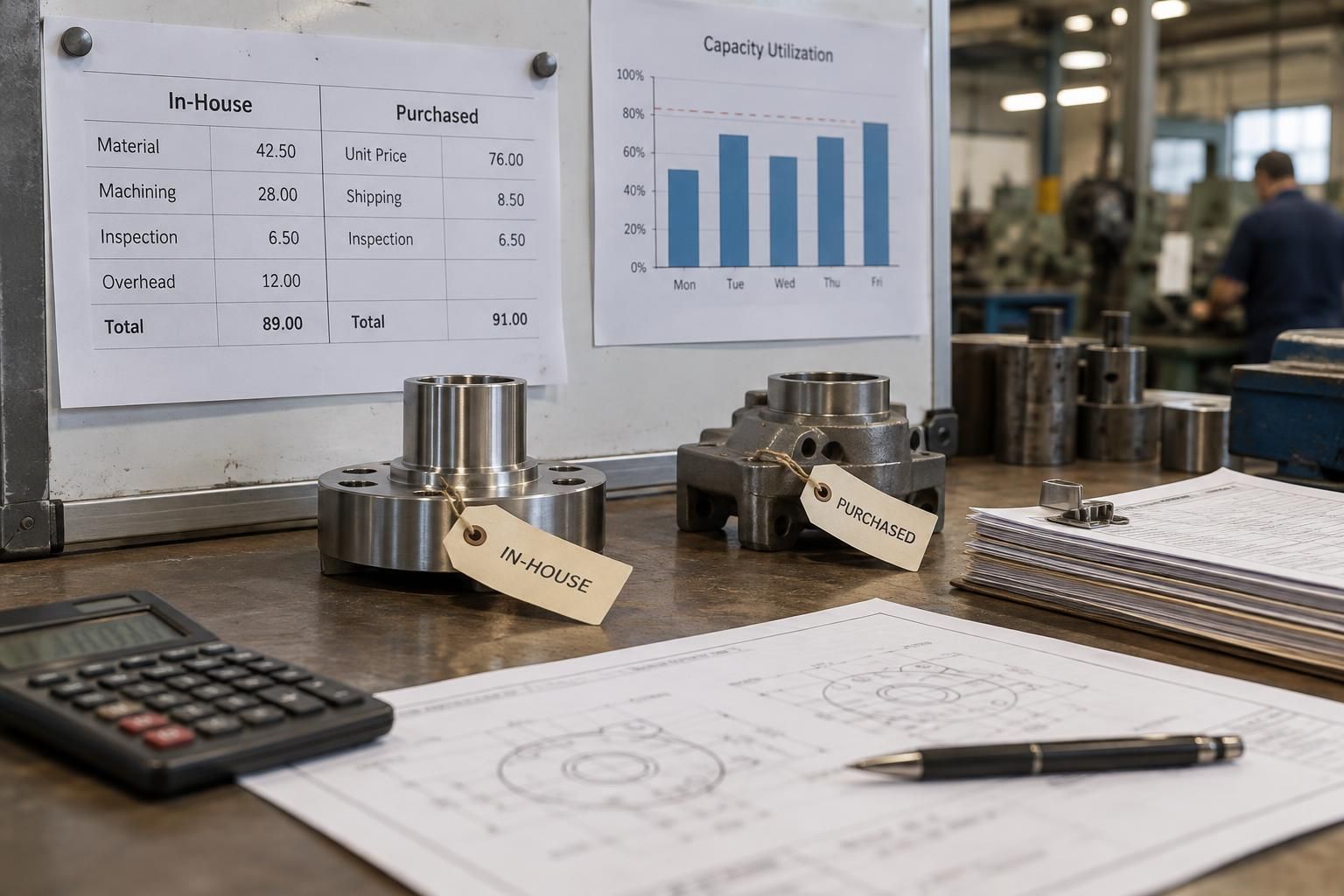
Production ControlMaking Dates, Capacities and Materials Manageable
Procurement glossary · Updated · 7 min read
Also known as: PPC, Production Control, Feinsteuerung, Shop Floor Control, Auftragssteuerung
Short answer
- Production control steers manufacturing orders in the short term with regard to dates, capacities, materials and sequences.
- It implements the production plan operationally and monitors releases, inventories and throughput times.
- For procurement, it provides requirement dates, release signals and early warnings of schedule risks.
Production control refers to the short-term steering of manufacturing orders with regard to dates, capacities, materials and sequences. It translates the production plan into concrete work queues, releases and machine allocations and forms the link between requirements determination, procurement and the manufacturing process. For buyers and suppliers it is a central information provider: it determines when and which material must be on site in line with demand. A functioning production control system reduces throughput times, tied-up capital and expensive express freight.
Key facts
- Production control converts the production plan in the short term into concrete manufacturing orders, allocations and releases.
- Core tasks are schedule planning, capacity alignment, sequencing and material availability.
- Typical KPIs are schedule adherence, throughput time, capacity utilisation and inventory in production.
- The most important control principles are kanban-based consumption-driven replenishment and order-centred scheduling board control.
- For procurement, production control provides release signals, requirements data and escalation deadlines.
- Digital systems such as MES, APS and ERP fine planning increase responsiveness and planning quality.
Contents
Definition: production control
Production control is the operational level of the production planning and control process: it plans, releases, monitors and adjusts manufacturing orders on an hourly and daily basis. It follows production planning, which determines type and quantities over a longer horizon, and draws on its framework data such as bills of materials, routings and set-up times.
Distinction from production planning
While planning defines gross requirements, lot sizes and date frameworks, control decides on the concrete sequence and release at each individual workstation. Planning typically works with weekly to monthly horizons, control with daily and shift horizons. In practice, modern ERP and MES systems map both levels in one data model, with control continuously reacting to actual data.
Tasks at a glance
Core tasks are schedule and capacity planning per order, sequencing at bottleneck machines, material provision and the monitoring of ongoing operations. In addition, backlog monitoring, resolution of schedule conflicts and the provision of information to interfaces such as purchasing, dispatch and quality management belong to the remit.
- Order release with material and capacity availability check
- Sequence and priority decision per resource
- Monitoring of target and actual dates including corrective control
Methods and procedures in production control
The choice of control method depends on the type of manufacturing, the value of the material and the order structure. In practice, three basic patterns dominate, which can also be combined.
Order-centred control (push)
In order-centred control, manufacturing orders are derived from customer orders or purchase requisitions and scheduled via the routing. A scheduling board or fine planning system checks availabilities, prioritises orders and controls releases. This method is suitable for variant manufacturing and customer-specific products, but requires clean order prioritisation so that short-notice rush orders do not pass through at the expense of overall performance.
Consumption-driven control (pull)
In repetitive manufacturing, consumption drives control: kanban cards, eKanban or consumption-based replenishment automatically trigger resupply as soon as reorder levels are undercut. This reduces planning effort and ties up stock at the point of withdrawal. Prerequisites are stable processes, reliable incoming quality and agreed delivery rhythms with suppliers.
Bottleneck and takt control
Methods such as drum-buffer-rope or takt planning orient the entire release logic around the bottleneck so that it does not incur idle times. A defined time buffer is held ahead of the bottleneck, and behind it orders are fed through in takt. For critical products with special characteristics, quality inspection steps and quality gates are additionally integrated directly into the control process so that inspection deadlines do not become schedule breakers.
Key KPIs of production control
Only what is measured can be improved. In practice, a few stable KPIs have proven their worth, used both for internal discussions and for supplier evaluations.
Schedule adherence and throughput time
Schedule adherence measures the proportion of orders completed on time; throughput time measures the span between release and completion confirmation. Both values are frequently evaluated per production area and product group. Falling schedule adherence combined with rising throughput times generally indicates bottlenecks, overload or unclear priorities.
Inventory, utilisation and remaining run time
The run-time-based inventory ratio sets work-in-progress inventory in relation to value added, while capacity utilisation shows how well resources are stretched. Open items and remaining run times per order provide operational dashboards with input for daily alignment.
KPIs from a procurement and logistics perspective
KPIs relevant to procurement are material availability, incoming quality and goods-in processing time as well as the frequency of express or special freight shipments. These figures frequently feed into a supplier scorecard or the supplier creditworthiness assessment for strategic partners and thus support the supplier development plan.
Risks and controls in production control
Control errors directly affect delivery capability, tied-up capital and contribution margins. Typical risks arise at the interfaces to planning, purchasing and quality management and can be limited by clear rules and controls.
Typical weak points
Frequent causes of control problems are unreliable actual confirmations, outdated bills of materials and set-up data, lack of capacity transparency at upstream suppliers and arbitrarily set priorities. A stocking strategy oriented solely on ABC analysis, ignoring critical C-parts with long procurement lead times, also regularly leads to production stoppages.
- Incorrect or incomplete master data leads to planning errors
- Apparent inventory due to unreported consumption or scrap
- Priority changes without coordination create chaos on the scheduling board
Controls and fallback levels
Effective controls are availability checks before every release, fixed release and confirmation disciplines and defined escalation paths for schedule risks. With single sourcing or critical system supplier relationships, safeguarding supply belongs on the checklist – for example with a contractual step-in right in the event of supplier failure or risk analyses such as bow-tie analysis for failure scenarios.
Interface to procurement
Purchasing requires reliable releases and binding requirement dates from production control; conversely, it feeds procurement lead times, order status and capacity bottleneck reports back into the control process. Regular alignment, for example within the framework of a bidder meeting or framework agreement negotiations, ensures that procurement logic and control logic do not work against each other.
Current developments in production control
Digitalisation, closer supply chain integration and fluctuating demand are changing the requirements placed on production control. Day-level responsiveness has become a competitive factor.
Digital scheduling boards and AI support
MES and APS systems now create fine plans automatically and show bottlenecks in real time. AI-based predictions improve requirements determination and sequencing, among other things, but do not replace ongoing alignment in production management. What is decisive are clean master data and standardised interfaces, for which classification systems such as ECLASS create a consistent material description.
Supply chain integration and supplier enablement
Upstream suppliers are increasingly being integrated directly into the control process: shared demand forecasts, eKanban connections and electronic schedule adherence reports increase plannability on both sides. Supplier enablement in this context means equipping suppliers with the necessary data and processes so that they can plan ahead. In international projects or advance payment and letter of credit transactions, payment and provision dates shift additionally, which must be factored into schedule planning.
Resilience instead of pure optimality
The current debate focuses less on theoretically optimal plans than on robust control under disruption: buffer capacities, second sources, defined escalation levels and a well-maintained supplier shortlist pool for rapid alternative sourcing are gaining in importance. Early payment discount calculations and flexible price commitments for urgent requirements are also aligned with control-related express freight frequencies.
Typical metrics
| Metric | Benchmark | Context |
|---|---|---|
| Manufacturing schedule adherence | > 95 % | Proportion of orders completed on time; varies depending on type of manufacturing |
| Material availability | > 98 % | Proportion of released orders without material-related stoppage |
| Goods-in processing time | < 24 hours | From lorry to booking; often considerably shorter for A-parts |
| Work-in-progress ratio | 5–10 days of value added | Typical benchmark for series production; higher for one-off production |
Typical practical benchmarks – they vary by industry, part and contract.
Practical example
A medium-sized mechanical engineering company manufactures customer-specific special machines in one-off production with an external manufacturing share of around 40 per cent. After several production stoppages due to missing bought-in parts, production control was restructured: the scheduling board was linked to material availability, critical parts were classified according to ABC analysis and procurement lead time, and upstream suppliers were connected via eKanban.
- Availability check as a mandatory criterion for order release
- Classification by ABC analysis plus criticality, with a derived stocking strategy
- Weekly capacity and schedule alignment with the three most important system suppliers
- Introduction of a goods-in processing time target of under four hours for A-parts
Conclusion
Production control is the nervous system of manufacturing: it determines whether plans become on-time deliveries. For buyers, it is less an internal manufacturing topic than a direct provider of value – it supplies requirements, releases and schedule risks to which procurement must respond. Those who interlock control logic and procurement logic reduce inventory, express freight costs and delivery delays at the same time. Prerequisites are clean master data, measurable KPIs and close alignment with strategically important suppliers. Investments in digitalisation and supply chain integration typically pay for themselves through more stable schedule adherence and lower tied-up capital.
Frequently asked questions
What does production control do?
Production control converts the production plan into concrete manufacturing orders: it releases orders, schedules dates and sequences, checks capacity and material availability and monitors ongoing operations. In the event of disruptions it takes corrective action and escalates risks to planning, purchasing or sales. The aim is on-schedule production with the lowest possible inventories and idle times.
What is the difference between production planning and production control?
Production planning determines on a medium- to long-term basis what is manufactured, in what quantities and within what time frame – for example via gross requirements, lot sizes and rough-cut dates. Production control works on a short-term basis, deciding on a daily or per-shift basis about releases, sequences and resource allocations. Both levels draw on the same master data but respond to different horizons.
Which KPIs are important in production control?
Key KPIs are schedule adherence (on-time delivery), throughput time, capacity utilisation, inventory in production and material availability. Incoming quality and goods-in processing time are also relevant, as upstream suppliers directly influence production dates. In practice these figures are evaluated per production area and product group and discussed in regular alignment meetings with purchasing and suppliers.
How does production control relate to Kanban?
Kanban is a consumption-based replenishment method and thus a control principle within production control: consumption at the point of use triggers replenishment without a planner actively creating an order. This is particularly suitable for repetitive manufacturing with stable demand. For variant-rich one-off production, order-centred control via a scheduling board or fine planning system remains the usual approach.
Why is production control relevant to procurement?
Production control provides purchasing with binding requirement dates, release signals and early warnings of schedule risks. Without this information, procurement plans blindly, which leads to excess stock or production stoppages. Conversely, procurement lead times, order status and supplier capacities must flow back into the control process so that plans remain realistic.
What software is used for production control?
Typical solutions are ERP systems with fine planning modules, dedicated MES systems for machine data and confirmations, and APS systems for demanding capacity and sequence planning. The choice depends on the type of manufacturing, variant diversity and degree of integration. More important than the product itself is usually data quality: without well-maintained bills of materials, routings and actual confirmations, any software remains an expensive calculating scheme.