Small batch productionflexible lot sizes between prototype and series
Procurement glossary · Updated · 8 min read
Also known as: Kleinserie, Kleinauflage, Kleinserienproduktion, Small Batch Production, Low Volume Production
Short answer
- Small batch production is the manufacture of small to medium lot sizes, typically between around 10 and 2,000 units in practice.
- It sits between prototype and volume production, meaning set-up and tooling costs strongly influence the unit price.
- For buyers, the choice of flexible suppliers with short changeover times and ramp-up competence is decisive.
Small batch production refers to the manufacture of quantities typically between a few dozen and a few thousand units per order. In the DACH industrial environment it is the normal state for spare parts, special machinery, medical technology and the early phases of a production ramp-up (SOP). For procurement professionals it requires dedicated strategies, because unit price, cost-effectiveness and supplier selection differ from volume production.
Key facts
- In practice, small batches frequently involve lot sizes of around 10 to 2,000 units per order.
- Unit prices are significantly above volume production levels, as set-up and tooling costs are allocated to only a few parts.
- Typical processes are CNC manufacturing, injection moulding with aluminium tools, laser cutting and 3D printing for bridge parts.
- Supplier selection determines set-up competence, changeover times and process stability under changing orders.
- Procurement professionals often manage small batches via framework agreements, call-off control and a clean purchase requisition (PR).
- The handover to volume production requires defined approval processes up to series release.
Contents
Definition: small batch production
Small batch production is the repetitive manufacture of components or assemblies in small to medium lot sizes that are too small for classic mass production and already too large for single-unit/prototype manufacturing. The term does not describe a fixed quantity, but a manufacturing category in which set-up time, lot size optimisation and flexibility determine cost-effectiveness.
Distinguishing from prototype and volume production
The prototype tests function and feasibility; the small batch validates process, cycle time and quality at real quantities. Only then does volume production follow with optimised tools, high quantities and low marginal costs. In practice the boundary is fluid: manufacturing departments often speak of small batches from around 10 to 50 units and regard series sizes from several thousand units as regular series production. For procurement, the number matters less than the question of whether tooling costs, set-up effort and material procurement remain manageable.
Typical use cases
Small batches dominate in special machinery engineering, medical technology, rail and special vehicle construction as well as spare parts supply for established systems. Market validation of new products is also frequently carried out via a small batch before investments in injection moulding tools or automated lines are approved. In every case, the buyer needs a sound purchase requisition (PR) with clear quantities, deadlines and technical documentation so that suppliers can calculate realistic prices.
Significance for technical procurement
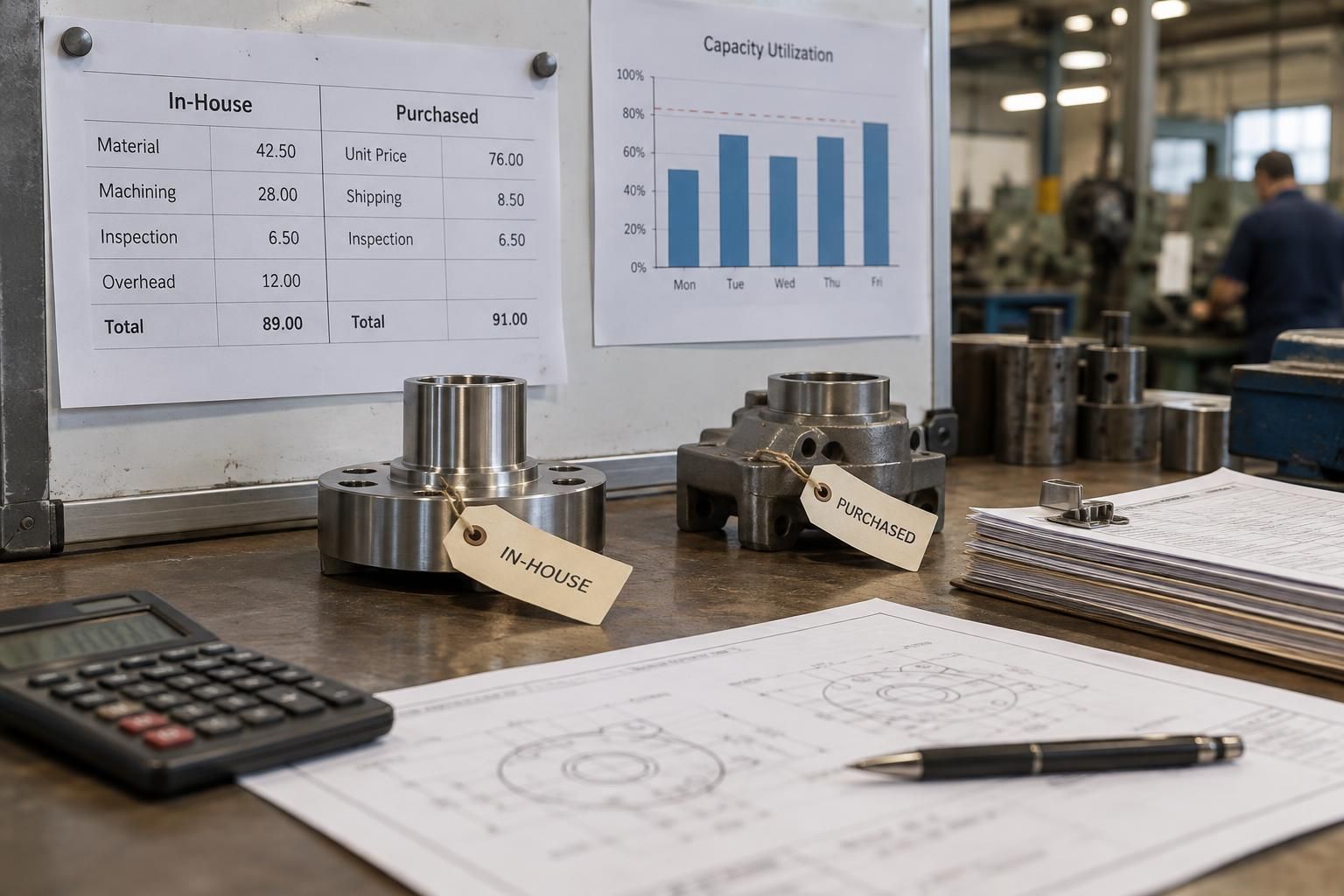
For procurement professionals, small batch production is both a capacity and a competence question: small quantities mean little leverage in price negotiations, but all the more leverage in selecting flexible partners. A structured make-or-buy analysis shows which parts remain in-house production and which go to specialised suppliers. Since quantities fluctuate per project, procurement is closely coupled with the sales forecast and production planning.
Methods and approach for procuring small batches
The procurement process for small batches follows the same basic rules as for volume production, but shifts the emphasis: set-up times, changeover competence and ramp-up support are important criteria alongside the unit price. A disciplined approach from demand determination to release prevents expensive ramp-up problems.
Demand determination and tendering
The starting point is a cleanly specified purchase requisition (PR) with drawings, tolerances, material specifications and target quantity. On this basis, procurement creates a supplier longlist, filters by manufacturing process and capacity, and sends enquiries to three to five relevant suppliers. For manageable lot sizes, a reverse auction can also make sense, though in practice usually only for standardised parts without complex ramp-up requirements.
Supplier selection and onboarding
Alongside price and delivery date, ramp-up competence, measuring equipment and the willingness to accept small lot sizes with short changeover times are decisive. A structured supplier onboarding secures qualification, certificates and communication channels such as a supplier portal through which drawing statuses, call-offs and notifications are handled. For new suppliers, a piloted first delivery with extended inspection effort is recommended before regular call-offs are released.
Contract and call-off control
Framework agreements with fixed unit prices over a term and flexible call-off quantities have proven effective, often supplemented by price escalation clauses for material costs. Delivery terms are defined unambiguously via Incoterms CPT or similar rules, clarifying the transfer of cost and risk up to the place of destination. Order release should be organised in tiers depending on order value, so that short-notice call-offs do not fail due to lengthy release procedures.
Manufacturing processes and cost-effectiveness
The choice of process determines unit price, lead time and scalability. Good buyers already check during the enquiry whether the chosen process can later be transferred to volume production or whether a costly process change looms.
Machining, sheet metal and additive processes
CNC machining is the standard for metal small batches from just a few units, as no tooling costs are incurred and changes can be implemented quickly. Sheet metal fabrication with laser cutting and bending delivers small lots flexibly, while additive manufacturing can handle complex geometries and bridge parts economically until tooling is available. In practice, several processes are quoted in parallel because the optimal choice varies considerably depending on geometry and quantity.
Tooling strategies in injection moulding
For plastic parts, an aluminium prototype tool typically reduces tooling costs significantly compared with steel tools, but has a shorter tool life. Many suppliers offer two-stage models: a fast small batch tool for market validation, then a transition to a series tool with an adapted mould design. Procurement should have transition costs, changeover effort and deadlines of both stages included in the quotation.
Lot size optimisation and cost drivers
The main cost drivers are set-up times, small-quantity material procurement and special inspections. In practice, the unit price can often be reduced through part families with shared set-ups, standardised materials and matching paints, and by consolidating several PRs into one consolidated order. A spend analysis across all small batch orders reveals which parts are procured repeatedly and thus offer potential for framework agreements.
Important KPIs in small batch production
Managing small batches requires metrics that capture flexibility and ramp-up quality rather than merely comparing unit prices. A small, consistently used selection of KPIs is more effective than extensive reporting without consequences.
Delivery and scheduling metrics
Delivery reliability and replenishment lead time are key metrics, because short-notice call-offs are the norm. In addition, the changeover time per article change shows how flexible a supplier really is. Both values can be derived directly from order data and factored into supplier evaluations.
Quality and ramp-up metrics
First pass yield, scrap rate and the number of reworks during ramp-up show how stable the process runs for small lots. For repeated deviations, an Ishikawa diagram helps to systematically separate causes and derive effective measures. Ramp-up metrics should be monitored particularly closely during transition phases up to series release.
Cost and process metrics
Alongside unit price, total cost of ownership, the share of urgent orders and planning adherence to the sales forecast count. In interplay with the S&OP cycle and capacity planning, it becomes apparent early when small batch orders compete with volume production orders for the same capacity. A well-maintained procurement data model ensures that these metrics remain comparable across projects.
Risks and controls
Small batches carry specific risks: smaller suppliers with limited depth, changes between lots and the temptation to neglect quality in favour of speed. Structured controls keep these risks manageable.
Quality assurance for small lots
Sampling plans based on classical statistical principles are of limited use for small lots; often each lot is inspected fully, or first and last article inspections are used. Metrological first-article assessment and documented series release criteria prevent process changes between lots from going unnoticed. What is essential is well-maintained specification management so that drawing statuses and inspection plans remain consistent across all lots.
Dependencies and transition risks
For critical parts, there is a risk that specialised small batch suppliers become de facto monopolists because second-source and sampling approaches are lacking. Procurement should maintain at least qualified dual sources or documented emergency production options. During the transition to volume production, schedule losses threaten if toolmaking and sampling phases are not planned in parallel; here a clean production ramp-up (SOP) with defined milestones helps.
Compliance and documentation
For cross-border procurement, customs and statistical reporting obligations must be observed; in the EU this includes, among other things, Intrastat reporting for goods movements within the Union. Terms such as early payment discount calculation can be used well for small batches to preserve liquidity, provided the payment terms are weighed against supplier risk. All approvals and changes should be documented in an audit-proof manner, especially in regulated industries.
Current developments
Digitalisation and market consolidation are noticeably changing small batch production. Buyers who know the right levers can achieve faster lead times and better prices even for small quantities.
Digital platforms and marketplaces
Online marketplaces for manufacturing services enable instant quotes for CNC and sheet metal parts and reduce the enquiry time from weeks to days. This relieves procurement of standard parts, but does not replace supplier development for critical components. A tiered approach makes sense: platform for simple parts, managed tendering for safety-relevant components. The data quality of the enquiry, measurable for example via a data quality score, determines the validity of the instant quotes.
Additive manufacturing and automated toolmaking
Additive processes using steel and high-performance plastics push the lower economic threshold for lots further down; parts that were previously milled are increasingly economically 3D printed in practice. At the same time, automated toolmaking processes shorten the lead time for small injection moulding tools. For buyers this means: regularly re-evaluate process alternatives rather than sticking to established allocations.
Resilience and sustainability
Supply chain disruptions have increased the willingness to source even small batches regionally, even if the unit price is higher. Circular economy aspects such as second-life use of components and tools are gaining importance, especially for spare parts supply for long-lived systems. In practice, the evaluation is thus shifting further away from the pure unit price towards total cost and security of supply.
Typical metrics
| Metric | Benchmark | Context |
|---|---|---|
| Delivery reliability | > 95% | Critical for short-notice small batch call-offs; below 90% signals control problems. |
| Replenishment lead time | 2–8 weeks | Depending on the process; CNC and sheet metal considerably faster than injection moulding with tooling. |
| First pass yield | > 90% | Measures ramp-up quality; to be monitored closely during ramp-up to series approval. |
| Changeover time per article change | < 60 minutes | Benchmark for set-up-optimised suppliers; determines the unit price for small lots. |
| Scrap rate | < 2% | Orientation value for stabilised small batch processes; higher acceptable during ramp-up. |
Typical practical benchmarks – they vary by industry, part and contract.
Practical example
A medium-sized manufacturer of special machinery needed 150 aluminium housing parts for a customer-specific system. Instead of issuing a single tender, procurement consolidated five open small batch orders with similar materials into one consolidated request.
- Comparison of CNC machining, die casting with prototype tool and sheet metal fabrication per part family
- Framework agreement with fixed unit prices over 24 months and flexible call-offs
- First and last article inspection per lot with defined series approval criteria
- Connection of the supplier to the supplier portal for call-offs and inspection reports
Conclusion
For many industrial buyers, small batch production is the rule rather than the exception. It is managed successfully by those who openly compare process alternatives, select suppliers based on ramp-up competence and intelligently consolidate small lots. A clean data foundation, tiered release processes and robust framework agreements significantly reduce effort and risk. Those who plan the transition to volume production early avoid expensive duplicate investments. What may seem like a niche topic thus becomes a measurable lever for cost, schedule and security of supply.
Frequently asked questions
What is meant by small batch production?
Small batch production is the repetitive manufacture of parts in small to medium lot sizes, in practice often between around 10 and 2,000 units. It sits between prototype and mass production. Typical characteristics are higher unit prices and a significant impact of set-up times on cost.
From how many units is a production run considered a small batch?
There is no universally binding threshold; industries and manufacturing processes define the term differently. A range of around 10 to 2,000 units per order is commonly considered a small batch. What matters is less the absolute number than the ratio of set-up and tooling costs to the lot size.
Which manufacturing processes are suitable for small batches?
Typical processes are CNC machining, sheet metal fabrication with laser cutting, injection moulding with aluminium prototype tools and additive manufacturing. The choice depends on geometry, material, tolerances and quantity. In practice, several processes are usually quoted in parallel to identify the most cost-effective route.
Why are small batches so expensive?
Set-up times, tooling costs and inspection effort are spread over only a few parts, which significantly increases the unit price. Small-quantity material procurement and special requirements exacerbate this effect. Part families, consolidated orders, standardised materials and selecting set-up-optimised suppliers provide remedies.
How do you find suitable suppliers for small batches?
A proven approach is a structured search by manufacturing process and industry, starting with a supplier longlist followed by tendering to three to five suppliers. Alongside price, ramp-up competence, changeover times and quality capability count. Digital manufacturing platforms work well for standard parts; for critical components, targeted supplier development remains important.
How does a small batch transition into volume production?
The transition follows a defined production ramp-up with process validation, sample submission and formal approval for series production. Tooling and process investments are approved on the basis of the small batch results. Parallel planning of toolmaking and qualification is important to avoid a supply gap.