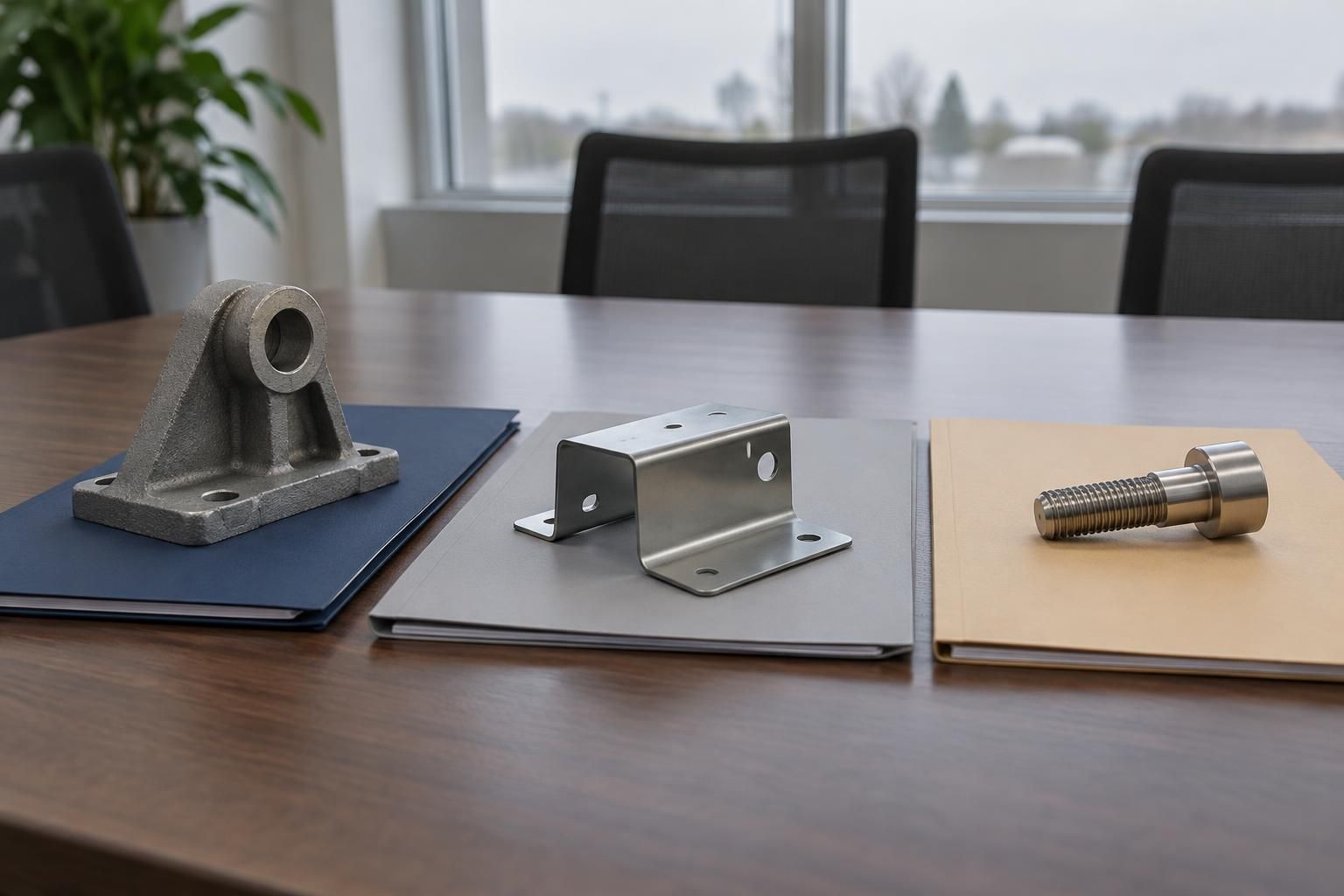
Contract for workfundamentals for technical procurement in the supply industry
Procurement glossary · Updated · 9 min read
Also known as: Werkliefervertrag, Werkvertrag BGB, Werkvertragstyp, contract for work
Short answer
- A contract for work is the contract for the production of a specific outcome against remuneration (§ 631 BGB).
- Remuneration typically becomes due upon acceptance of the work, after which the warranty phase begins.
- In technical procurement, it concerns above all contract manufacturing, maintenance and plant services – specification and acceptance must therefore be regulated precisely in the contract.
The contract for work is a central contract type under German law of obligations and governs the production of a work outcome against remuneration. For buyers in the manufacturing and supply industry, it is the typical contractual basis for contract manufacturing, maintenance services, plant construction and complex engineering contracts. Compared with procurement contracts involving purely the purchase of goods, it differs above all through the promise of success: what is owed is not the mere delivery of an item, but an agreed work result. Those who master the particularities of the law on contracts for work can control risks relating to warranty, acceptance and remuneration contractually at an early stage.
Key facts
- The contract for work obliges the contractor to produce an agreed outcome, not merely to supply an item.
- The legal basis in Germany is § 631 et seq. BGB; for consumer contracts, additional provisions on consumer goods sales apply.
- Acceptance is the legally key moment: it frequently establishes the due date of remuneration and the transition into the warranty phase.
- Typical use cases in B2B procurement are contract manufacturing, maintenance, plant installation and engineering services.
- Demarcation questions vis-à-vis contracts of sale and services are often defused in practice contractually through harmonised clauses.
- From a tax perspective, the place of supply is important, as it influences VAT liability and invoicing; the individual case should be reviewed.
Contents
- Definition: contract for work
- Use cases and demarcation in technical procurement
- Key topics of contract negotiation
- Contract for work in sourcing and supplier management
- Risks, controls and typical pitfalls
- Current developments: digitalisation and procurement practice
- Typical metrics
- Practical example
- Conclusion
- Frequently asked questions
Definition: contract for work
A contract for work is a contract under which the contractor undertakes to produce a promised work in return for remuneration owed by the customer. What is required is a specific outcome which the contractor brings about under its own responsibility. The contract for work is regulated in §§ 631 to 650 BGB and is one of the principal performance types of the BGB.
Legal basis
The core provisions are § 631 BGB (contract type) and the subsequent provisions on remuneration, performance, acceptance and warranty. For works involving construction services, special provisions apply; for consumer goods sales, additional protective provisions apply. In B2B relationships, the parties may deviate from many of these provisions, which is consistently exploited in technical procurement, for example through standard terms with uniform acceptance and warranty rules.
- § 631 BGB: obligation to produce the promised work
- § 632 BGB: due date of remuneration, closely linked to acceptance
- § 633 et seq. BGB: defect rights and warranty
Demarcation from contracts of sale and services
Under a contract of sale, an already existing or simply ordered item is supplied; under a contract for work, the outcome to be produced takes centre stage. Under a contract for services, the activity itself is owed, irrespective of the outcome. In practice the boundary is fluid: the manufacture of an item to drawing is regularly classified as a contract for work, pure consulting or support services as a contract for services.
- Contract for work: promise of success (e.g. a manufactured component)
- Contract of sale: transfer of an item
- Contract for services: owed activity without guarantee of success
Use cases and demarcation in technical procurement
For buyers in the manufacturing industry, the contract for work is the standard contract for everything that is manufactured, inspected or serviced on the basis of technical specifications. It forms the legal basis of contract manufacturing, in which a supplier works to drawing or spec. Maintenance, installation and engineering also typically fall under the contract for work type.
Contract manufacturing and supplied parts
In contract manufacturing, the customer often supplies material, drawings and inspection specifications; the manufacturer owes conforming parts. Legally, this is generally a contract for work with delivery of parts. Important are clear specifications, agreed inspection formats for incoming goods quality and provisions on the provision of material. Integration into the sourcing process should ensure that drawing revision status, material master attribute maintenance and the declaration of conformity are consistent.
- Fix drawing revision status and revision index in the contract
- Define responsibility for inspection and measuring equipment
- Regulate customer-supplied material and obsolescence risk
Maintenance, installation and plant construction
Service contracts for maintenance, repair or plant conversion are classic contracts for work, often with escalation rights to secure performance when a line stop threatens. Here the contractual design gains in importance: response times, spare parts availability and available-to-promise (ATP) checks at the supplier should be bindingly promised. For critical plant, it is additionally advisable to look at the stock coverage of one's own spare parts.
- Response and on-site times as contractual obligations
- Spare parts availability and stock-keeping obligations
- Escalation levels for downtime-critical faults
Contract architecture: framework agreement and individual orders
In serial and project business, buyers frequently combine a framework agreement and call-off orders – the characteristics of a contract for work then exist at both levels. This corresponds to the well-known tension between spot buying vs. framework agreement: flexible individual orders for fluctuating demand, plannable terms and capacities for regular orders. Remuneration formulas, capacity commitments and quantity corridors belong in the framework; details such as deadlines and lot sizes in the call-off.
Key topics of contract negotiation
In day-to-day procurement, the contract for work is rarely concluded from the blank BGB template, but via standard terms, a requirement specification and specific supplementary agreements. The quality of negotiation determines later dispute costs. A structured negotiation record secures agreements in documented form and prevents conflicts of interpretation.
Specification of work and specification
The heart of every contract for work is the precise description of the owed outcome: drawings, tolerances, standards, inspection plans and documentation requirements. Unclear specifications are the most common cause of renegotiations and claims for additional costs. The buyer should align the technical specification with design and quality before an enquiry is issued as part of RFX in procurement.
- Drawing and standards list as part of the contract
- Binding inspection planning and obligation to report measurement results
- Change service (engineering change) with cost logic
Remuneration, price logic and payment terms
Remuneration may be a fixed price, a preliminary calculation with evidence or a combination of material and manufacturing costs. Fixed prices provide planning certainty, but only with stable specifications. Payment terms, early payment discounts and payment milestones (e.g. in plant projects based on construction progress) are fixed contractually. For cross-border deliveries, ADR-relevant dangerous goods issues and Incoterms must be included in the pricing logic.
- Fixed price with a clear spec, evidenced calculation when close to development
- Milestone payments with technical acceptance criteria
- Price adjustment clauses with a clear formula and index
Acceptance and warranty
Acceptance marks the transition from production to liability for defects. It should be documented informally: inspection report, open points with deadlines, release note. The warranty period can be shortened contractually in B2B; in practice, one to two years are common, but case-by-case review remains necessary. Likewise, it should be determined who bears the costs of rectification, removal and refitting, and the consequences of downtime.
Contract for work in sourcing and supplier management
Contracts for work are not an isolated legal topic but part of the entire supplier life cycle. From supplier self-assessment via supplier rating to supplier development, supplier quality and stability influence whether the agreed work is actually produced with the agreed quality and on schedule.
Qualification before contract conclusion
Before the contract is concluded, the supplier's process capability for the specific characteristics of the work should be examined, particularly for safety-relevant or tolerance-critical parts. Certification evidence, references and the declaration of conformity for relevant products are documented. This phase is part of the sourcing process and is also supported by targeted procurement marketing in order to identify suitable suppliers of work at all.
Control during the term
In the serial phase, buyers continuously evaluate contract-for-work partners via a supplier rating: incoming goods quality, on-time delivery, lead time variability and responsiveness. A second source threshold helps ensure that critical work services are not lost to a single provider. Where deviations persist, targeted supplier development is launched instead of short-term switching, provided the tie-in is economically justifiable.
- Supplier rating with quality and logistics components
- Second source from a defined criticality value
- Joint improvement projects for process stability
Innovation and collaboration
Contracts for work offer scope for collaboration beyond mere manufacturing, for example within the framework of supplier co-innovation on functional integration or material alternatives. Such initiatives need clear rules on intellectual property, exploitation rights and remuneration of preliminary services. Those who regulate this in the contract for work avoid later blockages at the transfer to serial production.
Risks, controls and typical pitfalls
The main risks in a contract for work lie in vague specifications, unclear acceptance practice, delivery date risks and tax errors in cross-border services. Systematic controls significantly reduce these risks and cost only a fraction of later dispute costs.
Quality and schedule risks
Defects in the work often only become apparent during assembly or at the end customer – by which time the follow-on costs are high. Preventive effects come from defined first article sampling processes, ongoing incoming goods quality checks and contractual rights to process audits. In terms of deadlines, lead time variability should be monitored; creeping extensions are an early warning indicator of capacity or material problems at the contractor.
- First article acceptance before release for serial production
- Anchor audits and process capability evidence contractually
- Assess date trend and variability monthly
Taxes, customs and documentation
For cross-border work services, the place of supply is relevant for VAT; whether the customer is treated as the recipient of the service liable for VAT depends on the constellation. Customs tariff classification and rules of origin also influence costs and admissibility. These points are highly sensitive and should always be reviewed with tax or customs advice on a case-by-case basis. Formally, the master data process demands clean supplier and material data, including material master attribute maintenance, in order to correctly map invoices and goods movements.
Organisational hygiene
Contract amendments should run through documented change requests; verbal agreements at the tool or on the line are a frequent source of disputes. Every negotiation round of substantive significance is recorded in the negotiation record. Changes to master data, specifications or contacts run through a controlled master data process, not via e-mail chains of individual participants.
Current developments: digitalisation and procurement practice
The subject of contracts for work is changing less through legal amendments than through the digitalisation of procurement processes: contract data is systematically maintained, services are tendered via platforms and supplier evaluations automated. Buyers benefit when contract-for-work topics are interlinked with operational processes.
Digital enquiry and contract processes
Structured enquiry processes such as RFX in procurement make requirements comparable and accelerate the selection of contract-for-work partners. Digitally supported ordering processes reduce the ordering cost per transaction and increase data quality for later evaluations. Contract management systems help track deadlines, acceptances and warranty periods on time.
Resilience and procurement strategy
Following the experiences of recent years, procurement is placing a stronger focus on supply capability: stock coverage of critical works, alternative sources and clear emergency processes. Supplementary instruments such as a consignment agreement can secure material availability at the supplier's warehouse, but also change the contractual allocation of risk. The choice between short-term spot buying vs. framework agreement is increasingly made on a data-driven basis depending on demand certainty.
Sustainability and evidence obligations
Contracts for work are increasingly being linked to sustainability requirements: CO2 data, proof of origin and social standards. The supplier self-assessment is frequently extended to include these topics. It is important to integrate such requirements measurably and verifiably into the specification of work rather than formulating them as a non-binding declaration of intent.
Typical metrics
| Metric | Benchmark | Context |
|---|---|---|
| Incoming goods quality (PPM) | < 500 PPM | usual benchmark for serial parts; significantly stricter for critical characteristics |
| On-time delivery | > 95% | share of on-time work deliveries within the period |
| Lead time variability | < ± 3 days | measure of variation for agreed dates; early indicator of capacity problems |
| First article pass rate | > 90% without repetition | indicator of process control before release for serial production |
Typical practical benchmarks – they vary by industry, part and contract.
Practical example
A mid-sized mechanical engineering company awards the manufacture of a complex gearbox housing as a contract for work to a supplier. After a spate of mass defects in assembly, procurement analyses the causes and restructures contract and process control. Within a year, the rework rate falls significantly and delivery dates become predictable.
- First article acceptance and process capability evidence for critical dimensions contractually anchored
- Negotiation record and change service introduced; all spec changes run in writing
- Supplier rating with incoming goods quality and lead time variability introduced, quarterly reviews with the supplier
- Second source qualified for critical housing components to reduce supply failure risks
Conclusion
For technical procurement, the contract for work is far more than a legal footnote: it defines which outcome is owed, when payment is made and who bears the consequences of defects. Those who actively shape specification, acceptance and warranty reduce dispute costs and measurably improve delivery performance. Interlinking with the sourcing process, supplier rating and master data process turns the contract into an effective control instrument. Cross-border and tax questions should always be reviewed on a case-by-case basis. Those who consistently implement these principles transform the contract for work from a standard document into a genuine control instrument of procurement.
Frequently asked questions
What is a contract for work, explained simply?
Under a contract for work, the contractor owes a specific outcome – for example a manufactured component or a completed repair – in return for remuneration. The decisive factor is the promise of success, not mere activity or the delivery of goods. In technical procurement, this frequently concerns contract manufacturing and maintenance.
When does the remuneration under a contract for work become due?
As a rule, upon acceptance of the work, unless otherwise agreed. For larger projects, payment milestones based on construction progress are common. Buyers should interlink acceptance criteria and payment logic contractually in order to tie payments to demonstrable performance.
When is it a contract for work and when a contract for services?
The decisive factor is whether an outcome or merely an activity is owed. If the contractor owes a concrete result, such as a manufactured workpiece, it is a contract for work. Pure consulting or support services without a guarantee of success are typically a contract for services. In cases of doubt, clear contractual clauses defuse the demarcation.
What warranty applies under a contract for work in B2B?
Statutorily, the defect rights under the BGB apply with a typical limitation period that can be contractually adjusted between the parties in B2B. In practice, deviating periods are common depending on industry risk; the admissibility of individual clauses must be assessed case by case. Important is a documented acceptance as the starting point of the warranty phase.
Is contract manufacturing a contract for work or a contract of sale?
Manufacturing to the customer's drawing or specification is regularly classified as a contract for work, because a production outcome is owed. Where merely a standardised serial product is supplied, a contract of sale may apply. In practice, this is often defused by uniform standard terms and clear specifications of work.
What belongs in a contract for work for supplied parts?
Core components are the technical specification with drawing revision status, tolerances and inspection plan, remuneration, acceptance and warranty provisions, as well as deadlines and change management. Sensible additions: rules on incoming goods quality, process capability, customer-supplied material and escalation processes for supply problems. Everything is documented, for example in the negotiation record.