Contract manufacturingorder production as a strategic procurement instrument
Procurement glossary · Updated · 7 min read
Also known as: Auftragsfertigung, Werklohnfertigung, Contract Manufacturing, Lohnverarbeitung, Job Order Production
Short answer
- Contract manufacturing is the order production of parts by an external service provider according to the customer's drawings and specifications.
- The customer is responsible for design and specification, the contract manufacturer for machinery, personnel and process expertise.
- In procurement, contract manufacturing is managed through structured award processes, KPIs such as incoming quality and delivery reliability, and clear contracts on tooling and escalation.
Contract manufacturing refers to the order production of components, parts or products by an external service provider working on the basis of the customer's specifications. The buyer usually provides drawings, material specifications and quality requirements, while the contract manufacturer contributes machinery, personnel and manufacturing expertise. For buyers in DACH industry, contract manufacturing is a central instrument of outsourcing analysis and capacity management. Those who approach the topic in a structured way reduce processing risks, improve incoming quality and retain cost control over the value chain.
Key facts
- In contract manufacturing, the customer provides the manufacturing know-how, while the contract manufacturer provides production capacity and process expertise.
- Typical processes include machining, sheet metal working, welding assembly, foundry orders, surface treatment and electronic assembly.
- Contracts typically govern materials, drawing status, inspection instructions, escalation processes and ownership of tooling.
- Pricing is often based on clean-sheet calculations, time standards and material indexation.
- The contract manufacturer's capability evidence, e.g. on Cpk/process capability, is decisive for series production readiness.
- Consignment agreements and buffer stock strategies can balance delivery flexibility and capital tie-up.
Contents
Definition: contract manufacturing
Contract manufacturing is the contractually regulated production of parts or assemblies on behalf of a customer who is responsible for design, specification and usually also material management. The contract manufacturer provides a service for payment and is often referred to as a contract or toll manufacturer.
Distinction from system suppliers and OEMs
The contract manufacturer produces to third-party drawings and specifications without carrying any design responsibility itself. A system supplier, by contrast, co-develops components and takes on part of the engineering responsibility. For procurement, this means: with contract manufacturing, the customer carries the design risks, whereas in value creation partnerships design and process responsibility lie partly with the supplier. The choice of model should be part of the outsourcing analysis and clarify which value creation stages remain in-house and which are outsourced.
Forms of contract manufacturing
Several forms have become established in practice: pure capacity utilisation during peak loads, permanent outsourcing of non-core manufacturing areas, and specialised processes such as heat treatment, electroplating or gear manufacturing that are not economically viable in-house. Hybrid models with customer-owned tooling are also common. The chosen form influences contract design, stock strategy and pricing alike.
Methods and approach for awarding contract manufacturing
The award of contract manufacturing services follows a structured process, from enquiry through to series delivery. Methodological rigour in the early phases determines the cost and quality of the entire partnership.
Outsourcing analysis and make-or-buy
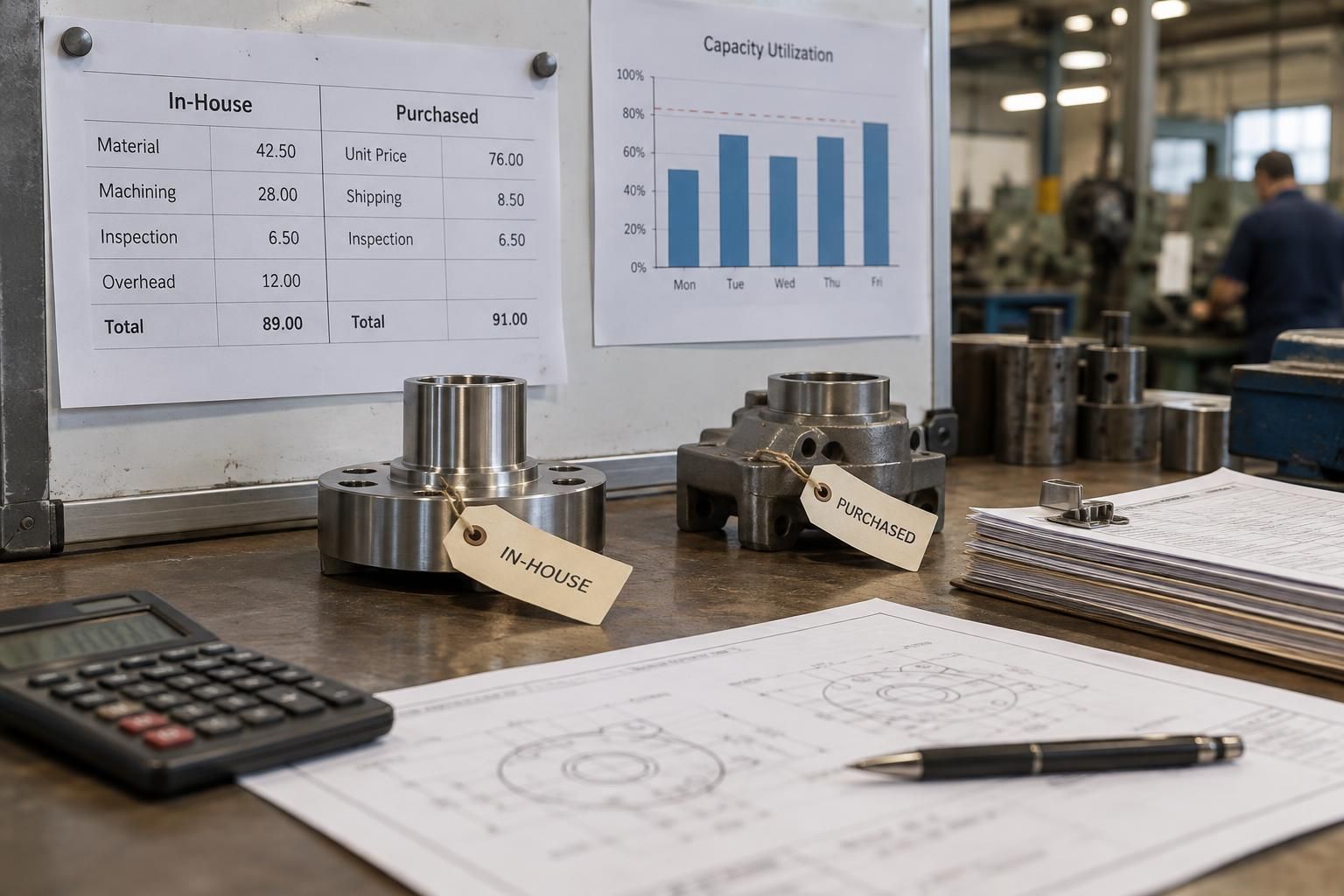
The basis of every decision is a systematic outsourcing analysis: which components are strategically relevant, and which manufacturing processes does the company master with superior cost or quality advantages? Core competencies and sensitive manufacturing know-how often remain in-house, while capacity-intensive standard processes are outsourced. What matters is an honest presentation of costs including set-up times, scrap, logistics and coordination effort – ideally supported by a clean-sheet calculation that makes the supplier's price structure transparent.
Enquiry, electronic tendering and quotation comparison
Qualified enquiries include drawing status, tolerances, material specifications, volume scenarios, inspection plans and logistics requirements. Electronic tendering allows several contract manufacturers to be priced in a structured and comparable manner. In addition to the unit price, tooling costs, minimum quantities, batch sizes and adjustment costs should be included in the comparison. A clean catalogue structure for recurring contract-manufactured parts makes later price adjustments and repeat sourcing considerably easier.
Prototyping and series readiness
Before series launch, contract manufacturers are typically proven in prototype and pre-series phases. First article inspection, capability evidence and documented process releases are standard practice for quality-conscious buyers. Only once process capability has been demonstrated – for example via Cpk values for critical characteristics – should the series release take place with binding delivery call-offs.
Key KPIs for managing contract manufacturers
Contract manufacturing services can only be managed if their performance is measurable. Established KPI sets combine quality, delivery reliability, cost and responsiveness into a supplier evaluation system.
Quality and process KPIs
Incoming quality is typically measured in parts per million (PPM); in practice, values below 100 PPM for mechanical series parts are considered decent, while critical industries expect significantly less. Process capability is reported via Cpk/process capability, frequently with requirements of Cpk ≥ 1.33 for critical characteristics. Complaint rate and 8D processing time complete the quality picture.
Delivery, cost and capital metrics
On-time delivery (OTIF) and schedule adherence against the delivery call-off are the central operational KPIs; target values of over 95 to 98 per cent are typically agreed. On the cost side, price indexation, material cost share and dynamics over the years are suitable measures. With consignment agreements, the focus additionally shifts to capital metrics such as days sales outstanding (DSO) on the supplier side, and coverage and inventory optimisation on the customer side.
Evaluation and escalation
The individual metrics feed into a supplier score that drives regular evaluations, competitive benchmarks and, where required, bonus agreements for exceptional performance. Conversely, a documented escalation process defines the thresholds at which special meetings, quality corrective actions or, ultimately, a shift in volume follow. Metrics without consequences have no effect – the process must make the action steps binding.
Risks and controls in contract manufacturing
Contract manufacturing ties the customer to external capacities and partially transfers process responsibility to third parties. The associated risks can be managed through contractual, organisational and technical controls.
Supplier risks and dependencies
A sole contract manufacturer for a critical component is a classic supply crisis scenario. Supplier consolidation saves administrative effort but increases concentration risk – both must be consciously weighed against each other. Dual sourcing for critical parts, regular supplier evaluations and a verified alternative-sourcing capability make sense. The financial health of the manufacturer also deserves attention: a payment default hits the customer with delivery delays and re-sourcing costs.
Tools, materials and ownership issues
Tools, fixtures and inspection equipment are frequently financed by the customer. Contracts should clearly regulate ownership rights, return claims and protection in the event of the manufacturer's insolvency; the supplier's retention of title on pre-products must also be observed. Material supplied via consignment agreements requires clear rules on liability, stocktaking and disposal. In international contract manufacturing, customs and preference issues are relevant – for example the presentation of an EUR.1 preference certificate in cross-border goods traffic.
Quality risks and legal safeguards
Quality fluctuations typically arise from material changes, staff turnover or unplanned process changes. Contractually, these can be mitigated through process change notifications, inspection plans, provisions on incoming quality and recall agreements. Legal statements – for example on warranty, production risks or remuneration adjustments – should be reviewed by qualified solicitors on a case-by-case basis, as details depend heavily on contract design and case law.
Current developments in contract manufacturing
Contract manufacturing is under multiple pressures: capacity bottlenecks, energy costs, skilled labour shortages and digitalisation requirements are changing the role of the contract manufacturer. Buyers who address these developments early secure better availability and terms.
Digitalisation and data exchange
Electronic delivery call-offs, computer-based backlog tracking and digital inspection equipment documentation are also becoming established among mid-sized contract manufacturers. Catalogue-based standard processes and platform-supported enquiries significantly shorten award lead times. At the same time, expectations regarding cyber and trade secret protection are rising: drawings and manufacturing data are valuable assets whose handling should be governed by the contract.
Sustainability, energy and resilience
Energy-intensive processes such as casting, electroplating or heat treatment react sensitively to energy prices and CO2 requirements. Buyers are increasingly asking for emissions data, recyclability of packaging and verifiable environmental standards from manufacturers. Resilience is becoming a second criterion alongside price: regionality, redundancy and a certain degree of capacity flexibility are being rated more highly again, which is also reflected in category intelligence and strategic sourcing plans.
Innovation partnerships with contract manufacturers
Contract manufacturers with process expertise are valuable innovation partners, for example on questions of design for manufacturing, component costs or alternative materials. Active innovation management in procurement systematically gathers ideas and rewards improvement proposals. In this way, a pure order relationship develops over the long term into a partnership that advances both parties in cost and technology development.
Typical metrics
| Metric | Benchmark | Context |
|---|---|---|
| Incoming quality (PPM) | < 100 PPM | Common guideline value for mechanical series parts; critical industries demand significantly lower values. |
| On-time delivery (OTIF) | > 95–98 % | Typical target corridor against the delivery call-off; below 95 % the escalation process should kick in. |
| Process capability (Cpk) | ≥ 1.33 | Frequently agreed guideline value for critical characteristics; safety-relevant parts sometimes require higher values. |
| Complaint processing time | 8D within 48 h | Usual initial response deadline for 8D reports on series complaints. |
Typical practical benchmarks – they vary by industry, part and contract.
Practical example
A mid-sized mechanical engineering company produced machined gearbox components partly in-house but regularly hit capacity limits during demand peaks. Following an outsourcing analysis, the company decided to permanently award standard components to two qualified contract manufacturers while retaining highly complex parts in-house.
- Structured tender via electronic tendering with uniform drawing and inspection specifications
- Clean-sheet calculation to verify quotation prices including a material index clause
- Mandatory first article inspection and Cpk evidence before series release
- Monthly supplier review meeting with a defined escalation process for OTIF below 95 per cent
Conclusion
Contract manufacturing is more than outsourcing production capacity: it is a strategic decision that shapes the company's value creation, risk profile and cost structure. Success depends less on the unit price than on the quality of preparation – from the outsourcing analysis through the specification to a binding execution process. Measurable KPIs on incoming quality and delivery reliability create transparency and enable timely intervention. At the same time, clear contracts on tooling, ownership and escalation safeguard the company's ability to act in a crisis. Buyers who involve contract manufacturers as partners in innovation management while keeping resilience in view turn an operational topic into a genuine competitive advantage.
Frequently asked questions
What is meant by contract manufacturing?
Contract manufacturing is the production of parts or assemblies by an external contract manufacturer to the customer's specifications, for example based on the customer's drawings, material specifications and quality requirements. The customer retains design and specification, while the contract manufacturer provides machinery, personnel and process expertise. Typical examples include machining, sheet metal working, welding assembly or surface treatment.
What is the difference between contract manufacturing and a system supplier?
A contract manufacturer produces to the customer's drawings without any design responsibility, whereas a system supplier takes on part of the engineering and development responsibility. This results in different distributions of risk: with contract manufacturing, design errors lie with the customer, while process and execution errors lie with the manufacturer. The choice of model should form part of the make-or-buy decision.
How is the price calculated in contract manufacturing?
Pricing is typically based on machine hourly rates, set-up times, material costs, labour hours and overheads plus a profit margin. Buyers should ideally verify such quotations for plausibility using a clean-sheet calculation. Additional key points are volume price breaks, tooling costs, minimum order quantities and agreed adjustment mechanisms, such as material index clauses.
What are the risks of contract manufacturing?
The main risks are supplier failures, quality fluctuations, dependencies on tools and fixtures, and the loss of manufacturing know-how. In addition, there are capital tie-up through customer-furnished materials and, in international sourcing, customs and preference issues such as the EUR.1 certificate of origin. Risks can be reduced through dual sourcing, clear contracts, supplier evaluations and a defined escalation process.
When is contract manufacturing worthwhile for companies?
Contract manufacturing is typically worthwhile for peak loads, missing special processes, capacity-intensive standard processes or parts outside the core competence. Core competencies and sensitive manufacturing know-how are frequently kept in-house. The decision should be based on a structured outsourcing analysis with complete costs, i.e. including logistics, scrap and coordination effort.
What belongs in a contract manufacturing agreement?
Key contents are specifications and drawing status, price and adjustment mechanisms, inspection instructions, process change notifications, delivery call-off arrangements and provisions on tools and ownership rights. Escalation processes, confidentiality and liability caps also typically belong in the contract. Legal details such as warranty or retention of title should be reviewed on a case-by-case basis.