Outsourcing potential analysismaking make-or-buy decisions systematically
Procurement glossary · Updated · 6 min read
Also known as: Make-or-Buy potential analysis, Outsourcing assessment, Sourcing potential analysis, Relocation potential analysis
Short answer
- An outsourcing potential analysis systematically determines which services can be economically and strategically transferred to suppliers.
- It combines total cost of ownership calculation with an assessment of core competence, capacity and the supplier market.
- The result is a prioritised pipeline of measures with concrete outsourcing candidates and robust business cases.
The outsourcing potential analysis is a structured approach for determining which services, assemblies or processes a company can sensibly transfer to external suppliers. It combines cost analysis, strategic evaluation and supplier market knowledge into a robust basis for decision-making. For buyers and supply chain managers, it is the central tool in the make-or-buy process for professionally realising savings potential.
Key facts
- The analysis compares the total cost of ownership of in-house production and external sourcing, not just unit prices.
- Typically, criteria such as cost, core competence, capacity, quality and supply security are evaluated.
- In practice, the achievable savings potential for outsourced assemblies and components frequently lies in the low to mid double-digit percentage range.
- An analysis is typically conducted at the level of the category hierarchy in order to evaluate part families in bundles.
- The result is usually a prioritised pipeline of measures with concrete outsourcing candidates and an implementation plan.
- Legal and tax aspects such as contract design or currency hedging (FX) should be examined on a case-by-case basis.
Contents
Definition: outsourcing potential analysis
The outsourcing potential analysis is a systematic examination of which services of a company can be economically and strategically sensibly handed over to external suppliers. It is part of strategic procurement and provides the decision-making basis for make-or-buy decisions.
Distinction from the classic make-or-buy analysis
While the classic make-or-buy analysis makes a case-by-case decision for a specific part or service, the potential analysis considers the entire spectrum of an area, such as a complete production main group or service category. It prioritises candidates and thereby creates the basis for a structured sourcing pipeline. The focus is not only on costs, but also on the availability of supplier capacities and the transfer of fixed cost blocks.
Position within the procurement process
The analysis belongs in the strategic phase of procurement and draws on data from the S&OP cycle, demand planning and the category hierarchy. It incorporates findings from technology assessment in procurement, for example which manufacturing processes are available on the market at all. Only after completion does supplier identification and concrete contract negotiation typically follow.
Methods and approach of the outsourcing potential analysis
In practice, a multi-stage approach has become established: stocktaking, evaluation, business case and implementation planning. The time horizon is frequently between eight and twelve weeks, depending on scope.
Stocktaking and spend allocation
First, all relevant parts, assemblies and services are recorded and bundled along the category hierarchy. For each group, annual volumes, production costs, capacity utilisation and qualitative characteristics are documented. A clean statement of internal costs is important, otherwise you are comparing apples with oranges. Frequently, it already becomes apparent here that the majority of the potential relates to a few part families.
Evaluation using criteria frameworks
In the second step, the groups are evaluated using a criteria framework. Typical criteria are: strategic relevance (core competence yes/no), cost position, technical feasibility on the sourcing market, quality assurance effort and dependency risks. A two-dimensional portfolio with strategic importance on one axis and market attractiveness on the other has proven effective. Candidates with low strategic relevance and a good supplier market typically have the highest outsourcing potential.
Business case and total cost of ownership
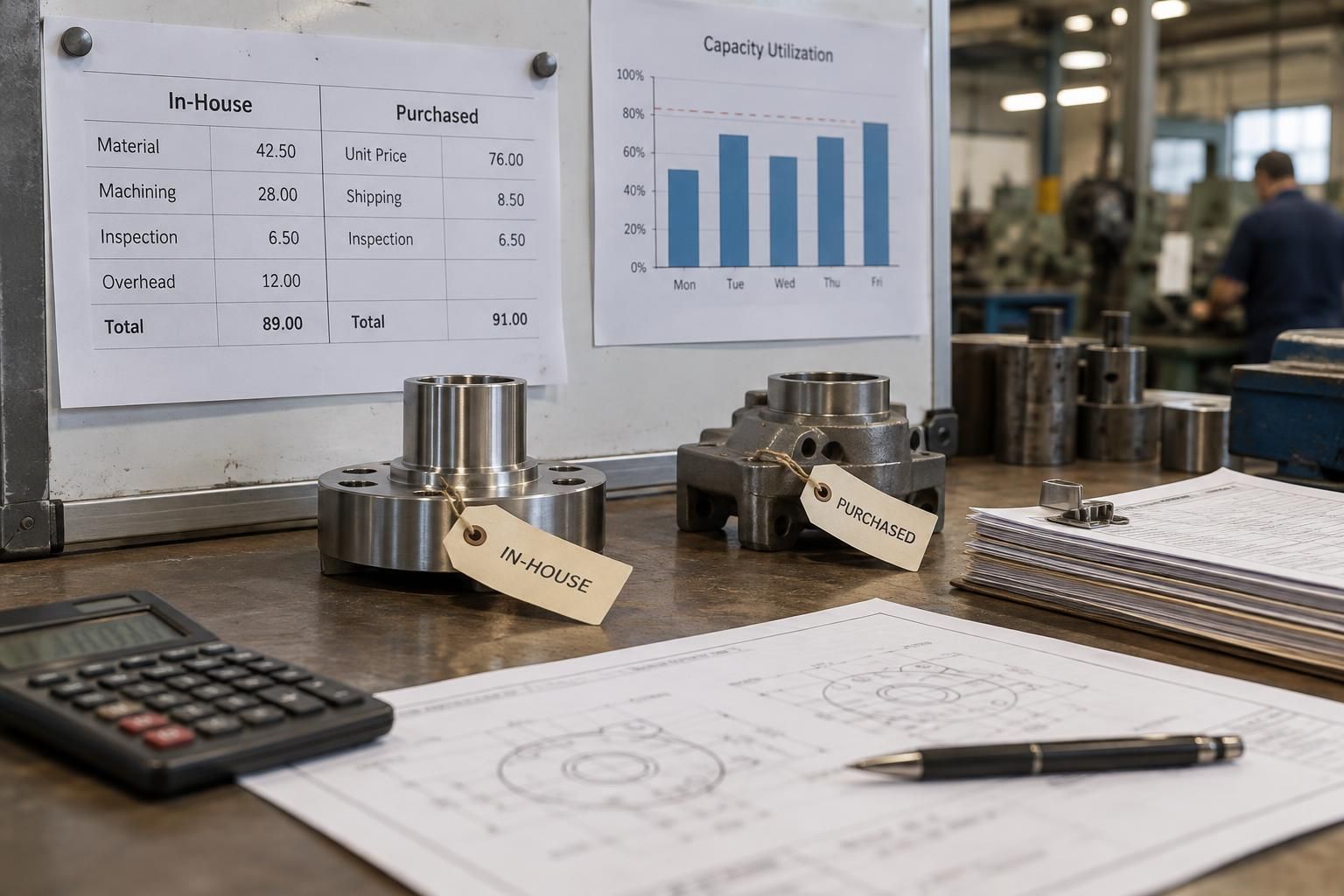
The business case compares the total cost of ownership of both scenarios: in addition to unit prices, transport and customs costs, quality and tooling costs, transition costs and ongoing coordination costs are incurred. Incoterms FOB or other delivery terms influence cost responsibility along the supply chain and must be reflected in the case. Exchange rate clauses and currency hedging (FX) also belong in the calculation if foreign suppliers are under consideration.
Key KPIs of the analysis
Measurable key figures make the potential tangible and create the basis for procurement approval limits and management decisions.
Cost and potential key figures
The central figure is the expected cost reduction measured against the internal reference cost picture, typically expressed as a percentage per part family. In addition, the material cost share of revenue, the in-house production depth (share of in-house production in value added) and the fixed cost reduction potentials serve as steering variables. Price indices, such as a suitable price index, help to neutralise inflation effects in the reference period.
Implementation and quality key figures
The analysis is accompanied by key figures on implementation: share of transferred part families, lead time from analysis to first delivery, as well as delivery reliability and delivery times of the new suppliers. The supplier PPM figure and the share of qualified alternative suppliers show whether the transfer is operating stably. These values later feed into exception management and ongoing contract management.
Risks and controls in outsourcing
Outsourcing entails considerable risks if it is carried out hastily or unstructured. The potential analysis therefore also serves to identify risks before the decision.
Dependency and quality risks
Transferring critical components creates a supply dependency risk: if the supplier fails, in-house assembly comes to a standstill. Dual sourcing in the sourcing pipeline, defined roles in procurement (RACI) and active expediting mitigate this risk. For drawing-relevant parts, a design freeze should be completed before tools or approvals pass to a supplier.
Contractual and financial controls
Contracts must contain clear provisions on quantities, price adjustments via a price index, liability and the return transfer of tools. Payment terms such as net targets or hedging via an exchange rate clause protect against currency risks. For ongoing orders, retention or a credit note arrangement for defects may be appropriate; the specific design should be legally examined on a case-by-case basis.
Organisational and personnel risks
Loss of know-how is a frequently underestimated risk: if you transfer a manufacturing process completely, you lose the ability to evaluate quality and technology. A minimum level of internal process competence, for example via technology assessment in procurement, should be retained. In addition, procurement approval limits and defined escalation routes are necessary so that the transfer does not deviate unnoticed in day-to-day business.
Current developments: resilience instead of pure cost logic
The evaluation criteria have shifted in recent years. Pure cost advantages are giving way to supply chain security, regionalisation and sustainability.
Nearshoring and resilience
Supply chain disruptions have sharpened awareness of dependencies. Many companies now weight risk criteria more heavily in the potential analysis and examine nearshoring options preferentially. Delivery terms such as Incoterms FAS or FOB, transport times and customs aspects thus flow into the business case earlier and more systematically.
Digitalisation and data basis
Digital spend analyses and volume forecasts from the master production schedule (MPS) significantly improve the data quality of the analysis. Replenishment and capacity data from the MPS allow more realistic statements about which volumes are actually suitable for outsourcing. A properly maintained supplier identifier in the master data is a fundamental prerequisite for robust supplier market assessments.
Typical metrics
| Metric | Benchmark | Context |
|---|---|---|
| Potential cost reduction per part family | typically 5–20 % | measured against internal full costs, including transition costs |
| In-house production depth | guideline: 30–60 % | share of in-house production in value added, depending on industry |
| Delivery reliability after transfer | > 95 % | target value during the ramp-up phase of the new suppliers |
| Supplier PPM | < 500 ppm | frequent quality target after completed ramp-up phase |
| Lead time from analysis to first delivery | 6–18 months | depending on complexity, qualification and tooling effort |
Typical practical benchmarks – they vary by industry, part and contract.
Practical example
A medium-sized mechanical engineering company with an annual procurement volume of around €180 million conducts an outsourcing potential analysis for its sheet steel production. The analysis along the category hierarchy shows that three part families (shell elements, small welded assemblies, bent parts) account for around 70 per cent of the internal sheet metal cost block, with low strategic relevance. More than ten qualified suppliers exist in the regional supplier market, several with spare capacity.
- Two part families with a low degree of automation are transferred first, while the third remains in-house as a core competence for prototypes.
- Business cases are calculated with total cost of ownership, including tooling costs and transition phase, on the basis of Incoterms FOB.
- A design freeze applies before the transfer; both target suppliers are dual-qualified to avoid dependencies.
- Implementation via a prioritised pipeline of measures with monthly reviews, accompanied by active expediting during the ramp-up phase.
Conclusion
The outsourcing potential analysis transforms the vague question of savings potential into a prioritised, robust basis for decision-making. Its value stands or falls with data quality: without a clean statement of internal costs and without a realistic overview of the supplier market, the result remains speculation. Those who evaluate strategic criteria, risks and total cost of ownership with equal weight avoid expensive misjudgements. Combined with a well-maintained sourcing pipeline and clear roles in procurement (RACI), the analysis becomes a repeatable standard process. Legal and tax aspects should always be professionally examined on a case-by-case basis.
Frequently asked questions
What is an outsourcing potential analysis?
An outsourcing potential analysis is a systematic examination of which services, parts or processes of a company can be economically and strategically sensibly transferred to external suppliers. It combines cost analysis with an assessment of core competence, capacity and the supplier market. The result is a prioritised list of concrete outsourcing candidates.
How is an outsourcing potential analysis carried out?
Typically in four steps: stocktaking of procurement and production volumes, evaluation of part groups using a criteria framework, creation of a business case with total cost of ownership, and derivation of a pipeline of measures. Depending on scope, the effort is frequently eight to twelve weeks. This is followed by supplier qualification and contract negotiation.
Which criteria matter in make-or-buy decisions?
Decisive factors are strategic relevance and core competence, cost position compared with in-house production, available supplier capacities, quality assurance effort, and dependency and know-how risks. Purely cost-driven decisions frequently lead to later problems, which is why qualitative criteria should be given equal weight. Legal and logistical aspects such as delivery terms also form part of the assessment.
How high is the typical savings potential from outsourcing?
In practice, the achievable savings for outsourced assemblies and components frequently lie in the low to mid double-digit percentage range, measured against internal full costs. The range depends heavily on depth of production, capacity utilisation and local cost structures. Transition and coordination costs must in any case be included in the calculation.
What are the risks of outsourcing in procurement?
The main risks are supply dependency, quality problems, loss of know-how and hidden follow-up costs. Countermeasures include dual sourcing, clear contractual provisions including price adjustment mechanisms, active expediting and maintaining a minimum level of process competence in-house. Structured contract management accompanies the implementation on an ongoing basis.
Who should carry out an outsourcing potential analysis?
Responsibility usually lies with strategic procurement in collaboration with production, engineering, quality and controlling. A defined RACI with clear roles in procurement (RACI) ensures that evaluation, approval and implementation are cleanly separated. External consultancy can help with sourcing market data, but the decision should be made within the company.