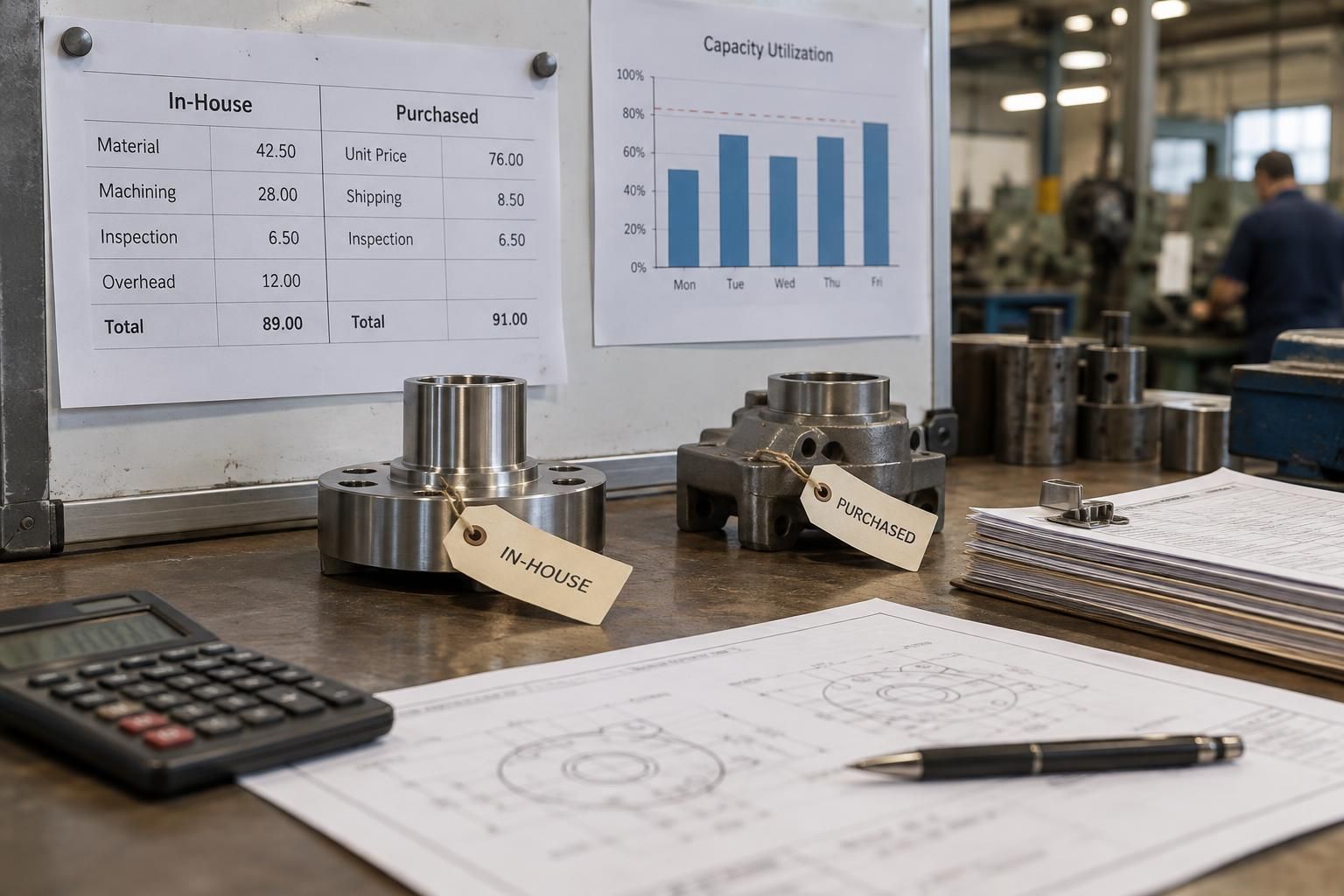
Vertical IntegrationMake-or-Buy as a Core Strategic Decision
Procurement glossary · Updated · 7 min read
Also known as: Fertigungstiefe, Vertical Integration, Fertigungsgrad, Eigenfertigungsgrad, value added ratio
Short answer
- Vertical integration describes the proportion of value creation that is delivered within the company itself.
- It is typically calculated as the ratio of own value added to revenue or total output.
- For procurement, it determines which services must be procured and how large supplier and dependency risks are.
Vertical integration describes the proportion of a company's value creation that is delivered under its own responsibility within its own operations and the portion that is outsourced externally to suppliers and sub-suppliers. It is a key metric for the strategic direction of production and procurement. For buyers, it determines which goods, components and services must be procured and which negotiation and management levers exist.
Key facts
- Vertical integration is typically measured as the ratio of own value added to revenue or total output.
- High vertical integration means more in-house production; low vertical integration a high share of external procurement.
- Make-or-buy decisions change vertical integration and directly affect cost structure, flexibility and dependencies.
- In practice, vertical integration in mechanical and plant engineering frequently fluctuates between approximately 30 and 70 per cent, depending on industry and business model.
- Managing vertical integration is a core task of procurement strategy and supply market intelligence.
- Outsourcing increases procurement volumes and supplier risks, while insourcing can exacerbate under-utilisation of capacity and fixed costs.
Contents
- Definition: Vertical Integration
- Methods and Approach: Assessing Vertical Integration
- Key KPIs Surrounding Vertical Integration
- Risks and Controls in Managing Vertical Integration
- Current Developments: Vertical Integration in Transition
- Typical metrics
- Practical Example
- Conclusion
- Frequently asked questions
Definition: Vertical Integration
Vertical integration indicates the proportion of the output delivered for a product or service that is produced by the company itself rather than relying on external intermediate inputs. It is usually presented as a ratio of own value added (e.g. operating output less intermediate inputs) to total output or revenue. A high level of vertical integration signals in-house production and internal competence; a low level signals a procurement- and network-based business model.
Distinction from Make-or-Buy
Make-or-buy is the individual decision on in-house production or external procurement of a service; vertical integration is the result of many such decisions across the entire value creation process. While make-or-buy is typically analysed case by case and product by product, vertical integration describes a company or site profile. In procurement business planning it is therefore managed as a target variable over several years and operationalised through sourcing wave plans.
Forms and Degrees
Vertical integration is not a binary variable. Companies frequently manufacture core components in-house, have standard parts produced externally and outsource assembly, logistics or services partly to external partners. Cooperative forms such as contract manufacturing, joint ventures or long-term contract production also lie between the two poles. For procurement, what matters is which value creation stages are actually outsourced – because procurement volumes, the number of suppliers and the level of management effort depend on this.
Methods and Approach: Assessing Vertical Integration
Determining vertical integration begins with a structured analysis of manufacturing depth at the level of product groups, assemblies and processes. From this, candidates for outsourcing or insourcing can be derived and evaluated with a sound cost and risk analysis.
Cost-Side Analysis
At the core is a complete cost comparison, ideally as a Total Cost Tree. In addition to unit costs and material consumption, set-up costs, quality assurance, capital tied up, transport, tooling costs, inventory and warehousing as well as internal overheads must be considered. For external procurement, customs, exchange rates, administrative effort and risk premiums are added. It frequently emerges that seemingly favourable external procurement catches up or overtakes when viewed on a total cost basis – and vice versa.
Assessing Risks and Dependencies
In addition to costs, risk classes must be defined per item procured: availability of suppliers, substitutable technology, approval and qualification barriers, dependency on single sources. Single-source management and supply chain resilience are directly affected when critical value creation stages are outsourced. In supply chain resilience management, vertical integration is therefore often discussed as a lever for risk reduction – for example through the deliberate repatriation of sensitive manufacturing steps.
Strategic and Capacity-Related Criteria
Core competencies, know-how-intensive processes and differentiating functions should typically remain in-house; pure volume production or labour-intensive processes are frequently suitable for external procurement. Wage levels, capacity utilisation, economies of scale and investment requirements (CAPEX) are also factored into the assessment. The result is a prioritised list of measures, implemented through tenders and contract negotiations via a sourcing wave plan.
Key KPIs Surrounding Vertical Integration
Vertical integration is measurable and should be reported regularly, for example as part of annual planning. Supplementary metrics reveal how stable and economical the chosen level of manufacturing depth is.
Core Metrics
In addition to the vertical integration ratio itself, the following are relevant: procurement volume in relation to revenue (material cost ratio), number of active suppliers per commodity group, share of external procurement in critical parts and utilisation of in-house production. In addition, KPIs such as expedite rate and delivery reliability of external manufacturers provide indications of the operational consequences of a low in-house production ratio. Savings types can also be assigned to outsourcing and insourcing projects.
Metrics in Context
Individual metrics must be interpreted critically: a high material cost ratio may result from deliberate outsourcing of standard components and may be economically sound. What is decisive is the combination with supplier evaluations, preferred suppliers (Preferred Supplier Programme) and data from consumption forecasting. This enables the buyer to recognise at an early stage whether outsourced value creation is being delivered reliably and cost-effectively.
Risks and Controls in Managing Vertical Integration
Changes to vertical integration are high-risk interventions with long lead times. Without a controlled approach, dependencies, loss of know-how, quality problems and unexpected costs loom.
Dependency and Failure Risks
Outsourcing shifts risks from one's own plant to external partners. What matter are alternative sources, clear contract structures with an escalation clause and defined contingency provisions, as well as a functioning exception management process for disruptions in the supply chain. For single sources, dependency rules similar to credit limits make sense – analogous to the supplier credit limit in finance, here at a professional level: concentration on one partner only with an exit plan and documented knowledge.
Quality, Know-How and Control
Outsourced processes require clear quality and specification requirements, regular supplier visits and audits at the manufacturing partner. Company-specific know-how must be protected contractually. Order processing for external manufacturing must be managed with clear demand notification and defined approval processes; uncontrolled free-text ordering undermines transparency about value creation actually outsourced.
Master Data, Contracts and Governance
Properly maintained supplier master data, reliable IBAN validation and documented contracts and specifications are fundamental prerequisites for keeping outsourced services manageable. Changes to vertical integration belong in a formal governance process involving procurement, development, production, quality and finance. Tax and legal questions – for example leasing, transfers of fixed assets, or transformation and employment law – should be examined by experts on a case-by-case basis.
Current Developments: Vertical Integration in Transition
The last decade was strongly shaped by globalisation and cost reduction through outsourcing; currently, the trend in parts of industry is moving towards re-regionalisation, resilience and strategic in-house production of critical components.
Resilience and Regionalisation
Supply chain crises, material shortages and geopolitical risks have re-opened the question of the optimal level of vertical integration. In supply chain resilience management, increasingly higher manufacturing depth for critical parts or dual sourcing is favoured, even if short-term cost advantages diminish. Variant management supports this by reducing complexity and thus keeping the number of manufacturing and supply sources small.
Digitalisation and AI in Procurement
AI in procurement and enhanced supply market intelligence allow make-or-buy candidates to be identified more systematically, market and supplier data to be continuously updated and value creation decisions to be made on a data-driven basis. Automated tenders and price analyses shorten the path from analysis to implementation. This creates greater transparency for suppliers in the sub-supplier network and better decision-making foundations for buyers.
Sustainability and Regulatory Requirements
Both in-house production and external procurement have implications for the carbon footprint, reporting obligations and supply chain due diligence duties. Higher vertical integration shifts emissions into one's own operations, outsourcing into the supply chain – both require adjustments in data collection and supplier management. The evaluation of make-or-buy alternatives should therefore include sustainability criteria from the outset.
Typical metrics
| Metric | Benchmark | Context |
|---|---|---|
| Vertical integration | typically 30–70 % | strongly industry-dependent; in mechanical engineering often in the mid-range |
| Material cost ratio | typically 40–70 % | tends to rise as vertical integration decreases |
| Supplier concentration for critical parts | Target: < 50 % per single source | rough practical heuristic; monitor critical parts closely |
| Expedite rate of external manufacturers | Target: < 5 % | indicator of the resilience of outsourced processes |
Typical practical benchmarks – they vary by industry, part and contract.
Practical Example
A medium-sized mechanical engineering company with high vertical integration is examining whether its own sheet metal fabrication should be outsourced while at the same time bringing critical gearbox manufacturing back in-house. The analysis using a Total Cost Tree shows clear cost advantages of external procurement for sheet metal fabrication, whereas gearbox manufacturing is classified as a single-source risk due to approval requirements, know-how and volatility, with only oneBid in hand.
- Creation of risk classes per assembly and prioritisation via a sourcing wave plan
- Tendering of sheet metal fabrication with defined quality criteria and an escalation clause in the contract
- Step-by-step return of gearbox manufacturing over six quarters with parallel qualification of a second source
- Regular supplier visits and an exception management process for delivery crises at the external manufacturer
Conclusion
Vertical integration is far more than a metric: it is an expression of the strategic question of what a company must control itself and what it sensibly delegates. For procurement, this directly determines procurement volumes, supplier structure and bargaining power. Make-or-buy decisions should therefore never be made on cost considerations alone, but always with consideration of total cost, risk and competencies. A deliberately managed level of vertical integration – regularly reviewed and underpinned by sound governance – is an essential building block for profitability and supply chain resilience. Those who actively manage it gain genuine strategic room for manoeuvre over competitors.
Frequently asked questions
What does vertical integration mean in simple terms?
Vertical integration (Wertschöpfungstiefe) shows how much of a product or service a company manufactures itself and how much it procures from suppliers. High vertical integration means a high level of in-house production, low vertical integration a high level of external procurement. It is usually expressed as a percentage or a ratio and serves as a strategic steering variable.
How do you calculate vertical integration?
Vertical integration is often calculated as own value added (total output minus intermediate inputs) divided by total output or revenue. Alternatively, on a product basis, the shares of in-house production and external procurement in manufacturing costs are compared. What matters is a consistent definition over time so that values remain comparable.
What are the advantages and disadvantages of high or low vertical integration?
High vertical integration secures know-how, quality and control, but ties up capital and fixed costs. Low vertical integration frequently reduces costs and increases flexibility, but carries dependency and supply failure risks. The right mix depends on industry, risk profile and core competencies.
What is the difference between vertical integration and manufacturing depth?
Manufacturing depth (Fertigungstiefe) relates specifically to the production area, i.e. which operations a plant carries out itself. Vertical integration is the broader concept and covers all value creation stages including development, services and sales. In common usage, the two terms are often used synonymously.
How does outsourcing affect vertical integration?
Outsourcing reduces vertical integration because value creation stages are shifted to external partners. As a result, procurement volumes, supplier risks and the effort required for supplier management in purchasing increase. Conversely, insourcing or backshoring increases vertical integration and internal control.
When does make-or-buy pay off for which components?
Typically, in-house production is worthwhile for volume-relevant, quality-critical or know-how-intensive components and where there is sufficient capacity utilisation. External procurement is recommended for standard parts, highly fluctuating demand or missing technology. The decision should be based on a total cost comparison and a risk assessment, not just on unit prices.