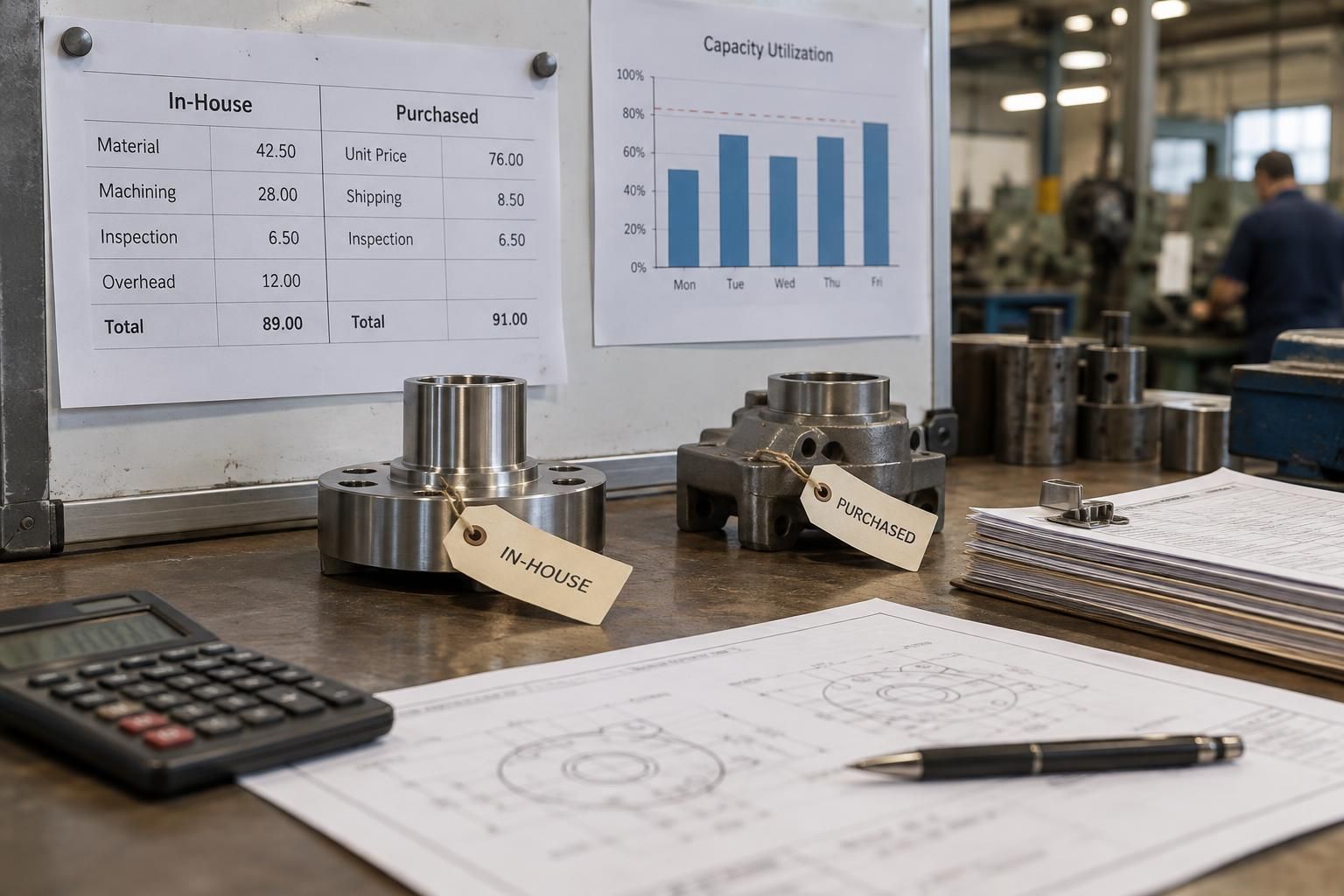
Contract ManufacturingStrategically managing and controlling toll manufacturing
Procurement glossary · Updated · 7 min read
Also known as: Contract production, Toll manufacturing, Contract Manufacturing Services, Build-to-Print
Short answer
- Contract manufacturing is the contractual award of production services to external contract manufacturers according to the customer's specification.
- The benefits are flexibility, lower fixed costs and access to specialist technologies; the risks lie in dependency, quality and know-how loss.
- Success factors are clean specifications, structured sourcing, robust contracts and continuous supplier management via KPIs.
Contract manufacturing refers to the outsourcing of production services to external contract manufacturers, who produce according to drawings, specifications or requirement specifications. For procurement professionals, it is a central instrument for keeping capacity flexible, reducing fixed costs and focusing on core competencies. Success, however, depends heavily on disciplined specification management, binding contracts and systematic supplier management. This article explains the definition, process, KPIs, risks and current developments from a procurement perspective.
Key facts
- Contract manufacturing encompasses toll manufacturing, contract production and electronics manufacturing services (EMS) based on detailed customer specifications.
- Typical contract models range from framework agreements with call-off orders to take-or-pay arrangements with capacity reservations.
- Practical criteria for the sourcing decision are, alongside price, above all capacity availability, process capability, traceability and supply chain resilience.
- For simple parts, the labour share is typically around 20 to 40 per cent of total costs relative to the material share – material costs and logistics must therefore be evaluated as well.
- Typical risks are know-how leakage, dependency on single sources and quality fluctuations, which are controlled through supplier rating and audits.
- Sustainability requirements such as Scope 3 emissions and due diligence obligations increasingly apply to outsourced manufacturing as well.
Contents
Definition: contract manufacturing
Contract manufacturing is the contractually regulated transfer of production services to an external manufacturer. The customer provides the design, specification and usually material pre-stages as well, or procures them via the contract manufacturer; intellectual property in drawings and processes remains with the customer in principle.
Distinction from OEM/ODM and system supply
In contract manufacturing, the partner produces according to the customer's specifications (build-to-print or build-to-spec). In the ODM model (Original Design Manufacturer), by contrast, the manufacturer is involved in developing the product itself. A further important distinction is from the system supplier: the latter additionally takes on development, assembly responsibility and, in part, logistics for components, whereas a pure contract manufacturer only handles a defined manufacturing scope. In practice, the boundaries blur as contract manufacturers gradually offer engineering services.
Typical services and industries
Contract manufacturing covers mechanical machining, sheet metal working and weldments, casting and forming processes, plastics injection moulding, electronics manufacturing (EMS) and surface treatment. Typical customers come from mechanical engineering, automotive supply, medical technology and the electrical industry. As part of nearshoring strategies, European contract manufacturers are also gaining in importance, since shorter transport routes and time-to-market advantages offer benefits over purely low-cost countries.
Process: from sourcing decision to series production
The sourcing of toll manufacturing typically follows a structured process: demand request, tender, sourcing decision, contract award, sample phase and production ramp-up. Each stage requires defined documents and decision criteria in order to avoid later renegotiations and quality issues.
Tendering and technology assessment
The basis of a robust tender is well-maintained specification management with up-to-date drawings, tolerances, inspection plans and material specifications. Alongside price, capacity situation, machinery, certifications and references must be evaluated. A structured technology assessment in procurement helps to verify whether the provider masters the required processes or whether alternative manufacturing methods would be more cost-effective. For larger volumes, e-auction preparation with defined qualification criteria can intensify price competition, provided sourcing policies and compliance requirements permit.
Contract structures and pricing models
Framework agreements with delivery call-offs, fixed-price arrangements for defined volumes and material price escalation clauses are common. For capacity reservations, take-or-pay arrangements secure the manufacturer's utilisation but shift risk onto the customer. Also important are provisions on tooling ownership, non-assignment (protection against unauthorised transfer of rights), confidentiality and intellectual property. In practice, volume flexibility and lead times are contractually defined as ranges.
Industrialisation and production ramp-up
Series production is preceded by sample production, first article inspection (PPAP or comparable approval processes) and, where required, a supplier development workshop for process optimisation. Only after a successful run-at-rate test and approval of the inspection plan is regular order release via the ERP system activated. This discipline during start-up significantly reduces later rework.
Key KPIs for managing contract manufacturers
Contract manufacturing can only be managed if performance is made measurable. The key metrics capture delivery performance, quality and economic development.
Delivery and inventory metrics
Core metrics are on-time delivery (on-time-in-full), the backorder rate for items not available on time and the coverage of safety stock at the manufacturing site. Ideally, the supplier should be integrated into the customer's S&OP cycle for planning purposes, so that capacity bottlenecks become visible early. As a rule, on-time delivery of over 95 to 98 per cent is regarded as the target value for series production.
Quality and process metrics
Relevant are reject and rework rates, complaint rates and the process capability of critical characteristics (Cp/Cpk values). Full traceability via batch and serial numbers is mandatory, particularly in medical technology and automotive. A structured supplier rating process aggregates these metrics into an overall score, which serves as the basis for assortment and volume decisions.
Cost and sustainability metrics
Economically interesting are price development per part, the material share of the total price and the realisation of savings against the savings forecast in the procurement business plan. Increasingly, ESG metrics are also included in the rating, in particular Scope 3 emissions of manufacturing and energy intensity per component. This data must be reliable – a data quality report covering master data and supplier data provides transparency here.
Risks and controls in contract manufacturing
Outsourced manufacturing shifts responsibility, but not liability or reputation. Procurement must systematically identify typical risks and safeguard against them through contractual and operational controls.
Dependency and procurement risks
Single-source situations for special processes or tooling are common and increase vulnerability in the event of failures. A regular risk analysis assesses manufacturers against criteria such as financial stability, on-time delivery, location risks and substitutability. In addition, tier-n transparency clarifies which upstream suppliers the contract manufacturer depends on – an aspect increasingly supported on a data basis through supply chain analytics.
Knowledge protection and compliance
Know-how leakage through drawings, process knowledge or staff attrition is a central risk. Protection is provided by confidentiality agreements, separate tool storage, non-assignment clauses and controlled information disclosure. Compliance requirements such as supply chain due diligence obligations demand due diligence along the chain, particularly for suppliers in risk countries. Legal details should always be reviewed on a case-by-case basis.
Quality assurance and release control
Without the customer's own process expertise, responsibility for quality outcomes remains difficult. Proven controls include process audits, agreed inspection scopes, measuring equipment correlation and spot checks in the event of delivery fluctuations. Changes to drawings or processes are subject to formal change management with a renewed sample approval obligation.
Current developments in contract manufacturing
The contract manufacturing market is being transformed by resilience requirements, digitalisation and sustainability regulation. Procurement must adapt its sourcing strategy accordingly.
Resilience and nearshoring
Many companies are moving production volumes back to Europe or to nearby countries in order to shorten supply chains and reduce customs and transport risks. This typically increases unit costs but improves flexibility, time-to-market and responsiveness to engineering changes. Dual sourcing across several manufacturers remains the standard approach for critical parts.
Digitalisation of collaboration
Digital data transfer via CAD portals, automated quotations for standard parts and shared inventory or call-off systems shorten lead times. AI-supported request handling and guided buying rules standardise the sourcing process internally, while supplier portals improve the feedback of capacities and dates. A prerequisite is high data quality in item master data and drawing revisions.
Sustainability and the circular economy
Supply chain reporting obligations make the emissions balance of toll manufacturing relevant as well; manufacturers with green electricity and efficient processes are rated preferentially. Topics such as second-life use of components and material cycles additionally shift requirements towards documentation and take-back capability. These criteria increasingly belong in tenders and supplier evaluations.
Typical metrics
| Metric | Benchmark | Context |
|---|---|---|
| On-time delivery (OTIF) | > 95% | Typical target value for series production; critical parts often > 98%. |
| Backorder rate | < 2% | Share of line items not available on time; the lower, the more stable the supply. |
| Complaint rate | < 500 ppm | Industry-dependent; automotive supply typically demands significantly lower values. |
| First-pass yield | > 95% | Share of parts approved free of defects during production start-up. |
| Process capability (Cpk) | ≥ 1.33 | Common minimum value for critical characteristics; 1.67 for safety-relevant parts. |
Typical practical benchmarks – they vary by industry, part and contract.
Practical example
A medium-sized mechanical engineering company with annual revenue of around €400 million awarded weldments and machined precision parts to a single contract manufacturer in Eastern Europe. After repeated delivery delays and rising freight costs, procurement conducted a comprehensive risk analysis and restructured the sourcing. Within one year, the volume was distributed across two European manufacturers and one existing Asian manufacturer, supplemented by measurable control mechanisms.
- Sourcing via structured request documents including drawing revisions, inspection planning and proof of the manufacturer's capacity.
- Renegotiation of framework agreements with volume tiers, material price escalation clauses and clear tooling and non-assignment provisions.
- Introduction of a monthly supplier rating with on-time delivery, complaint rate and price discussions as mandatory agenda items.
- Integration of the manufacturers into the S&OP cycle for early capacity coordination during demand peaks.
Conclusion
Contract manufacturing is far more than simply outsourcing production: it is a strategic decision about competencies, capacity and risk allocation. Procurement professionals who keep specifications clean, make sourcing decisions in a structured manner and manage manufacturers using reliable KPIs benefit from flexibility and cost advantages without loss of control. Contractual safeguards – from tooling rules to non-assignment clauses – are part of the craft, as are regular audits and a functioning risk analysis. Those who additionally address resilience and sustainability requirements early make toll manufacturing a stable pillar of the procurement strategy. What matters in the end is discipline in the process, not choosing the cheapest supplier.
Frequently asked questions
What does contract manufacturing mean?
Contract manufacturing refers to the contractual transfer of production services to external contract manufacturers, who produce according to the customer's drawings or specifications. Intellectual property generally remains with the customer. Typical forms include toll manufacturing, build-to-print and electronics manufacturing services (EMS).
What is the difference between contract manufacturing and OEM?
The OEM (Original Equipment Manufacturer) sells the product under its own brand and may manufacture in-house or source components. In contract manufacturing, a partner produces on behalf of and to the specifications of this OEM. In the ODM model, by contrast, the manufacturer develops the product itself and carries greater development expertise.
What are the benefits of contract manufacturing for companies?
The benefits include lower fixed costs, flexibility in response to demand fluctuations, access to specialist technologies and a focus on core competencies. Capacity peaks can also be covered without in-house investment. These must be weighed against dependency, quality and know-how risks, which need to be actively managed.
What should you look for when selecting a contract manufacturer?
Key factors are process expertise and machinery, certifications, capacity availability, financial stability and industry references. Quality data such as reject rates and traceability, as well as sustainability criteria, should also be reviewed. A structured comparison of several suppliers based on defined evaluation criteria is recommended.
How are contract manufacturing agreements typically structured?
Framework agreements with call-off orders, volume tiers and price adjustment clauses for material costs are common. Key provisions concern tooling ownership, confidentiality, intellectual property and non-assignment. Capacity reservations may involve take-or-pay arrangements; the details should be reviewed legally.
Is contract manufacturing the same as outsourcing?
Not quite: outsourcing describes the general delegation of business functions, including services such as IT. Contract manufacturing is the specific outsourcing of production processes to a contract manufacturer. The term toll manufacturing is often used synonymously in German-speaking contexts.