External manufacturingstrategically managing outsourced production
Procurement glossary · Updated · 7 min read
Also known as: Contract manufacturing, Outsourced production, Outsourcing of production, Contract Manufacturing, Third-party manufacturing
Short answer
- External manufacturing means awarding production services to external partners who produce according to your specifications.
- It reduces fixed costs, creates capacity flexibility and provides access to specialised technologies.
- It is only successful with clean specification, verified manufacturers, clear contracts and ongoing KPI control.
External manufacturing refers to the transfer of production services to external suppliers or contract manufacturers who produce parts, assemblies or complete products on a company's behalf. For buyers, it is a central instrument for absorbing capacity peaks, reducing fixed costs and accessing specialised technologies. At the same time, it requires stringent control of quality, logistics and costs, since production control no longer sits within the company's own walls. Those who organise external manufacturing professionally transform it from a pure capacity buffer into a genuine strategic competitive advantage.
Key facts
- External manufacturing encompasses contract manufacturing, outsourcing of complete assemblies and the OEM/ODM model as classic implementation forms.
- Typical motivations are capacity bottlenecks, specialisation advantages, cost advantages and risk diversification across several locations.
- Make-or-buy analyses are the foundation of every decision for or against external manufacturing.
- In practice, 30 to 60 per cent of value creation frequently lies with external manufacturing partners, particularly in mechanical engineering and the electrical industry.
- Success factors are binding specifications, contract for work and services provisions, quality agreements such as MSA and a robust supplier capacity assessment.
- KPIs such as on-time delivery, first-pass yield share and scrap rate make the performance of external manufacturers measurable.
Contents
- Definition: external manufacturing
- Decision foundations: make-or-buy and externalisation
- Implementation: from the RFQ to series production
- Key KPIs for controlling external manufacturing
- Risks and control mechanisms
- Current developments: resilience, digitalisation, nearshoring
- Typical metrics
- Practical example
- Conclusion
- Frequently asked questions
Definition: external manufacturing
External manufacturing exists when a company awards production processes in whole or in part to third parties who produce on a contract basis on the basis of design documents, specifications or sample parts. The client remains the legal owner of the design and typically bears material responsibility or responsibility for the technical specifications. External manufacturing must be distinguished from pure trading in standard components: the focus is always on the transfer of a value-adding stage.
Distinguishing it from contract manufacturing and the system supplier
Contract manufacturing is the most common sub-form: the manufacturer processes material supplied or procured by itself according to exact specifications and charges labour time and machine hours. With a system supplier, responsibility goes further: it takes on development proximity, sub-assemblies and partly the materials management including procurement of bought-in parts. In practice, both forms blend depending on the complexity and maturity of the product.
The OEM/ODM model as a special form
In the OEM/ODM model, the partner produces under the client's brand. In the OEM case, the partner produces according to the client's design; in the ODM case, the partner contributes its own development work and the client awards only the product idea and the specification. For buyers, this changes the subject of negotiation: in the ODM case, intellectual property and exclusivity are negotiated above all, alongside price and capacity, usually secured through a Non-Disclosure Agreement (NDA).
Decision foundations: make-or-buy and externalisation
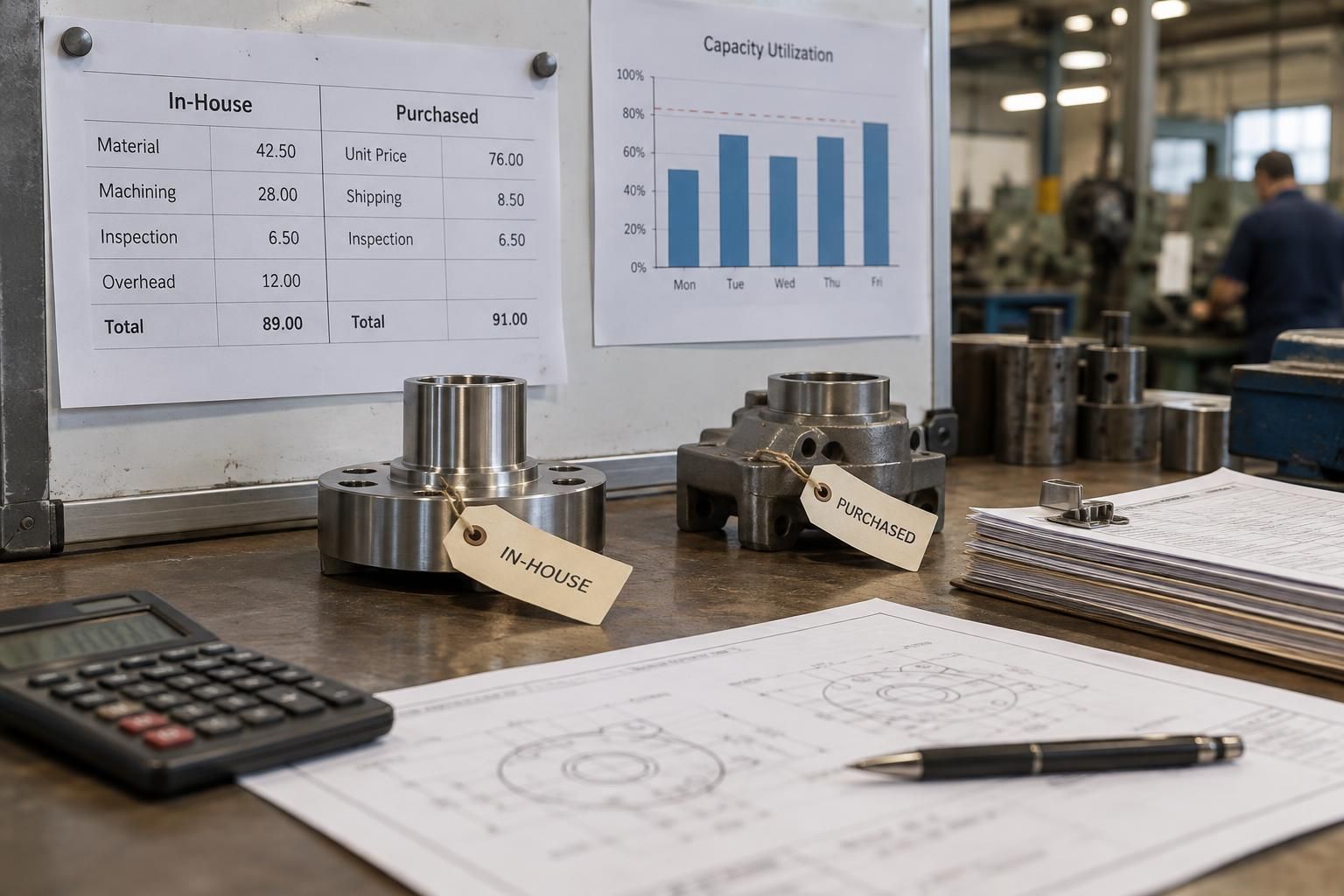
The decision for external manufacturing should never be made solely on the basis of short-term capacity bottlenecks. Decisions are sound when they arise from a structured make-or-buy analysis that weighs up costs, technology, core competence and risks. Reversibility – the question of whether production can later be brought back in-house – also belongs in the assessment.
Cost comparison based on total cost
In addition to manufacturing labour and materials, transport, customs, quality inspection, packaging management, tool maintenance and coordination effort must be factored in. In practice, companies frequently underestimate internal control costs: scheduling, first article inspection, complaint handling and travel typically consume 5 to 15 per cent in additional costs compared with the pure quotation calculation. Anyone comparing only the unit price decides systematically too optimistically.
Core competence and risk assessment
Manufacturing processes that are market-differentiating or contain important process know-how should remain in-house. Non-differentiating processes with high volumes, by contrast, lend themselves well to externalisation. A risk matrix covering failure probability and value-adding share helps to identify critical parts and to avoid placing production in a single pair of hands.
Supplier identification and selection
The search for suitable manufacturers begins with structured supplier identification across categories, technologies and certifications. This is followed by a supplier capacity assessment: available machine hours, set-up times, shift model, scrap rates and financial stability. Only once capacity and quality capability have been demonstrated should prices be discussed.
Implementation: from the RFQ to series production
Operational implementation follows a proven pattern: RFQ, sample phase, first article approval, series start-up and ongoing control. Each phase has its own tools and documentation requirements, which should be defined as binding in advance.
RFQ, price enquiry and preparation
For spare part requirements and small series, a quick-process price enquiry is suitable; for complex components, a detailed RFQ with drawings, tolerance classes and inspection requirements. Consistency of documentation is important: manufacturing systems, material data and inspection characteristics must be specified in such a way that several suppliers can quote on a comparable basis. Unclear specifications are the most frequent cause of later renegotiations.
Prototype procurement and first article acceptance
Before the series, prototype procurement should be set in motion in order to validate fits, material behaviour and manufacturing limits. First article approval takes place according to documented inspection plans, often supplemented by statistical methods such as an MSA (measurement system analysis) to ensure measurement capability. Only after approval of the first articles may the manufacturer move to series production.
Series control and volume flexibility
In the series phase, procurement assumes production control together with the manufacturer: deadline coordination, call-off quantities, capacity meetings and short-term planning. Materials management and supply planning ensure that long-lead parts are at the manufacturer in good time. With multi-sourcing, pooling of volumes secures better terms without jeopardising delivery capability.
Key KPIs for controlling external manufacturing
External manufacturing escapes direct plant control, which is why measurable transparency is indispensable. In practice, a lean KPI set with a clear data basis from the ERP or supplier portal is sufficient, provided it is evaluated regularly.
Operational core metrics
On-time delivery (OTD), scrap rate, rework rate and first-pass yield share show whether the manufacturer delivers in a stable manner. In addition, inventory metrics such as average inventory at the client provide information on the cost of the supply strategy. Min-max control for C-parts keeps the scheduling effort low.
Commercial and quality metrics
Cost efficiency is measured via unit price development, index clauses and budget deviation; procurement cost centre reporting on the impact of internal control costs also belongs here. Quality data flows into supplier evaluations and feeds the Preferred Supplier policy. Those who do not evaluate KPIs quickly lose their negotiating position vis-à-vis the manufacturer.
Risks and control mechanisms
The greatest risks of external manufacturing are quality deviations, availability bottlenecks, knowledge outflow and hidden costs. These can be significantly reduced through contractual clarity, operational controls and targeted relationship work.
Contractual safeguards
Contract for work and services law, warranty, liability limits, confidentiality via a Non-Disclosure Agreement (NDA) and provisions on tools and tooling documents belong in every framework agreement. For price changes, for example due to material price or exchange rate fluctuations, a price escalation clause should specify which cost drivers may be passed on. For cross-border manufacturing, currency hedging (FX) and transport documents such as the bill of lading are added; legal details must be examined on a case-by-case basis.
Ensuring quality and compliance
Material compliance, for example for RoHS- and REACH-relevant substances, must be contractually evidenced by the manufacturer. Supplier development workshops and joint audits improve process capability before errors become expensive during series start-up. Packaging management ensures that logistical requirements such as container type, labelling and stackability are defined as binding.
Managing product changes
Design changes are handled via an Engineering Change Notice (ECN) with defined transition deadlines, residual quantity provisions and re-approval of the first articles. Without an ECN process, mixed stock, duplicate stock and deviations between drawing status and the manufactured part typically arise. Tool maintenance and tool ownership documents also protect the ownership of injection moulding and die-casting tools held at the manufacturer.
Current developments: resilience, digitalisation, nearshoring
External manufacturing is under twofold pressure: supply chains are to become more resilient, while cost pressure is simultaneously rising. The answer of many industrial companies is a combination of diversification, regional relocation and digital control.
Multi-sourcing and nearshoring
Many companies deliberately reduce their level of vertical integration with individual partners and distribute critical parts across two to three manufacturers in different regions. Nearshoring, i.e. relocating production closer to the home market, shortens transport routes and response times but frequently increases the unit price. Today's decisions are more strategic than before the crisis: cost is only one criterion among several.
Digital platforms and AI-supported RFQ processes
Digital marketplaces and supplier portals shorten supplier identification and make it possible to find suitable manufacturers in days rather than weeks. AI-supported RFQ processes structure drawings and requirements data, making comparisons between manufacturers more robust. At the same time, pressure on supplier development is increasing because resources for requalification are scarce.
Typical metrics
| Metric | Benchmark | Context |
|---|---|---|
| On-time delivery (OTD) | > 98 % | Share of punctual and complete deliveries from external manufacturers per month |
| First-pass yield share | < 3 % | Share of parts that run flawlessly straight after first article approval |
| Scrap rate of external manufacturing | < 500 ppm | Depends on industry and component; typically higher for assemblies |
| Procurement control cost ratio | 5–15 % | Additional costs compared with the pure quotation calculation, typical benchmark |
Typical practical benchmarks – they vary by industry, part and contract.
Practical example
A mid-sized mechanical engineering company with around 200 employees produced welded assemblies and mechanically machined frame components entirely in-house. Order peaks regularly led to overtime and long lead times. After a make-or-buy analysis, the company outsourced two manufacturing families with low differentiation impact to two certified contract manufacturers, and a third manufacturer was qualified as redundancy.
- Structured supplier capacity assessment including auditing and MSA of measuring equipment before first article approval
- Framework agreement with a price escalation clause for material costs, NDA and clear tooling provisions including tool maintenance
- Weekly production control via a supplier portal, min-max control for fast-moving spare parts
- Monthly KPI review covering on-time delivery, scrap and procurement cost centre reporting, integration into the Preferred Supplier policy
Conclusion
External manufacturing is not purely a cost issue but a strategic decision about depth of value creation, risk diversification and core competence. Success depends less on the lowest price found than on clean specification, verified supplier capability and consistent control across the entire life cycle. Those who reliably establish KPIs, contracts and change processes can scale external manufacturing flexibly. Those who neglect these controls lose money to hidden coordination and quality costs. The path is therefore only worthwhile for companies that understand externalisation as a process, not as a one-off relocation.
Frequently asked questions
What is meant by external manufacturing?
External manufacturing refers to the award of production services to external partners who produce parts, assemblies or products according to the client's specifications. The client remains the owner of the design and defines specification, quality and quantity. Typical forms include contract manufacturing (Lohnfertigung), outsourcing of complete assemblies and the OEM/ODM model.
What are the benefits of outsourcing production processes?
Benefits include flexibility in the face of capacity fluctuations, lower fixed costs, access to specialised technologies and risk diversification across several locations. Cost advantages often arise from higher utilisation and volumes at the manufacturer. These must be weighed against control costs, transit effort and quality risks, all of which must be included in the overall calculation.
How does external manufacturing work in practice?
Following the make-or-buy decision, supplier identification takes place with a supplier capacity assessment, then the request for quotation and prototype procurement. After first article approval, often supported by MSA, series production begins under ongoing production control. Product changes are handled via an Engineering Change Notice (ECN) with defined transition deadlines.
When is Make preferable to Buy?
In-house production is worthwhile when technology is market-differentiating, volumes are high, quality control is strict and capacity is available. Dependence on individual manufacturers and the protection of process know-how also argue for Make. A structured make-or-buy analysis covering the total cost of all stages should underpin the decision.
What does external manufacturing cost compared with in-house production?
In practice, the pure unit price of external manufacturers is often lower than the full cost of in-house production, particularly at low utilisation. However, transport, quality inspection, coordination and complaint handling costs are added, typically amounting to 5 to 15 per cent. The real comparison is therefore made on total cost per part, not on the quoted price.
What risks does outsourcing production entail?
The key risks are quality deviations, failure of a single manufacturer, knowledge outflow to third parties and uncontrolled cost increases. In addition, there are compliance breaches, for example in material compliance, or missing documented evidence. Contracts with an NDA, a price escalation clause and clear tooling provisions considerably reduce these risks.